
The Sun Pharma-Organon deal, UAE’s divorce from OPEC, and more…
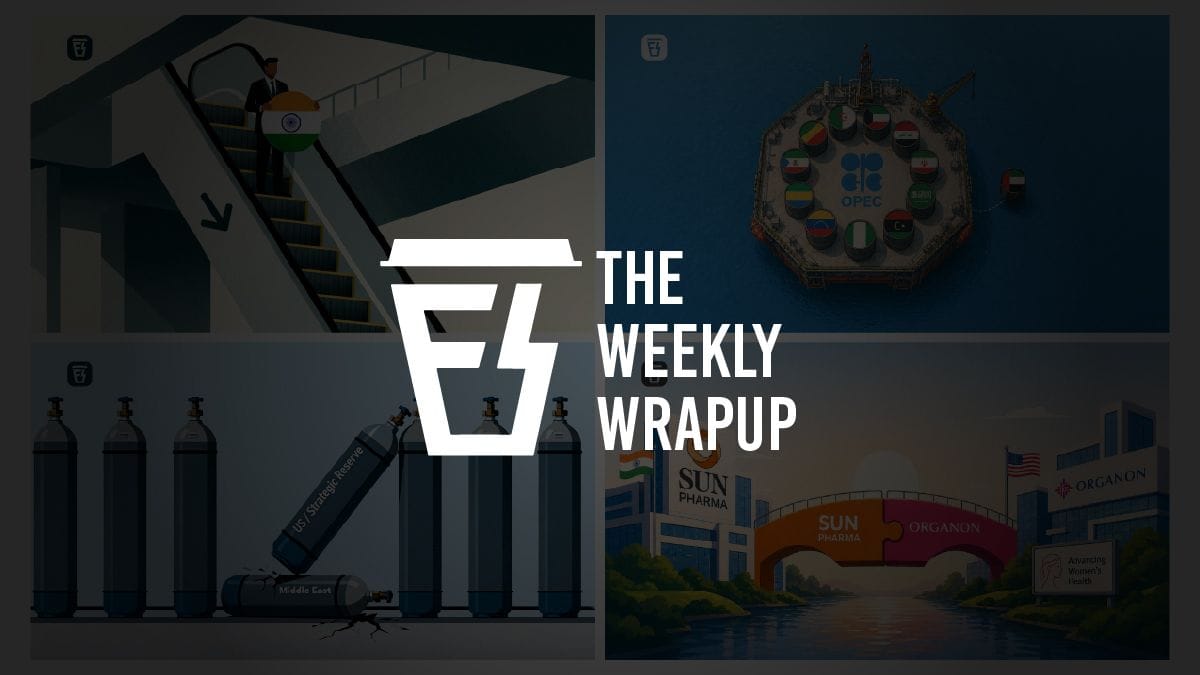
In this week’s wrapup, we talk about Cisco’s breakthrough that might change quantum computing forever, the paradox of India’s slipping GDP ranking, the global helium shortage, the UAE’s exit from OPEC, and what happens when India runs out of urea.
Also, in this week’s Markets edition, we discuss India’s largest overseas pharmaceutical deal, as Sun Pharma announced its acquisition of Organon & Co., a US-based company focused on women’s health. We don’t just break down the deal, but also what it means for Sun Pharma and its numbers. You can read the full story here.
With that out of the way, let’s look back at what we wrote this week.
The missing piece in quantum computing
Quantum computers are powerful. But they have one embarrassing problem. They still can't talk to each other.
Each machine works alone. There’s no sharing, teamwork or network. And that’s the gap Cisco is trying to close with its new “universal quantum switch”.
The tricky part? Quantum information is fragile. You can't copy it or resend it. And different quantum systems encode information in completely different ways, making communication incredibly difficult.
Cisco’s switch acts as a translator, converting signals between systems without destroying the information in the process. It works at room temperature and runs on existing fibre optic cables. No exotic cooling, no new infrastructure.
The bigger idea: instead of building one impossibly large quantum machine, you could network many smaller ones together. Same outcome, completely different approach.
In Monday’s story, we break down why this missing piece matters so much today.
India’s economy is growing. So why is its GDP rank slipping?
The IMF recently said that India slipped from the fourth-largest to the sixth-largest economy in the world. Naturally, that triggered panic among many Indians.
Because if rankings are falling, growth must be slowing… right?
Well, not quite. Because the confusion comes from what these rankings actually measure.
Most global GDP rankings use nominal GDP in US dollars. That means India’s output is first calculated in rupees and then converted into dollars.
And that’s where things change. If the rupee weakens against the dollar, India’s economy can grow in real terms, producing more goods and services, and still appear smaller on a global leaderboard.
Apart from this, India recently revised its GDP base year, which led to a slight downward adjustment in the size of the economy on paper. Combine that with a weaker rupee, and the ranking drop starts to make sense.
Meanwhile, real indicators like the PMI suggest the economy is still expanding strongly.
Which raises a bigger question: Should we really judge an economy by its global rank… or by how much better its people are actually doing?
Read our full story to find out.
Inside India’s response to the global helium shortage
The one thing that’s been grabbing headlines for a while is rising oil prices, thanks to tensions in the Middle East and the Strait of Hormuz. But there’s another problem that not many people are talking about — helium.
You might not realise it, but this gas quietly powers a lot of things around us, whether it’s the chips in your phone or MRI machines in hospitals. And now, supply disruptions in Qatar are squeezing its global availability. With shipments stuck and helium prices rising, countries like India, which import all their helium, are starting to feel the pressure. The tricky part being that there’s no easy substitute for this noble gas.
So what happens when something so small begins to affect big sectors like tech and healthcare? Find out in Wednesday’s newsletter here.
If OPEC still matters, why is the UAE leaving?
The UAE, OPEC's third-largest producer, is walking out of the cartel. And honestly, it's been a long time coming.
OPEC was once untouchable. It controlled a huge chunk of the world's oil supply, and when it cut production in 1973, it sent the entire global economy into a tailspin. But that world has quietly changed. US shale producers can now ramp up and fill any gap OPEC creates. Members keep squabbling over quotas, and some quietly cheat on their limits. And with the energy transition gathering pace, the window to monetise oil reserves is slowly closing.
So the UAE has decided to play it differently. The bigger worry? It probably won't be the last to leave. Iraq and Kazakhstan have already clashed with OPEC repeatedly. And a cartel that can't hold its third-largest member is going to struggle convincing the fourth and fifth to stay in line.
In Thursday's story, we dig into why the UAE is leaving, what it means for oil prices, and whether OPEC can hold itself together.
What happens when India runs out of urea
The recent conflict in West Asia has disrupted global urea supply. And that’s a bigger problem than it sounds.
Because urea is the backbone of modern agriculture, used heavily in crops like rice and wheat. And India is deeply dependent on it.
The country consumes around 400 lakh tonnes of urea every year, but produces only about 300 lakh tonnes. The rest is imported, largely from the Gulf.
But here’s the real issue. Even India’s “domestic” urea depends on imported natural gas. Nearly 86% of that comes from abroad. So whether we import urea directly or produce it locally, we’re still exposed to global disruptions.
So should India rethink how it uses urea altogether?
Read yesterday’s story to find out more.
Finshots Weekly Quiz v2.0 🧠
Hey folks! As you probably already know, the Finshots Weekly Quiz has a new avatar. If you missed out, don’t worry. Click here to check out the rules and start participating in the quiz today to stand a chance of making it to this month’s leaderboard, and maybe even winning some merch!
But for now, it’s time to announce the top scorers of our previous weekly quiz. There were a whole bunch of you who participated, and many of you ended up with the same scores. So we’re calling you Bulls, Bears, Unicorns, Blue Chips, and Rising Stars. Here’s how the leaderboard looks right now:
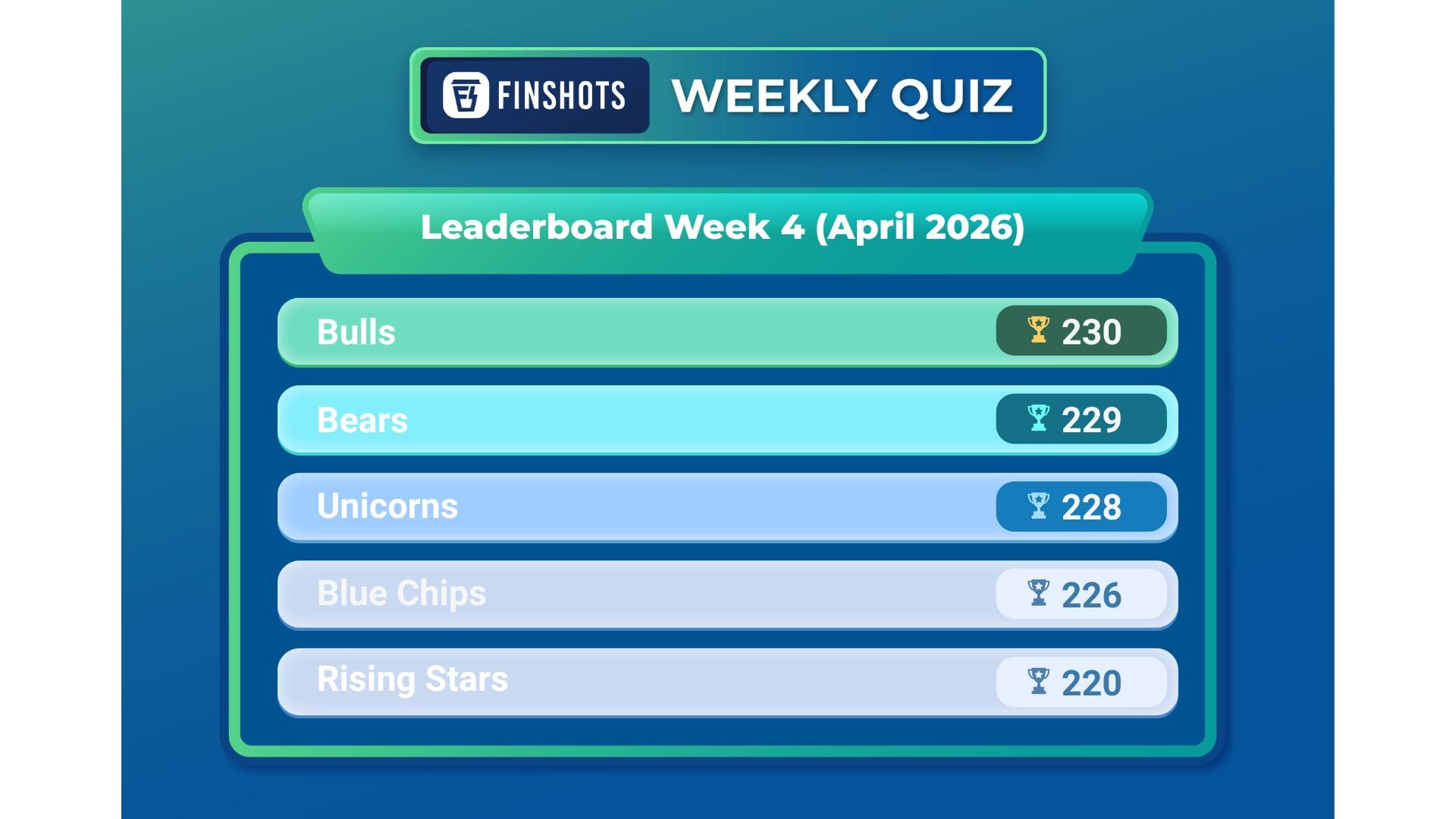
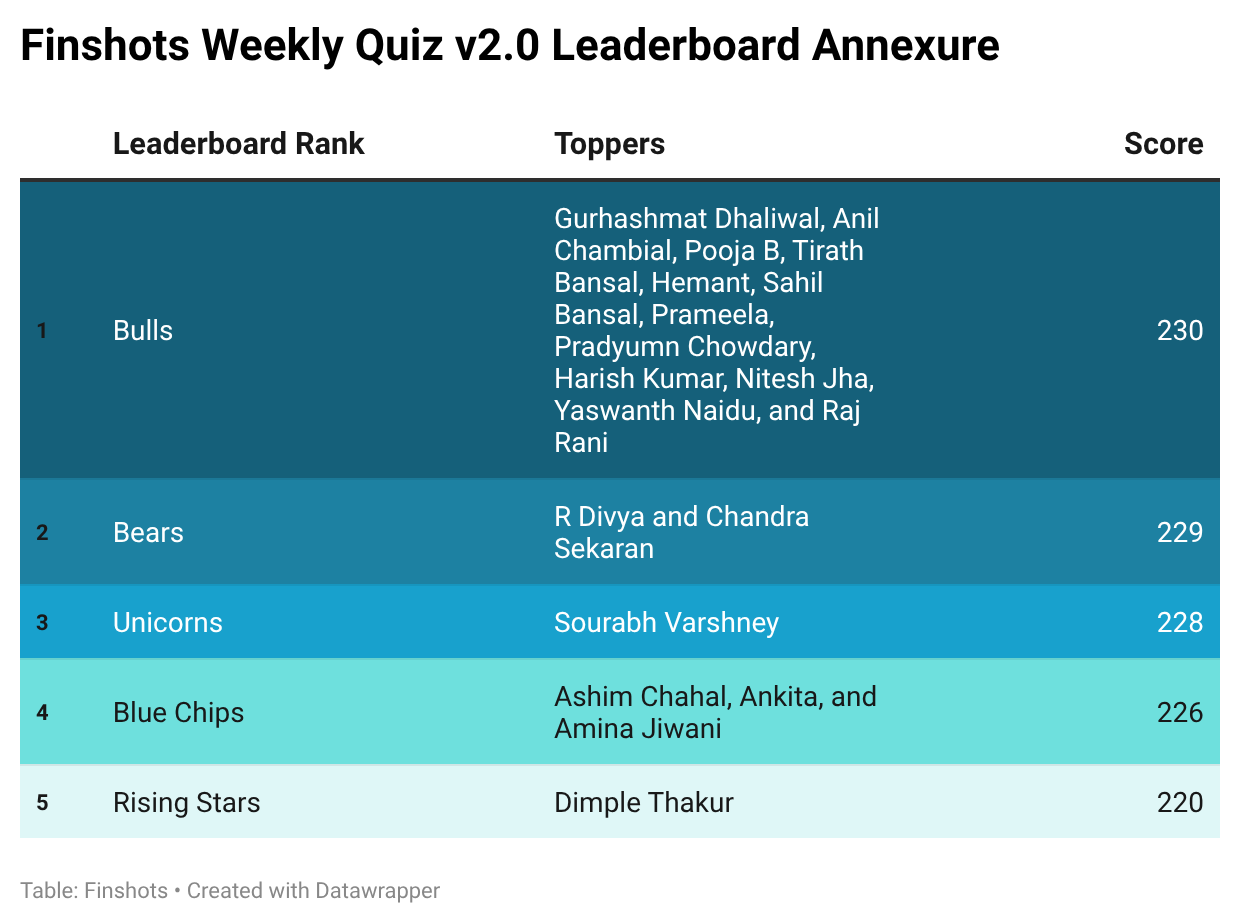
As you can see, we have twelve top scorers fighting for the merch. But unfortunately, there’s just one merch box to be won every month.
So to break the tie, we’ll be sending a tie-breaker question to all the “Bulls” via email. Keep an eye on your inbox! The one who gets it right the fastest wins the exclusive Finshots merch for April 2026, and we’ll reveal the winner’s name next week.
And to the rest of you whose names made it to the leaderboard, congratulations! You may not have won the merch this time, but you showed up consistently and earned a spot on Finshots’ weekly leaderboard. That’s pretty cool.
So don’t lose hope. Hit the reset button this month and keep answering all the weekly quizzes. Who knows? You might just be the winner this time around.
Click on this link to take this week’s quiz, which is open till 12 noon, Friday, 8th of May, 2026. The more answers you get right, the better your chances of appearing on the Finshots Weekly Quiz leaderboard. We’ll publish it every Saturday in the Weekly Wrapup. And the winner will be announced in the first week of June.
Liked this week’s wrapup?
Don’t forget to share it with your friends, family, or even strangers on WhatsApp, LinkedIn, and X. And subscribe to Finshots, if you haven’t already. Plis!
Myth Alert: I'm Too Young to Buy Life Insurance!
The other day, one of our founders was chatting with a friend who thought life insurance was something you buy in your 40s. He was shocked that it was still a widely held belief.
Fact: Life Insurance acts as a safety net for your family. The younger you are, the cheaper it is. And the best part? Once you buy it, the premium remains unchanged no matter how old you get.
Unsure where to begin or need help picking the right plan? Book a FREE consultation with Ditto's IRDAI-Certified advisors today.