
India’s economy is growing. So why is its GDP rank slipping?
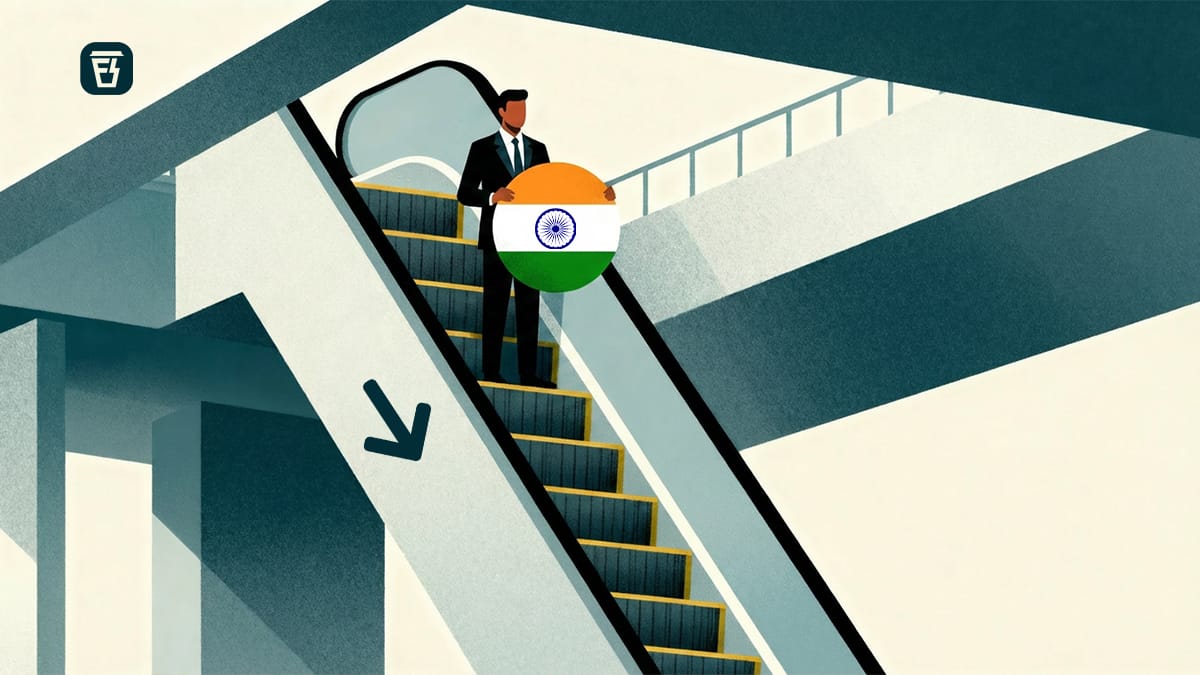
In today’s Finshots, we unpack how India’s economy can keep growing strongly on the ground while still slipping in global GDP rankings on paper.
But here's a quick sidenote before we begin.
We’re hosting a free 2-day Insurance Masterclass that helps you build real financial security by understanding health and life insurance the right way.
📅 Wednesday, 29th April at 6:30 PM: Life Insurance
How to protect your family, choose the right cover amount, and understand what truly matters during a claim.
📅 Thursday, 30th April at 6:30 PM: Health Insurance
How hospitals process claims, common deductions, the mistakes buyers usually make, and how to choose a policy that won’t disappoint you when you need it most.
👉🏽 Click here to register while seats last.
Now on to today’s story.
The Story
It is remarkable how quickly human minds jump from certainty to alarm. A single headline about India slipping in global GDP (Gross Domestic Product or the total value of goods and services a country produces over a given period) rankings was enough for many on Twitter and Reddit to assume that the country’s growth story had suddenly weakened and that we were heading into turmoil.
However, that same instinct says as much about human psychology as it does about economics. Because humans are naturally wired to treat changing numbers as warning signs and rankings as hard truths, even though they often reflect changes in methods, currency, or temporary factors, not real decline. So, in uncertain moments, the brain prefers a simple explanation. And “India is falling behind” is exactly what feels simpler than the truth.
But the truth is that economies, much like people, can look weaker on paper while becoming stronger beneath the surface. Let’s talk about India’s Composite PMI, for instance.
For the uninitiated, PMI, or Purchasing Managers’ Index, is one of the quickest ways to gauge economic momentum. Every month, businesses are surveyed on whether new orders, production, hiring, inventories, and overall activity are improving or worsening. A reading above 50 signals expansion, while anything below 50 points to contraction. Think of it as an early pulse check for the economy, often offering clues long before official GDP data arrives.
And India’s pulse has looked healthy. For context, just this month, the country’s Composite PMI rose from 57 to 58.3, indicating robust growth across both manufacturing and services. Companies reported stronger demand, rising output, and increased hiring to meet fresh orders. In other words, businesses on the ground were behaving as if the economy were accelerating, not sliding into distress.
Which is why the recent IMF rankings showing that India’s GDP fell from the fourth-largest to the sixth-largest economy confused many people.
If business activity is expanding, jobs are improving, and India remains among the fastest-growing major economies in the world, how did the country appear to slip from fourth to sixth place in some global GDP tables?
The answer lies in understanding what those rankings actually measure.
When headlines say that one country has overtaken another in terms of GDP, they are usually referring to nominal GDP measured in US dollars, not inflation-adjusted domestic output. For the uninitiated, nominal GDP is the value of all goods and services measured using the prices that actually prevailed in that year. It rises either because we’ve produced more, or because of inflation. So in simple terms, economists first calculate the nominal GDP, usually in local currency, and then convert that figure into dollars for global comparison.
And that second step changes the story significantly.
India may be producing more cars, software services, housing, electricity, and consumer goods than before. But if the rupee weakens against the US dollar at the same time, the value of that larger output may appear smaller when converted into dollars. So an economy can grow in real life while looking weaker on an international leaderboard.
Think of it this way. Suppose your salary rises in rupee terms this year, but the rupee loses value sharply against the dollar. You are earning more locally, but in dollar terms, your income may not look as impressive. The same logic applies to countries.
This is why nominal GDP rankings can be misleading when viewed in isolation.
They are influenced not only by real economic growth, but also by exchange rates, domestic inflation, and global commodity prices. This means that a country with modest real growth but a strengthening currency can climb rankings quickly. While another country with stronger real growth but a weakening currency can slip beneath the surface despite doing better economically.
There is another technical reason for the shift in rankings. India recently revised its GDP base year from 2011–12 to 2022–23. Whenever the base year is updated, statisticians also refresh methodology, sector weights, and data sources to better reflect how the economy actually functions today. In this case, the revised series suggested that earlier estimates had somewhat overstated the economy’s nominal size, leading to downward adjustments for recent years.
For FY26, for instance, the estimated size of the economy was revised lower from roughly ₹357 lakh crore under the old series to about ₹345 lakh crore under the new one. And once a smaller domestic base is combined with rupee depreciation against the dollar, the impact on global nominal GDP rankings becomes even more visible.
Besides, the rupee has faced pressure from a stronger dollar environment and global uncertainty. Geopolitical tensions involving the US and the Middle East have also complicated matters. Whenever such conflicts escalate, oil prices tend to rise, and investors often move money into dollar assets considered safer. For a country like India, which imports a large share of its crude oil needs, that creates a double whammy. Higher oil prices widen the import bill, while a stronger dollar can further pressure the rupee.
And naturally, once the rupee weakens, nominal GDP rankings become harder to defend, even if domestic activity remains solid.
There is another layer to this story that often gets ignored. Some economies post higher nominal GDP growth not because they are fundamentally stronger, but because inflation lifted prices or their currency appreciated temporarily. In rankings, this can make them look healthier than they really are. But high inflation without productivity growth does little to improve long-term prosperity.
That is why obsessing over GDP rankings can distract from what actually matters.
A country does not become richer merely because it overtakes another nation on a chart. What matters more is per-capita income, because it reflects how much output there is relative to the population. Productivity matters because it determines how efficiently labour and capital are used. Job quality matters because headline growth means little if employment remains weak or informal, and wage growth matters because it tells us whether households are truly participating in economic progress.
India’s challenge, therefore, is to keep compounding real growth while improving the quality of that growth. That means building stronger manufacturing capacity, generating productive jobs, improving logistics, strengthening education and skills, and making Indian firms more globally competitive.
If those fundamentals improve consistently, nominal rankings will usually follow over time.
And there is good reason to believe that we can.
India still benefits from a favourable demographic dividend, expanding infrastructure, and a large domestic market that can support scale. And very few other economies have that combination. But translating this potential into durable prosperity requires patience, execution, and adequate government support.
So yeah, India’s economy can grow while its GDP ranking slips. There is no contradiction there. One reflects what is happening inside the economy. And the other reflects how that output looks after being translated through currencies and global market conditions.
The real story is not whether India is fourth, fifth, or sixth on the GDP leaderboard this year. It is whether the average Indian becomes materially better off over the next decade. That is the ranking that matters most.
Until next time…
If this story helped you make sense of why India slipped in GDP rankings, share it with a friend, family member or even strangers on WhatsApp, LinkedIn and X.
Also, if you’re someone who loves keeping tabs on the world of business and finance, hit subscribe if you haven’t already. And if you’re already a subscriber, thank you! Maybe forward this to someone who’d enjoy our stories but hasn’t discovered us yet.
A leading insurer is revising its health insurance premiums!
Policies issued after today (midnight) will reflect the updated premiums. If you've already generated a quote, the premium may change once the revision comes into effect.
So, book a free call with Ditto to understand your options.