
Inside India’s response to the global helium shortage
In today’s Finshots, we talk about the global helium shortage and how India is navigating it.
But here’s a quick sidenote before we begin. If you’re someone who loves keeping tabs on the world of business and finance, hit subscribe if you haven’t already. If you’re already a subscriber, thank you! Maybe forward this newsletter to someone who’d enjoy our stories but hasn’t discovered us yet.
Now onto today’s story.
The Story
A few days ago, Union Bank of India released a report on the prolonged closure of the Strait of Hormuz due to war and how it could reprice global risk because of rising oil and gas prices. The report said that disruptions in Hormuz have pushed oil prices above $100 per barrel, up from a stable level of around $70 before the war. That somehow feels like an “energy tax” on India’s economy, since we import nearly 85% of our crude oil.
But while everyone is talking about oil price rises and inflation, there’s one thing fewer people are talking about. And that folks, is helium.
Helium is an inert gas, which means it’s an introvert and does not react readily with other substances. And while you might not realise it, many of the products and processes you use every day depend on helium.
For instance, every electronic device you use today has helium in its origin story, i.e., it helps make the tiny chips that power your smartphones, laptops, and TVs. Plus, when you buy something at a supermarket, helium-neon lasers in barcode scanners read your items during checkout. Helium also helps inflate your car’s airbags in case of crashes. It is used to dry fibre optic cables during production, enabling faster internet. And of course, it’s the gas that fills your party balloons.
But the world is slowly running out of this useful gas. We wrote about this here, exactly a year ago. But back then, things weren’t as bad as they are today, as the war in the Middle East has disrupted the global supply of helium.
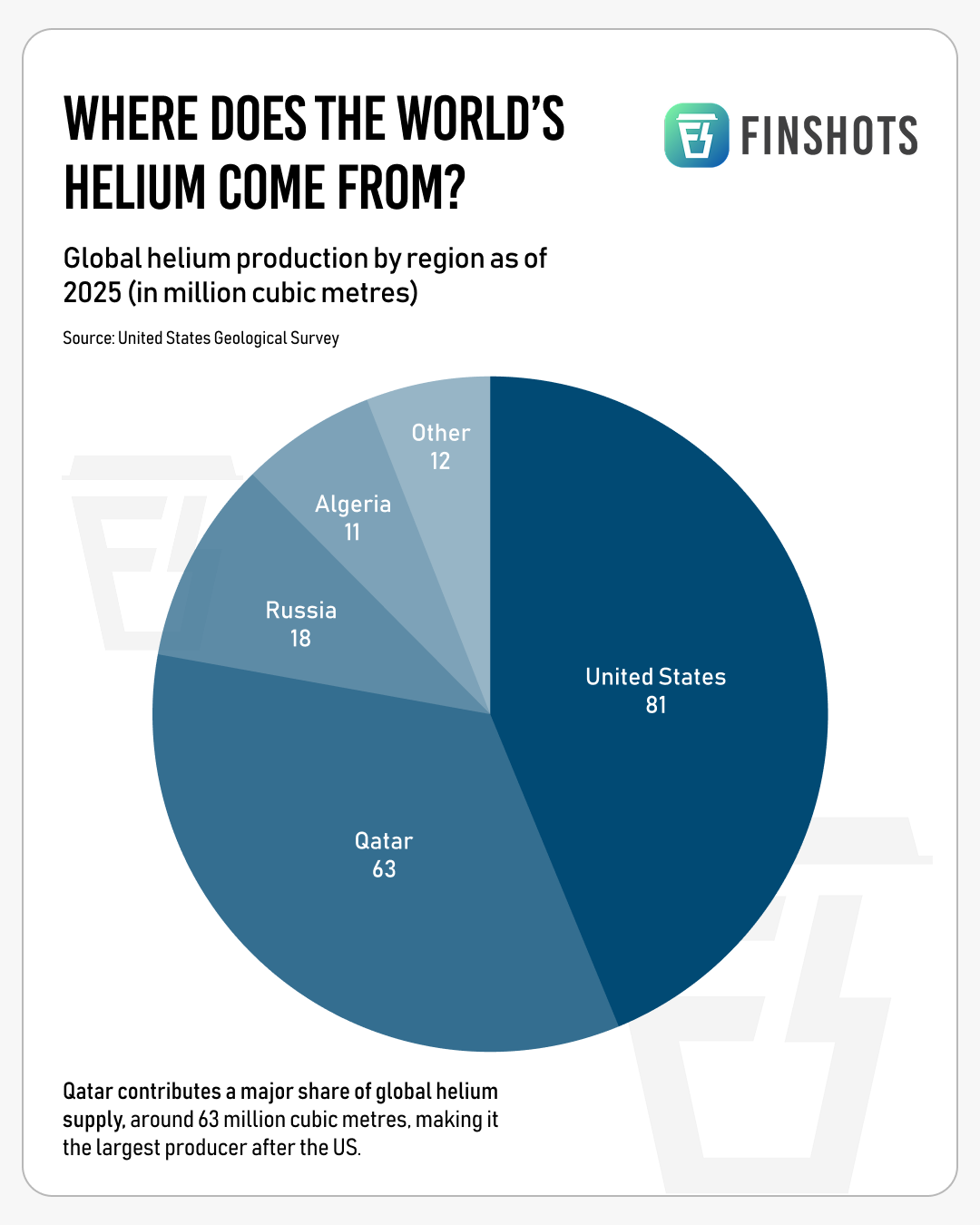
For context, Qatar supplies about 30% of the world’s helium, most of which comes from its Ras Laffan facility, the world’s largest liquefied natural gas (LNG) plant. But after attacks on its gas infrastructure, it was forced to stop production and supply of LNG and related products, even to contracted customers.
And LNG is where helium comes from. It is formed over very long periods through the natural decay of uranium and thorium in rocks and then gets trapped in some gas reservoirs. Producers can only recover it economically when natural gas contains enough helium to make separation worthwhile.
And despite being inert and seemingly harmless, there are two things about helium that are quite scary.
First, helium is scarce on Earth and is a non-renewable resource. Second, it is so light that it’s difficult to store as a gas because it can easily leak into the atmosphere and escape into space.
So naturally, exporting helium isn’t simple. It requires highly specialised cryogenic containers to keep it extremely cold — at around -269℃ during transport. Anything above that, and liquid helium slowly boils off, even in insulated containers.
That’s why it has to be transported and used, or stored in proper reserves, within about 4–6 weeks. Beyond that, the boil-off losses can exceed 50%, making it economically unviable to use.
So you can imagine what’s happening to shipments stuck at sea, as Iran has partially blocked the Strait of Hormuz, allowing very few ships to pass through one of the world’s busiest shipping routes, through which Qatar exports both natural gas and helium.
All of this is affecting global helium access, especially in Asia, where semiconductor manufacturing accounts for a large share of demand. The gas is used in chip-making processes for cooling and for flushing out contaminants from wafers.
Now, we know what you’re thinking. Qatar isn’t the world’s largest helium supplier. That crown belongs to the US. And US helium doesn’t pass through the Strait of Hormuz. So why worry?
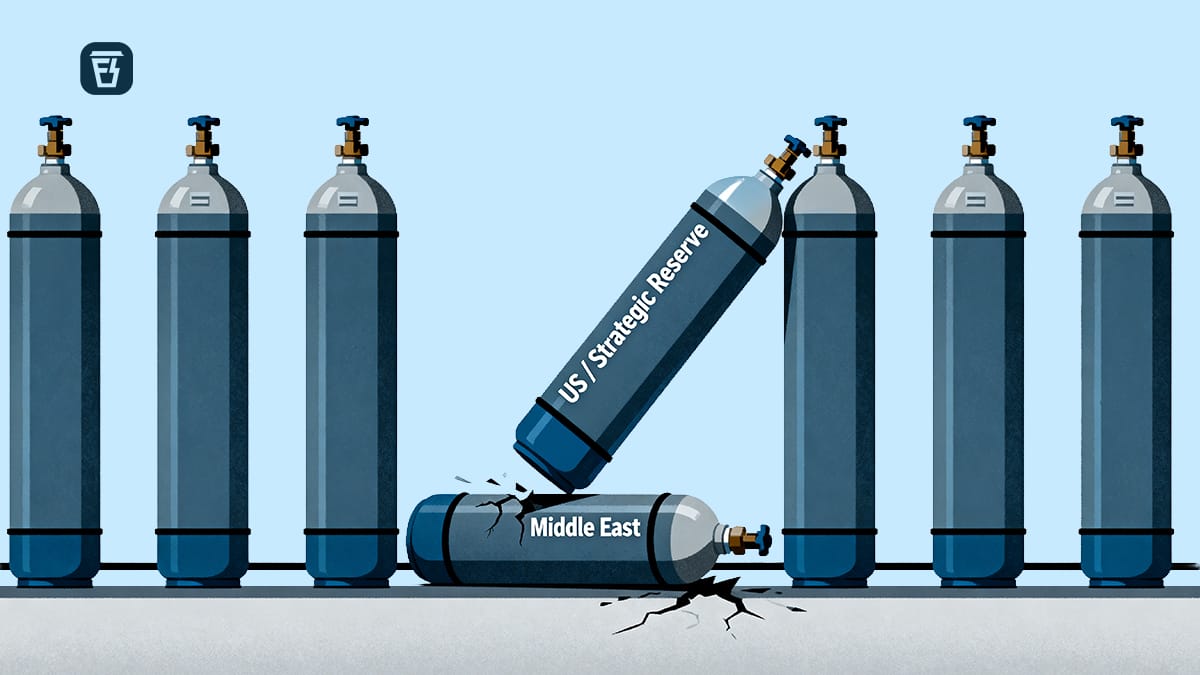
Well, the issue is that Qatar’s sudden disruption creates an outsized impact. Its production is concentrated in a single major facility and is heavily export-dependent, so any shutdown can remove a significant chunk or about 14% of global supply at once.
The US, on the other hand, has production spread across multiple states and facilities, with a stronger domestic focus. Also, the US government officially sold off the last of its National Helium Reserve in 2024, shutting down a federal stockpile that once held about 30% of the world’s helium. So, while the government no longer maintains a strategic reserve, large privately held supplies still exist, mainly in Texas and Wyoming. Which means that as supply tightens and prices rise, access increasingly depends on who can pay more and afford it.
That’s a big challenge for a country like India, which imports 100% of its helium needs. India consumed about 3.4 million cubic metres of helium in 2025. That’s only about 2% of global consumption, but over 50% of India’s imports traditionally come from Qatar — which itself accounts for roughly a third of global helium exports.
And even though India is not yet a major semiconductor manufacturing hub, the helium shortage affects it in two big ways.
First, India wants to become a global player in semiconductor and electronics manufacturing. But the helium shortage is pushing up costs in the sector by 35–50%. It has also extended chip lead times to about 12 weeks and delayed the commissioning of new fabs and OSATs (Outsourced Semiconductor Assembly and Test), even if it hasn’t caused complete shutdowns.
And since helium has no real substitute, and India typically holds just 7–10 days of inventory, you can imagine the impact. It could slow down India’s semiconductor ambitions.
Second, helium is widely used in India’s healthcare system, especially in MRI (Magnetic Resonance Imaging) machines.
These machines offer a non-invasive way to see inside the body in detail — especially soft tissues like the brain, muscles, ligaments, and organs. Unlike X-rays or CT scans, they don’t use radiation. Instead, they rely on magnetism and radio waves to create images.
Inside every MRI machine there’s a powerful superconducting magnet. But this magnet doesn’t work that way naturally. It needs to be cooled to extremely low temperatures to become superconducting. That’s where liquid helium comes in. It’s one of the few substances cold enough to make this possible.
Once cooled, the magnet creates a strong and stable magnetic field. This interacts with hydrogen atoms in your body, which behave like tiny magnets. Their responses are then used to generate detailed images.
Without regular helium refills, hospitals can’t run MRI machines efficiently. And that’s already showing up in rising costs, as helium prices have increased sharply over the last few weeks. In some cases, hospitals may even have to prioritise only emergency scans.
So yeah, these are the two key sectors where helium demand in India is expected to grow — potentially at around 8% each year, especially with the AI-driven semiconductor push. But repairs at Ras Laffan could take 3–5 years.
So how can India manage this crisis, you ask?
Well, at least in the short term, things can be manageable, even with low inventories.
If we’re talking about healthcare, most MRI scanners in India now use zero boil-off (ZBO) technology, which recycles helium and doesn’t need frequent refills. These machines come with an initial charge of liquid helium and typically need refilling only once every 4–10 years. But newer machines will cost more. So expansion in smaller towns and rural areas could become a challenge.
In the long term, India will have to diversify its supply with multi-origin contracts, including from Russia, the US, and emerging suppliers like South Africa and Tanzania.
Because the reality is that, India doesn’t have commercially viable helium reserves. While natural gas fields in West Bengal and Jharkhand have shown small traces of helium — below 0.2%, extracting it economically is still difficult. Domestic production could be 5–10 years away and very expensive, making its viability uncertain.
So for now, recycling and alternate supply routes are our only real options until Ras Laffan is fixed and the Strait of Hormuz reopens.
And when that will happen is anyone’s guess.
Until then…
If this story helped you understand the logistics and economics of the global helium shortage and its impact on India, why not share it with your friends and family on WhatsApp, LinkedIn, or X? Actually, even strangers will do.
Our co-founder asked people why they avoid Term Insurance. The top reason? Right here. 👇🏽

31% said their biggest fear is being mis-sold. Many worry that agents may push costly plans or add confusing extras without full transparency.
That's a valid concern. After all, how can you trust something you don’t completely understand?
That’s why Ditto, a product of Finshots, has pioneered India’s #1 Spam-Free insurance platform. Our IRDAI-Certified advisors offer honest advice and help you find the right plan. Book a FREE consultation today.