
If OPEC still matters, why is the UAE leaving?
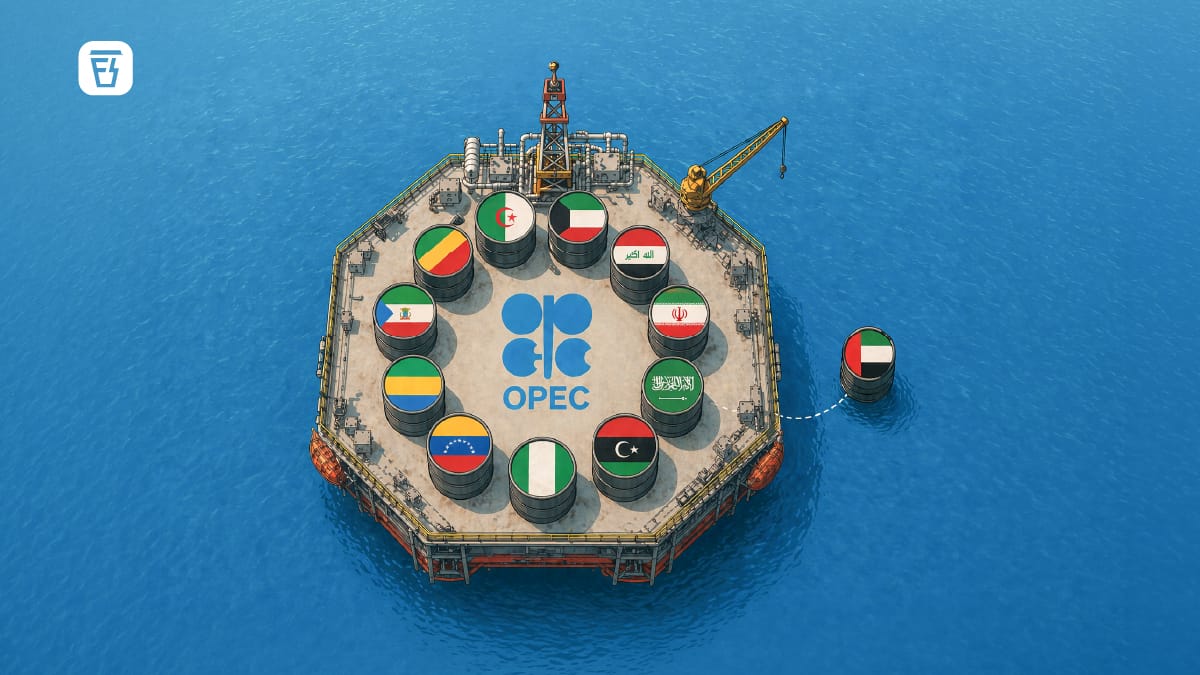
In today’s Finshots, we look at why the UAE is leaving OPEC and whether the cartel still holds the power it once did.
But here’s a quick sidenote before we begin. If you’re someone who loves keeping tabs on the world of business and finance, hit subscribe if you haven’t already. If you’re already a subscriber, thank you! Maybe forward this newsletter to someone who’d enjoy our stories but hasn’t discovered us yet.
Now onto today’s story.
The Story
Until recently, this would have been hard to imagine. The United Arab Emirates (UAE), OPEC's (Organization of Petroleum Exporting Countries) third largest producer, is leaving the group tomorrow.
For decades, OPEC wasn't just another organization. It was one of the most powerful forces in the global economy, controlling a large share of the world's oil. In simple terms, it regulated the global supply of oil to influence its price. So you can say, it’s an oil cartel.
Formed in 1960 by countries like Saudi Arabia, Iran, Iraq, Kuwait, and Venezuela, it was built on a powerful idea. If oil producers acted together, they could take control of pricing power back from Western oil companies. And it worked. The 1973 oil crisis showed just how much power it wielded. The world didn't just slow down. It stalled. Long lines at gas stations, soaring inflation, and a global recession — all triggered by a coordinated decision to cut supply.
And just when its influence seemed to fade, OPEC found a way to extend it. Through OPEC+, it brought in major producers like Russia, tightening its grip on global supply once again. We’ve written about this before here.
The logic was simple. A handful of countries controlled a large share of the world's oil. Acting together gave them pricing power. But that world has been quietly changing.
To be fair, the UAE's departure doesn't come as a surprise. It's just the loudest crack in a wall that's been fracturing for years.
Let’s start by talking about supply. The rise of US shale producers has rewritten the rulebook. Unlike traditional oil projects that take years and billions of dollars to develop, shale can be produced quickly and scaled up or down with ease.
When prices rise, producers ramp up fast. When prices fall, they pull back just as quickly. So every time OPEC tightens supply to push prices up, American shale steps in and fills the gap. In oil markets, it’s the marginal barrel (the extra supply) that sets prices. And OPEC no longer controls it.
Then there's internal friction. OPEC was never a perfect alliance, but it used to at least move in one direction. Today, it's a looser coalition of countries with conflicting interests. For example, some members, like Venezuela and Nigeria, desperately need high oil prices to fund public spending and avoid economic collapse. Others, like the UAE, have diversified economies and would rather pump more oil at moderate prices than pump less at higher ones. That tension has repeatedly broken into arguments over production quotas, with some members quietly cheating on their agreed limits.
And then there's the bigger picture. Oil is no longer the uncontested king of energy. The push toward renewables, the rapid rise of electric vehicles, and energy diversification mean that long-term demand faces real uncertainty.
That explains why the UAE decided to choose flexibility. It must have thought, why stay stuck in a system that may be losing its grip?
And it has been clear about what comes next. It wants to aggressively expand its own production capacity to reach 5 million barrels per day by 2027. That's not the plan of a country stepping back from oil. It's the plan of a country that wants to pump as much as possible, as fast as possible, before the energy transition makes that harder to justify. Staying in OPEC, with its production ceilings, was simply getting in the way.
And it isn't leaving in defeat. In fact, it may be the one showing others the way out. And not everyone is unhappy about it. Here’s why.
Every time OPEC cuts production to prop up prices, consumers feel it at the pump and policymakers feel the heat. A weaker OPEC means less coordinated supply cuts, which generally means lower oil prices. That’s good news for inflation and household budgets.
There's a strategic angle too. The US shale producers we spoke about earlier have been waiting, and with OPEC's grip loosening, they have more room to ramp up and capture market share without any fear of retaliation — something the cartel has done before to punish rivals.
So the question now is simple: is OPEC still relevant?
Because this isn't just about one country leaving. A cartel only works if members are willing to sacrifice individual gains for collective control. When one of its largest producers walks away, it weakens both the credibility of future agreements and the ability to enforce anything across the group.
And the UAE may not be the last to walk out. Iraq and Kazakhstan have both repeatedly clashed with OPEC over production quotas. If the UAE's exit sets the example that leaving carries no real consequences, others may quietly start taking the same route. Because a cartel that can't hold its third-largest producer is going to have a harder time convincing the fourth and fifth to stay in line. And if more members begin to think this way, OPEC may face a future where working together becomes optional rather than necessary.
That said, for the time being, OPEC isn't disappearing. It still controls a significant share of global oil supply, and when it acts in coordination, markets respond. Prices still move when production cuts are announced. Traders still watch every meeting closely. Saudi Arabia alone has enough leeway to move oil markets with a single decision. But that now comes at a steeper price.
With the UAE gone, every barrel it produces freely outside the system is one Saudi Arabia may have to offset through its own cuts. The fewer members that stick to production limits, the heavier the burden on those who do, and the harder it becomes to keep prices stable.
Where OPEC once set the direction of oil markets, it now spends more time responding to them — reacting to shale, shifting demand, and geopolitics it can no longer fully control.
So yeah, the UAE's exit isn't the cause of OPEC's problems. It's the clearest sign of them. For some members, the benefits of acting collectively no longer outweigh the cost of lost flexibility — especially when the window to monetize oil reserves may be narrowing with every passing year of the energy transition.
In the end, OPEC still matters. It can steady the market when things get volatile, influence prices at the margin, and Saudi Arabia will make sure of that.
But the days of OPEC turning a tap and sending economies into crisis feel increasingly like history. The cartel that once made the world tremble is now fighting to stay together.
Until next time…
If this story helped you understand why UAE is leaving OPEC, share it with a friend, family member or even strangers on WhatsApp, LinkedIn and X.
How Strong Is Your Financial Plan?
You've likely ticked off mutual funds, savings, and maybe even a side hustle. But if Life Insurance isn't a part of it, your financial pyramid isn't as secure as you think.
Life insurance is the crucial base that holds all your wealth together. It ensures that your family stays financially protected when something unpredictable happens.
If you’re unsure where to begin, Ditto's IRDAI-Certified insurance advisors can help. Book a FREE 30-minute consultation and get honest, unbiased advice. No spam, no pressure.