
The story of the Indian rupee since 1947
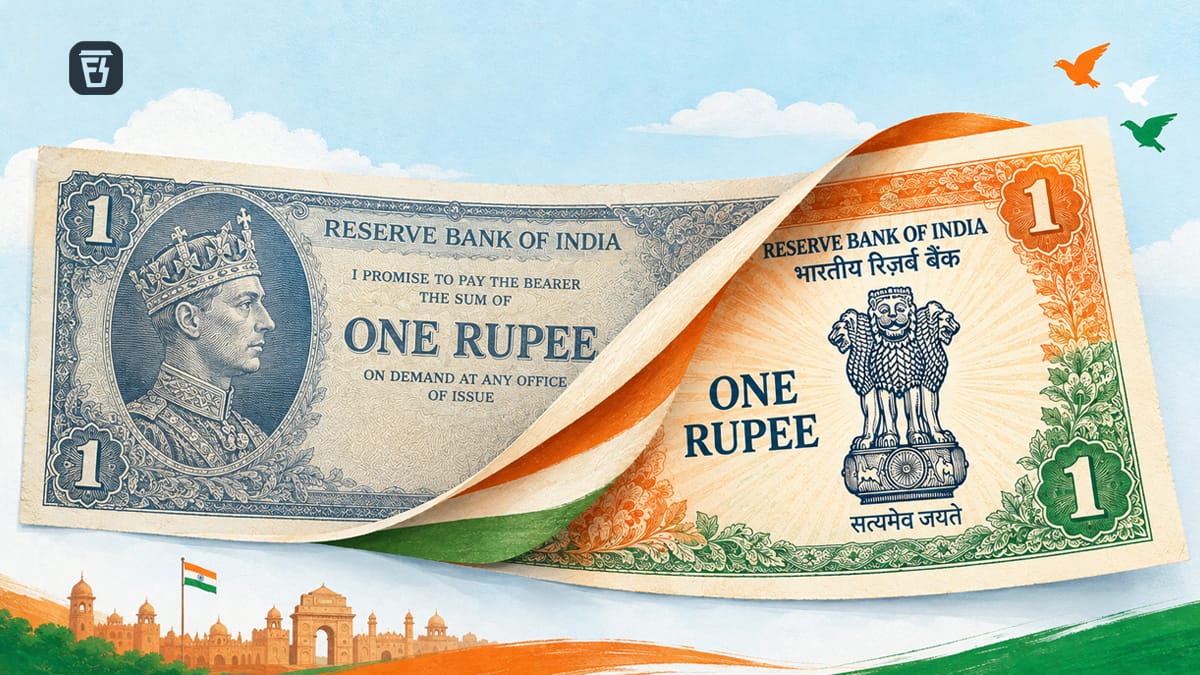
Hey folks, as you probably know, every year we have a tradition of doing a post-Independence Day special. This one’s two days late because there was a Sunday in between. But nevertheless, here it is.
So, in today’s Finshots, we tell you how money has evolved in India since the British left. Just a heads up though. This one’s a Finshots special and a little longer than our usual stories.
The Story
Over the last few weeks, we’ve had editions on plastic money, a UPI that may no longer be free — basically, different ways of making payments. But have you ever wondered how it all started?
Well, we did. And that got us digging into the history of how the Indian rupee evolved over the last eight decades. But we can’t start from August 15th, 1947 since we’ll need to give you a little context first.
See, today, it’s the RBI (Reserve Bank of India) that issues Indian currency, except for the one-rupee note, which is issued by the Finance Ministry. But the central bank was born only in 1935.
Long before that, Indian money was printed in Great Britain by a company called De La Rue. Today, you probably know it as the world’s largest banknote printing company, which designs and prints paper and polymer banknotes for over 140 countries. But that changed in 1928, when the British Indian government set up India’s first currency printing press in Nashik, Maharashtra.
Fun fact: Nashik was chosen because of its stable climate and proximity to a key railway network connecting it to the rest of India.
And yes, those notes featured King George VI, the last emperor of colonial India. But August 15th, 1947 didn’t immediately change that. Designing new notes and coins takes time, so during this transition, India continued using a frozen series of old British Indian currency.
Then, in 1950, as you know, India became a republic, with the government running the country on its own and the President as the head of state instead of a King or Queen. And that was also the year the Lion Capital of the Ashoka Pillar was adopted as our national emblem. So it replaced the King’s portrait on one side of the one-rupee coin. On the other side, a corn sheaf replaced the earlier Tiger. Even today, if you look at the larger one-rupee coins, you’ll see these corn sheaves on either side of the number 1 engraved on them. If you’ve ever wondered why, well, it was simply meant to signify agricultural progress and self-sufficiency.
But there was still something unusual about this rupee. It wasn’t divided into 100 paise like it is today. Instead, one rupee was equal to 16 annas or 192 pies. So, if your parents ever told you stories of buying bella candy (jaggery sorbet) for 4 annas, that was technically 25 paise.
There was just one problem with this rather odd system. These smaller units were cumbersome to deal with when businesses maintained accounts, calculated taxes, or even converted annas into foreign currency. Not that you’d do the last one every day, but you get the point. Which is why, in 1957, the new Coinage Act came into effect and divided the rupee into 100 simpler units called paise.
Another fun fact: Although 100 paise was easier to understand, the transition was anything but easy. Back then, even smaller units like paise and annas had real purchasing power unlike today where paise has practically disappeared from physical use and mostly survives on price tags, fuel bills and bank balances.
For instance, 25 paise, or 4 annas, could buy you a meal or even a movie ticket. But for reasons not clearly known, shops started pricing the same things at 26 paise after decimalisation. And you can imagine that customers weren’t thrilled because that extra 1 paisa could itself buy a packet of peanuts. This ended up in plenty of confusion and, sometimes, even fights between buyers and shopkeepers.
So yeah, that’s the story of how the rupee evolved over the first decade after independence. And it might sound like a pretty simple history lesson. But the truth is, it wasn’t that easy. Indian money had to go through quite a few phases over the years, some of them rather painful.
#1 The painful partition of money between India and Pakistan
If we asked you to imagine the bittersweet day of India’s independence in 1947, you’d probably think of the celebrations on one side and, on the other, the mass violence and displacement caused by Partition.
The money part is probably something you’d think of least. But as it turns out, that too was no less painful. Because if you remember, the RBI was created as the central bank of undivided India. So when the country was partitioned, it had to temporarily serve as the central bank for both India and Pakistan. The idea was to give Pakistan some time to build its own monetary system. So, for a while, the Indian rupee remained a common currency in both countries, which meant that the RBI had to continue managing and printing currency for Pakistan even after Partition.
But things quickly got complicated. As tensions between India and Pakistan grew, so did disagreements over money. For context, India’s cash balance during Partition was roughly ₹400 crore. And this was to be divided between the two countries in an 82.5:17.5 ratio, with India getting the larger share. Pakistan was therefore entitled to roughly ₹75 crore, of which ₹20 crore had already been cleared by August 14th, 1947.
The remaining ₹55 crore became a bone of contention as Pakistan’s claims on Kashmir intensified. India was increasingly reluctant to release the money, fearing it could ultimately be used against itself. The dispute became so heated that Pakistan eventually ended the RBI’s role earlier than planned, assuming control of its finances in April 1948, several months before the original September deadline.
Now, India eventually released these funds after Mahatma Gandhi began a fast unto death because he felt India was dishonouring an agreement by withholding money that was legally due to Pakistan.
But that wasn’t the end of the monetary mess. In 1949, India devalued the rupee by about 30% after Britain devalued the pound (since it was still pegged to the pound). Pakistan refused to follow suit. Suddenly, the two countries that had started with a common currency were dealing with different exchange rates, disrupting trade and payments between them.
In other words, even before independent India could figure out what its own currency should look like, it first had to figure out how to separate its money from Pakistan’s.
A third fun fact: Since the disagreements over the division of money and assets continued over the years, Pakistan’s central bank still carries some of these unsettled claims on its balance sheet as an asset even today, which adjusted for inflation, is worth more than ₹560 crore.
#2 How the rupee replaced the currencies used in princely states
Another fascinating thing that happened after the Partition was that some princely states continued to use their own currencies. For instance, Baroda had the Baroda Rupee, Travancore, which covered parts of modern-day Kerala and Tamil Nadu, had the Travancore Rupee, while Hyderabad, which comprised parts of modern-day Telangana, Maharashtra and Karnataka, had the Hali Sicca or Osmania Sicca.
Once these states merged with India, their currencies had to make way for the Indian rupee. Baroda and Travancore made the switch by 1948 and 1949 respectively. But there’s not much account of how the transition actually happened.
But this story only becomes clearer if you read about the demonetisation of the Hyderabadi Osmania or Hali Sicca. It was a three-phase demonetisation which first began with the Indian rupee becoming legal tender in the state in 1950. Then, about half of the Osmania Sicca was quietly withdrawn from circulation by 1953, without any prior public announcement. It was only then that people were told that their Hyderabadi currency would expire by 1955. That deadline was then eventually extended to 1959 to avoid further inconvenience, especially since prices had risen after the higher-valued Indian rupee replaced the Osmania Sicca.
And that’s when the Indian rupee finally became the common currency in every state.
#3 How the Indian rupee got its modern design
In the beginning, we told you how the Lion Capital of Ashoka became the face of the Indian rupee. But here’s what we didn’t tell you. Mahatma Gandhi’s portrait was actually considered as a replacement for the King’s portrait right at the beginning. Even design specimens were created for this. But they never made it to circulation.
Gandhi only eventually appeared on an Indian ₹100 note in 1969 to mark his birth centenary. His portrait returned in 1987 on the ₹500 note. But it became permanent only in 1996, when India felt that it needed to strengthen security features to protect against counterfeiting. A human image was considered harder to counterfeit than a symbol like the Lion Capital. The Lion Capital, of course, continued to appear alongside Gandhi, while the new notes also came with a bunch of additional security features, including a changed watermark, a windowed security thread, a latent image and intaglio printing to help the visually impaired.
And that, folks, is how the rupee survived Partition and went on to become the currency we know today — living through bank nationalisation, economic liberalisation, multiple demonetisations, the shift to digital payments through UPI, and now even the e-RUPI.
If this story helped you look at the rupee through the lens of partition and independence, and you learnt something new about the currency we use today, feel free to spread the knowledge by sharing it with your friends, family, colleagues or even strangers on WhatsApp, LinkedIn and X.
Also, if you’re someone who loves keeping tabs on the world of business and finance, hit subscribe if you haven’t already. And if you’re already a subscriber, thank you! Maybe forward this to someone who’d enjoy our stories but hasn’t discovered us yet.
Message to all the breadwinners
You work hard, you provide and make sacrifices so your family can live comfortably. But imagine when you’re not around. Would your family be okay financially? That’s the peace of mind term insurance brings. If you want to learn more, book a FREE consultation with a Ditto advisor today.