
Why monks are turning investors, and more...

Hey folks!
Would you trust a smartwatch to tell you your country is about to have a breakdown?
We know that sounds like something out of a sci-fi show. But an Australian startup called In Truth is trying to build something like that.
Last month, over 131 communities around the world strapped on fitness trackers like Garmin watches, Whoop bands and Oura rings. The devices picked up everyone’s heart rate and how relaxed or wound up their bodies were. People also journaled how they felt. Put together, this gave each group a “Peace Score” from 0 to 100, where 50 was considered to be average.
So, what exactly is the idea behind this?
Well, you could think of this this way. We already have early warning systems for storms. Meteorologists spot pressure building days before a cyclone hits land. But there’s no equivalent for people. Stress builds in families and communities for years before it turns into a mental health crisis or unrest.
So right now, “how stressed everyone is” is just a feeling nobody can point to on paper. And you can’t build a budget around a feeling.
But governments do budget around numbers, like unemployment or inflation. So if collective stress becomes a number too, a health ministry can finally have something to point to when asking for more funding.
Sounds like a neat theory. Except it’s been tried before, and not with great results.
Bhutan for instance, has measured a national happiness score since the 1970s. It’s literally in their Constitution. Yet by Bhutan’s own survey in the last decade, only about half its citizens hit the government’s own bar for “happy”. Five decades of tracking a number didn’t fix what the number was tracking.
And on mental health specifically, the data has existed for a while. The WHO’s (World Health Organization) latest report found that countries still spend a median of just 2% of health budgets on mental health, which has remained unchanged since 2017.
So maybe the missing piece was never the data. Governments have had plenty of numbers pointing at this problem for years, and largely looked away.
Whether a number on a watch can do what a decade of reports couldn’t, well, that’s something that will be really interesting to see.
Here’s a soundtrack to put you in the mood… 🎵
Aayat by Zaiff
You can thank our reader, Vishal Rawat for this rec. He’s been recommending some great stuff lately. And if you want your recommendations featured in our Sunday editions too, send them our way. Especially those hidden gems from underrated Indian artists that many of us may not have discovered yet.
Now, let’s dive in.
What caught our eye this week
Why are Japanese monks turning to investing?
Japanese monks are investing in stocks and bonds.
Which sounds strange, because Buddhist teachings emphasise staying detached from material things such as money and profit.
So why are Japan’s monks not following these principles?
Well, it turns out they may not have much of a choice.
A few days ago, Bloomberg broke a very interesting story about Koukyo Yoneta, a Buddhist priest in rural Hokkaido and a former salesman at Daiwa Securities.
When his 100-year-old temple needed around $162,000 for repairs, he didn't wait for donations. Instead, he invested the money the temple already had. He put it into US Treasuries, Japanese REITs (Real Estate Investment Trusts. You can read about them here) and stocks such as BYD and Hyundai.
The portfolio earned more than 10% a year, which was enough to cover the repair costs.
And this isn’t just one monk. Temples across Japan are turning to financial markets because their traditional sources of income are drying up.
For starters, Japan's Buddhist population has fallen about 14% in 20 years. Older followers are passing away, while younger people, especially those living in cities, are becoming less connected to religion.
Temples have traditionally depended on funeral fees. But funerals have become smaller and cheaper since COVID, which has hit temple incomes hard.
At the same time, their costs are rising.
Japan spent decades dealing with very low or even falling prices. But that has changed. A weaker yen has made imported energy and materials more expensive, while a shrinking workforce has pushed wages higher. So temples are facing the same problem as everyone else: less money coming in and more money going out.
And that leaves priests in a bit of a bind. They need to find ways to make their money grow, but they also have to balance those financial needs with their religious beliefs.
Different temples are handling this differently. Some are investing heavily in financial markets, while others are keeping most of their money in cash, with only a small amount in safer investments. Meanwhile, larger Buddhist institutions are buying government bonds now that Japanese interest rates have risen enough to make them worthwhile.
So yeah, while Japan spent a generation as the world's example of ultra-low inflation and idle cash, an ageing population and a weakening currency are now forcing even its oldest, most tradition-bound institutions to rethink how they hold and manage their money.
And that tells you just how much Japan’s economy is changing.
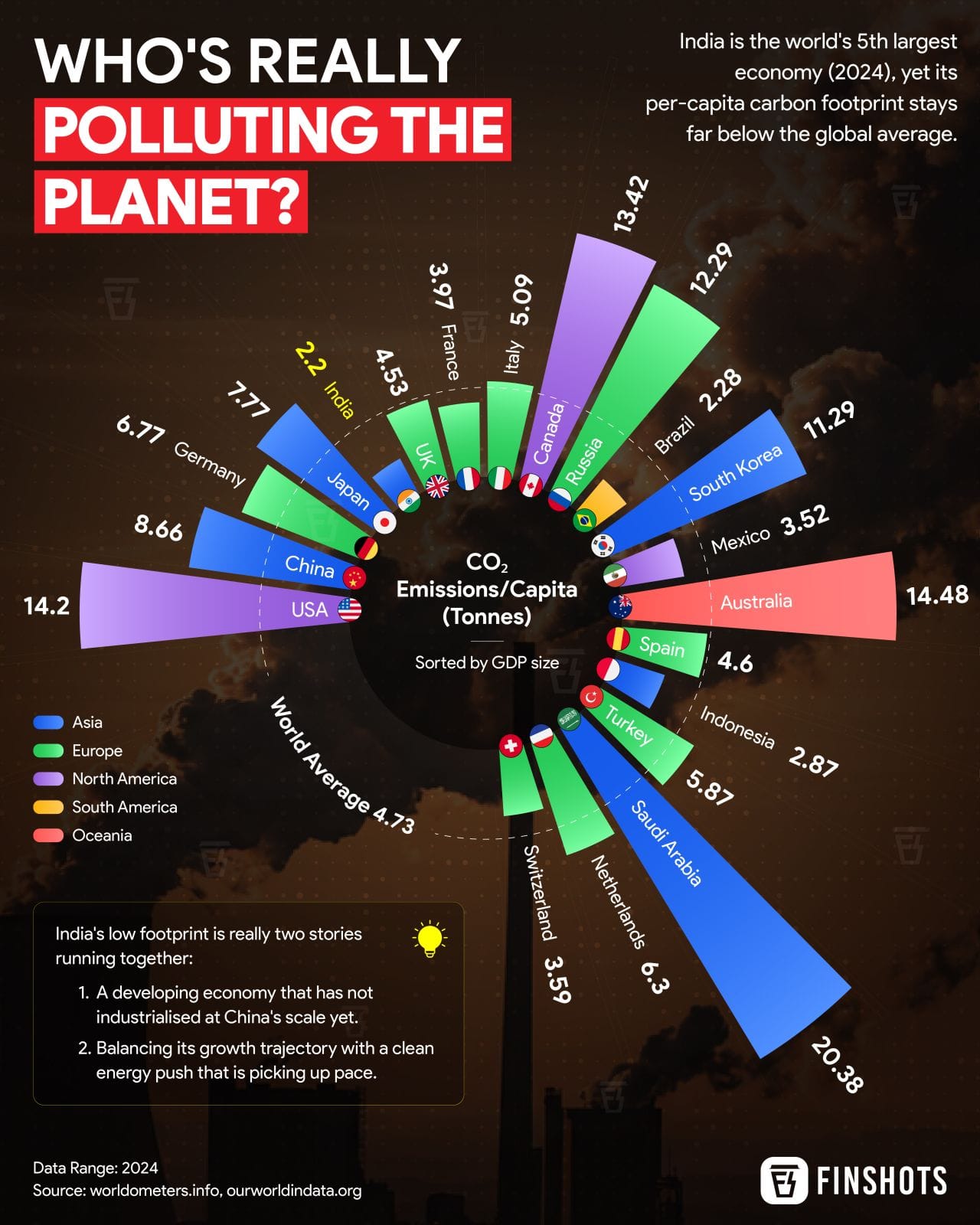
Infographic
Readers Recommend
This week, our reader Payal Kenia recommends reading Down But Not Out by Subrata Mitra and Pankaj Mishra.
She says,
This book is about the journeys of Indian founders who refused to give up and, along the way, created world-class products and companies. The stories beautifully capture the emotions of each founder and are further enhanced by brilliant graphics. Hence, I would suggest reading the book in physical format rather than digitally.
Happy reading!
Thank you for the rec, Payal!
That’s it from us this week. We’ll see you next Sunday.
Until then, send us your book, music, business movies, documentaries, or podcast recommendations. We’ll feature them in this newsletter! Also, don’t forget to tell us what you thought of today’s edition. Just hit reply to this email (or if you’re reading this on the web, drop us a message at morning@finshots.in).
Don’t forget to share this edition on WhatsApp, LinkedIn and X.