
How do you scale UPI if it's not free?
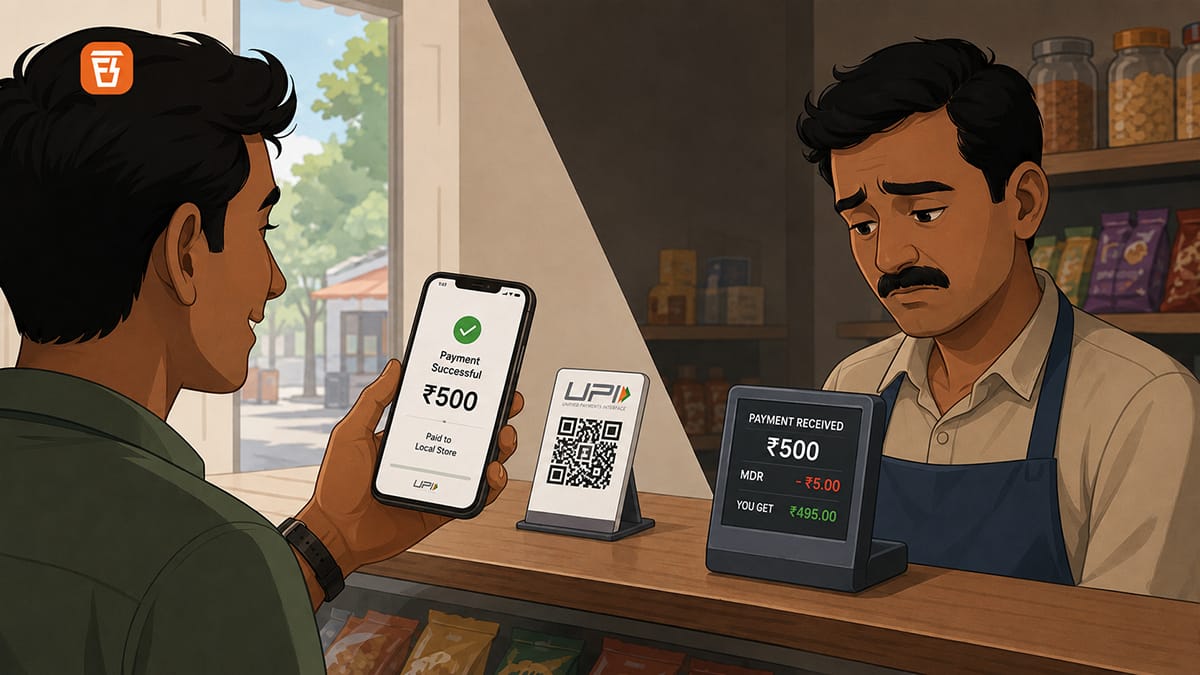
The Indian government recently got the power to decide which payment methods and types of transactions can remain free or be charged after the Parliament passed a new bill. And that has sparked widespread concern about whether UPI could continue to scale if charges eventually kick in.
So, in today’s Finshots, we look at the economics of scaling UPI, even if it isn’t free.
But here’s a quick sidenote before we begin. If people depend on your income, you need to read this.
Most first-time earners skip insurance entirely or buy the wrong thing because someone sold it to them. Both are expensive mistakes. That’s why we’re running a 2-day Insurance Masterclass to help you get it right from the start.
📅 Monday, 17th August at 6:30 PM: Life Insurance
📅 Tuesday, 18th August at 6:30 PM: Health Insurance
Only 300 seats remaining. 👉🏽 Click here to reserve your spot today.
Now onto today’s story.
The Story
Last year on a vacation to Thailand, I ordered a few essentials off a quick commerce app. The bill was 14 baht. I paid 20, but they didn’t have change. So the delivery executive pulled out his phone, tapped a few times on the screen, showed me a QR code and asked me to scan it.
It was my first day there, and communication was hard because he didn’t understand English and I didn’t understand Thai. Which meant I ended up using Google Translate and figured out that I needed to download an app, link a prepaid tourist card and pay. And this isn’t just for tourists. Thai residents have a similar app where they can pay with a bank-linked card or prepaid card.
That’s when I realised how simple UPI has made our lives. You can pay even if you don’t have a debit card linked to your account. Just download any UPI app, link it to your bank and pay, all for free. You don’t think twice before paying, even for small amounts.
For six years, that frictionless nothing has been the whole point of UPI. But as it turns out, it’s also its biggest problem.
Because even if you weren’t paying anything extra directly, someone always was. And that someone was you, just indirectly.
Let’s explain how.
See, every time you send money on UPI, banks on both ends do real work. They move funds instantly, check for fraud and keep servers running around the clock. None of that is free. With card payments, this backend work is charged through a fee called MDR, or Merchant Discount Rate, paid by merchants to banks and card networks like Visa and Mastercard.
But with UPI, the government banned banks from charging MDR in 2020. That’s because an Income Tax Act amendment made it compulsory for businesses earning over ₹50 crore to offer digital payment options. But when adoption is forced and comes with a new cost, merchants could simply pass that cost on to customers, impose minimum purchase or order values, or sometimes even refuse to comply. So zero-MDR became a thing.
And because banks couldn’t sustainably carry the cost of running UPI without being compensated, the government tried to fill the gap with an annual subsidy for UPI and RuPay debit card transactions. Which, of course, was funded by taxpayer money or in other words, you and me.
The whole thing went on fairly well until that subsidy kept shrinking. For context, at its peak in FY24, it was about ₹3,631 crore. But it dropped to ₹1,441 crore in FY25 and just ₹435 crore in FY26 before being revised up mid-year because it wasn’t enough to cover costs.
And while subsidies kept shrinking, transaction volumes didn’t. To put that in perspective, UPI processed over 24,000 crore transactions worth ₹314 lakh crore in FY26, up roughly 30% in volume and 21% in value year-on-year. Yet, a parliamentary committee recently found that the subsidy meant to keep these transactions free covered barely 11% of what the industry was spending to keep UPI running between 2022 and 2025.
So you could say that apart from taxpayers, banks and fintechs were also paying to keep the country’s most popular payment habit alive.
That math finally caught up with policy this month when the Parliament passed a bill amending the Payment and Settlement Systems Act. It lets the Central Government notify which electronic payment modes, categories of payers or payees and transaction thresholds can remain exempt from charges, replacing the current blanket zero-MDR mechanism for UPI and RuPay.
Now, that doesn’t mean a shopkeeper will suddenly start charging you for paying via UPI. The government has clarified that UPI will remain free for citizens. But there could be a nominal MDR on a limited set of merchant transactions in the future, perhaps above a certain threshold.
And that could make a huge difference. Jefferies estimates that even if the threshold were transactions above ₹2,000, a fee as small as 0.15-0.3% could generate ₹5,000-10,000 crore by FY28, giving payment apps, banks and NPCI ( National Payments Corporation of India) additional revenue.
But here’s something that got us thinking. Everyone’s panicking about UPI being charged. Some users online even say they’d stop using it if they had to pay extra. Much like how recharges on payment apps became discouraging once platforms started charging a fee.
So how do you scale UPI with charges?
Well, India isn’t the only country to try instant, free-feeling payments at scale. Brazil has done it too, with something almost the opposite of what India is now attempting. In November 2020 Brazil’s central bank launched an instant payment system called Pix. But unlike UPI, Pix never pretended that fees did not exist.
From day one, sending money between two people, like splitting expenses with a friend, was free. But the moment a business was on the receiving end, banks and payment providers could charge a small fee.
You’d think that should have slowed things down. But fifteen months after launch, Pix had actually overtaken debit and credit cards combined in transaction volume. Within a couple of years, more than 140 million Brazilians or roughly eight out of ten adults, were using it and making over 4 billion transactions a month.
That’s proof that UPI can clearly scale with charges. The trick is that Pix wasn’t competing against “free”. It was competing against credit card fees of 2-3%, or sometimes higher. So even with a fee attached, Pix was still significantly cheaper than what merchants were already paying to accept a Visa or Mastercard.
Add instant settlement and a central bank rule forcing every major bank to join the network, and you get a system with every incentive to scale fast.
Brazil built its fee and free layers side by side, without anyone having to unlearn anything. Businesses budgeted for a Pix fee the same way they’d always budgeted for a card fee, except it happened to be much smaller.
India did the opposite. It trained an entire country of merchants, over six years, to expect zero. Now it has to reverse that expectation without breaking the trust that made UPI universal in the first place. That’s a much harder psychological sell than charging a fee from the beginning.
Besides, if you remember UPI also wasn’t actually free from day one. Between its launch in 2016 and 2020, merchant fees were somewhere between 0.25-0.3%. And despite that, UPI scaled and overtook debit and credit card transactions both by volume and value by 2019.
Which means that India has also effectively run its own version of the Brazil experiment for four years with a modest merchant fee which was well below card rates. And that didn’t result in merchants mass-reverting to cash.
The only difference is that Brazil never had to convince anyone that a fee was fair, because there was never a “before” to compare it with. India does.
So yeah, the real experiment isn’t really about economics. It’s about whether a country can walk back a promise of “free forever” without the story becoming about betrayal rather than sustaining a payments system.
Until next time…
If you liked this story, feel free to share it with your friends, family or even strangers on WhatsApp, LinkedIn, and X.
Also, if you’re someone who loves keeping tabs on the world of business and finance, hit subscribe if you haven’t already. And if you’re already a subscriber, thank you! Maybe forward this to someone who’d enjoy our stories but hasn’t discovered us yet.