
The Orient Cables IPO, India's falling rice output, and more...
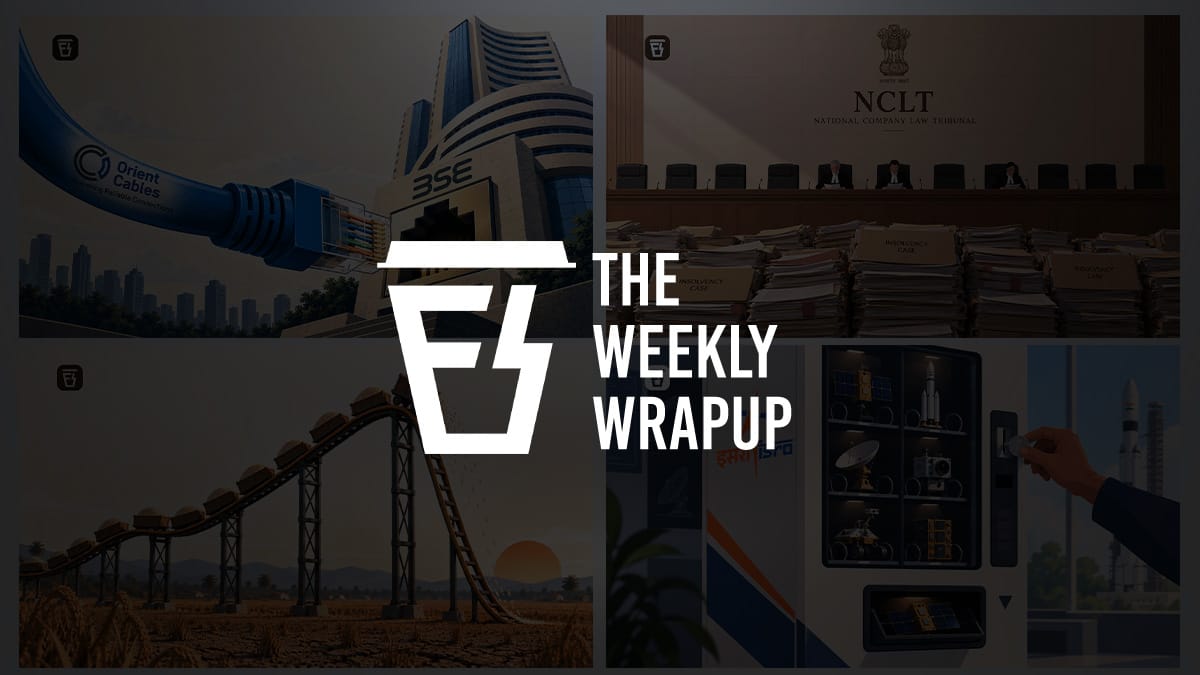
In this week’s wrapup, we discuss the concept of tokenised corporate bonds, India’s falling rice output, the misconception of ISRO’s privatisation, why India’s Company Law Tribunal (the NCLT) is in a crisis and the Orient Cables IPO.
 Love our insights? Add Finshots as a Preferred Source on Google ⭐
Do we really need blockchain for bonds?
SEBI has just rolled out a pilot testing tokenised corporate bonds under its new Demat 2.0 framework. On the surface, this might seem unnecessary since Indian bonds are already digital and sit in demat accounts. So what would blockchain add to this?
Well, to understand why blockchain is needed, we must understand how the current system works. You see, a surprisingly complex web of intermediaries, registrars, depositories, and banks must coordinate every time a transaction takes place, and any small error along the way triggers slow, manual reconciliation.
Having blockchain and ’tokenising’ these bond contracts aims to fix exactly that. Because encoding a bond’s terms directly into a smart contract means payments trigger automatically, without going through so many layers.
However, this convenience also comes with a bunch of tradeoffs. So can tokenised bonds actually solve real structural problems in India’s debt markets, or does removing one kind of risk simply introduce a new one?
Read our full story to find out.
What’s happening to India’s rice output?
India’s rice production could fall by 10 million tonnes this year. That’s the biggest drop in nearly two decades. And it’s already pushing rice prices higher and could make Indian exports more expensive.
But here’s the thing. India is sitting on around 60 million tonnes of rice stocks, which is nearly 5 times more than what it normally keeps as a buffer. So why can’t the government simply release that stock and prevent prices from rising?
As it turns out, the problem isn’t quite as simple as having enough rice in the warehouse. To find out what the real complications are, check out Tuesday’s newsletter, where we broke it all down.
Why ISRO is handing its commercial empire to private industry
ISRO has built its reputation on doing extraordinary things without spending extraordinary money. The Mars Orbiter Mission cost roughly ₹450 crore, and Chandrayaan-3 landed near the Moon’s south pole for around ₹613 crore, a fraction of what NASA or ESA missions cost. And for decades, this frugality meant ISRO did everything itself, including designing, building, launching, and commercialising its technology.
That model is now changing. And it’s sparked talk of the government "privatising" ISRO. But the reality is more nuanced than that.
Under the Indian Space Policy 2023, ISRO’s role is narrowing toward advanced R&D and deep-space exploration, while three other bodies take on everything else. And the idea behind this move is straightforward. Freeing ISRO from commercial work should let it focus more on frontier research.
But will that alone help India build a thriving private space industry?
Read Wednesday’s newsletter to find out.
India’s Company Law Tribunal is in a crisis
If you have a case before India’s NCLT (National Company Law Tribunal), you might want to practice being more patient.
We’re saying this because the tribunal was created to speed up company disputes and insolvency cases. But of late it is struggling with delays, vacant positions and even a shortage of basic infrastructure. Some benches are working only half-days because there aren’t enough members. And while the government has finally passed a new law to reform India’s tribunal system which also means good news for the NCLT, it may not solve all of its immediate problems.
So, how did an institution meant to make corporate insolvency faster end up in this mess? We wrote about it in Thursday’s newsletter. You can read it here.
The Orient Cables IPO Explained
The AI boom is creating a rather unexpected investment opportunity. As companies spend billions building data centres, they need plenty of cables to connect servers, storage and networks.
That’s where a company like Orient Cables comes in. It is already a major player in India’s networking cable market and is now tapping into newer areas such as optical fibre, EV charging and solar infrastructure.
But there’s a catch. Despite a sharp jump in revenue, profits barely moved last year. So can Orient Cables actually turn the data-centre boom into sustainable profits before bigger rivals catch up? Find out in yesterday’s Markets edition.
Finshots Weekly Quiz v2.0 🧠
Hey folks! As you probably already know, the Finshots Weekly Quiz has a new avatar. If you missed out, don’t worry. Click here to check out the rules and start participating in the quiz today to stand a chance of making it to this month’s leaderboard, and maybe even winning some merch!
But for now, it’s time to announce the top scorers of our previous weekly quiz. There were a whole bunch of you who participated, and many of you ended up with the same scores. So we’re calling you Bulls, Bears, Unicorns, Blue Chips, and Rising Stars. Here’s how the leaderboard looks right now:
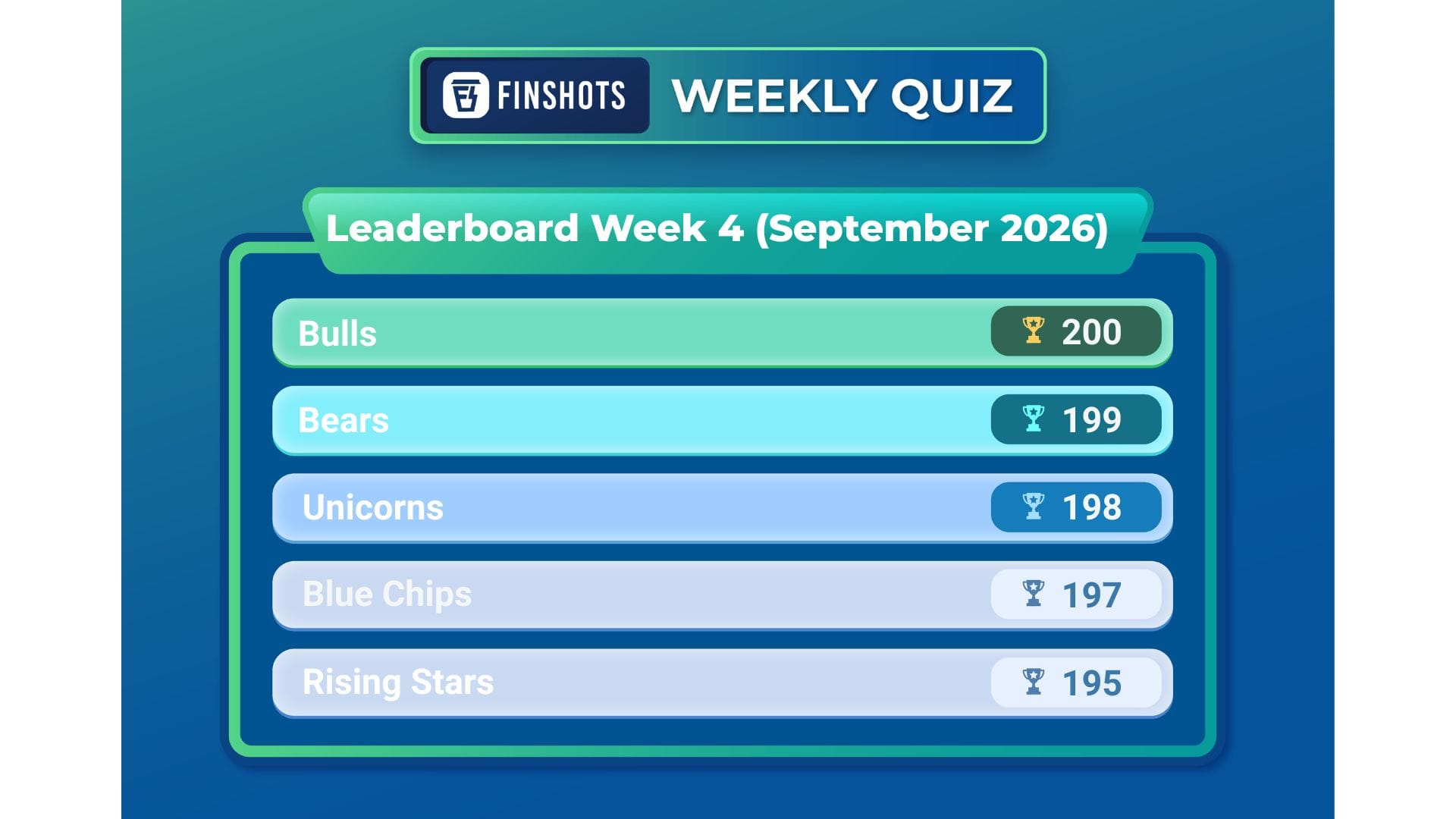
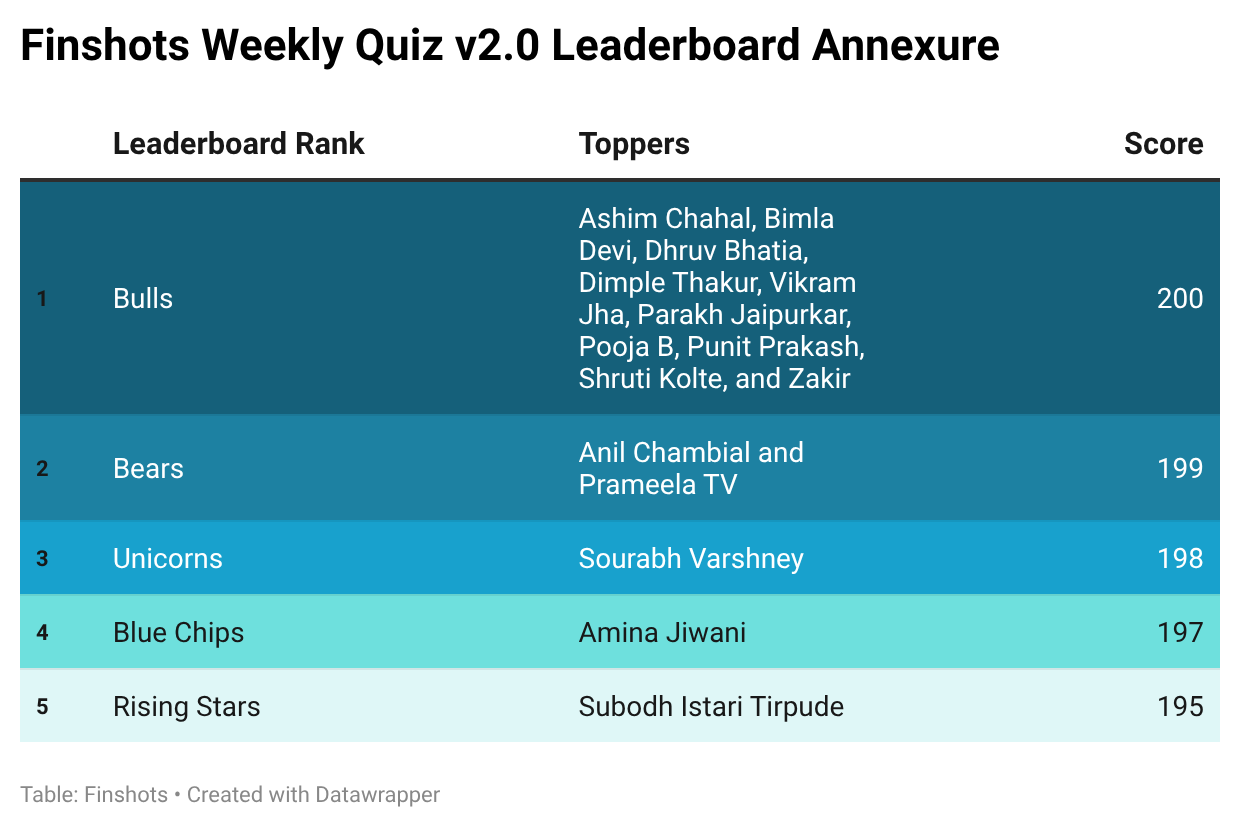
As you can see, we have ten top scorers fighting for the merch. But unfortunately, there’s just one merch box to be won every month.
So to break the tie, we’ll be sending a tie-breaker question to all the “Bulls” via email. Keep an eye on your inbox! The one who gets it right the fastest wins the exclusive Finshots merch for September 2026, and we’ll reveal the winner’s name next week.
And to the rest of you whose names made it to the leaderboard, congratulations! You may not have won the merch this time, but you showed up consistently and earned a spot on Finshots’ weekly leaderboard. That’s pretty cool.
So don’t lose hope. Hit the reset button this month and keep answering all the weekly quizzes. Who knows? You might just be the winner this time around.
Click on this link to take this week’s quiz, which is open till 12 noon, Friday, 2nd of October, 2026. The more answers you get right, the better your chances of appearing on the Finshots Weekly Quiz leaderboard. We’ll publish it every Saturday in the Weekly Wrapup. And the winner will be announced in the first week of November.
Liked this week’s wrapup?
Don’t forget to share it with your friends, family, or even strangers on WhatsApp, LinkedIn, and X. And subscribe to Finshots, if you haven’t already. Plis!