
The tricky case for plastic banknotes
In today’s Finshots, we tell you why plastic currency notes aren’t really a no-brainer.
But here’s a quick sidenote before we begin. Your 30s and 40s are peak earning years. They’re also the years most people fly without an insurance safety net.
Between EMIs, school fees, and ageing parents, there’s always something more urgent. But one medical emergency or unexpected loss of income can unravel everything you’ve built.
Our 2-day Insurance Masterclass will help you put that safety net in place.
📅 Saturday, 25th July at 11:00 AM: Life Insurance
📅 Sunday, 26th July at 11:00 AM: Health Insurance
👉🏽Click here to save your spot.
Now onto today’s story.
The Story
You’ve probably heard the news. The RBI is contemplating field trials of plastic notes. And the internet has been in a frenzy, with some people even spreading panic that all Indian currency notes will soon be made out of polymer.
But hold on. That’s not happening anytime soon. There are quite a few things you need to understand before assuming that you’ll be carrying plastic notes in your wallet before you know it.
To begin with, why do we even need to move to polymer notes?
You may have already read about it, but let’s quickly give you a rundown to set the context.
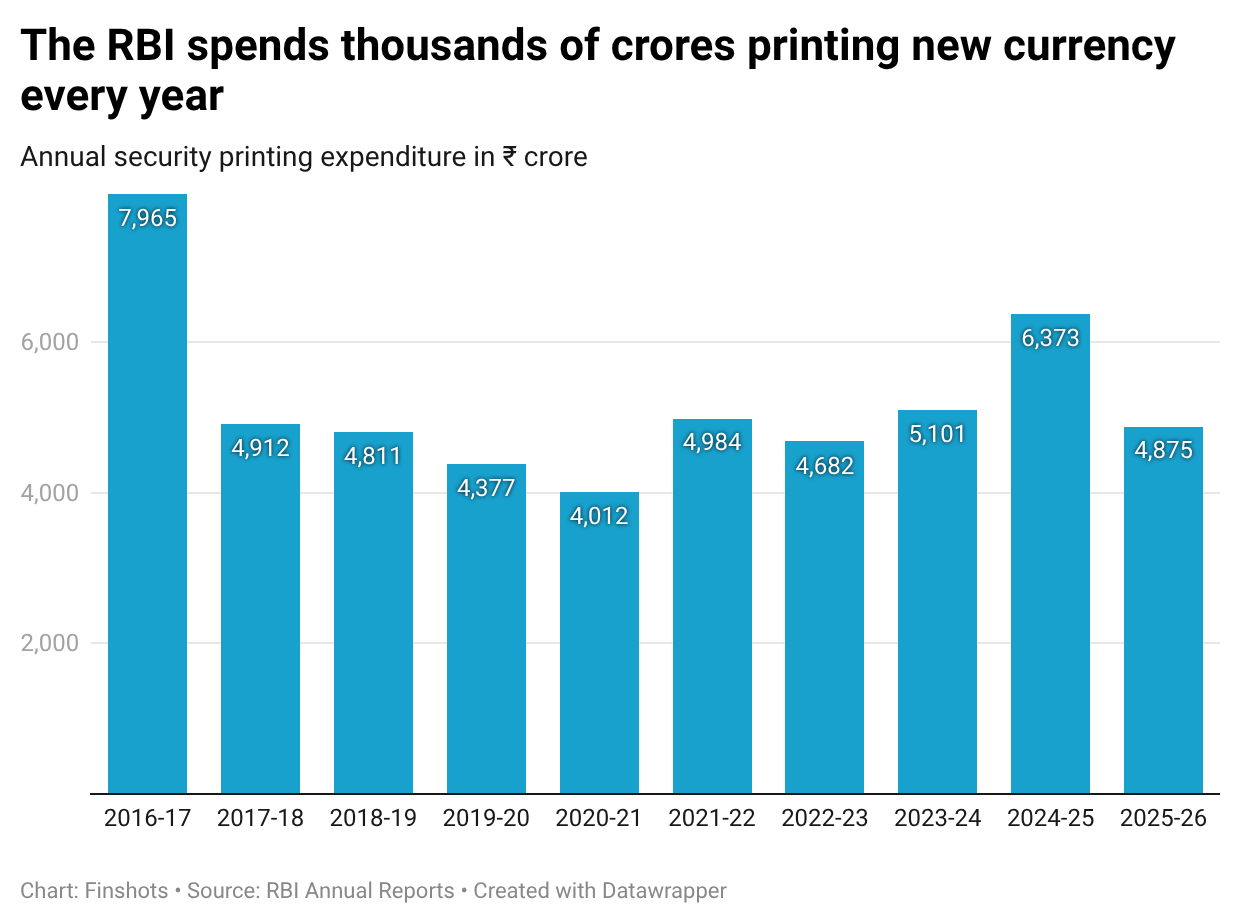
See, right now, the currency notes we use are made from a special kind of paper that’s made from a blend of 75% cotton and 25% linen. This paper can withstand around 4,000 double folds before it finally tears. But in a densely populated country like India, paper notes get soiled and damaged pretty quickly. Which means the RBI has to keep spending money collecting these worn-out notes, destroying or recycling them, and printing fresh ones to replace them.
To put that into perspective, since the 2016 demonetisation, the RBI has spent roughly ₹4,000–5,000 crore every year printing new currency notes. Those costs haven’t risen dramatically over the past decade, except in FY17, when it had to replace the demonetised ₹500 and ₹1,000 notes, and again in FY24 and FY25 after discontinuing the ₹2,000 note.
So, if currency notes could simply last longer, the RBI could at least reduce the money it spends replacing soiled notes. And that’s where polymer notes come in. They’re generally believed to last 2.5 to 4 times longer than paper notes. They aren’t indestructible, of course, but they’re far more resistant to everyday wear and tear, dirt, and even moisture.
And more durable currency notes could also help lower the carbon footprint. Think about it. If notes last longer, you don’t have to keep growing as much cotton or use as much water, pesticides and chemicals to make the paper needed for replacement notes. At least that’s what the Bank of England says. According to it, the carbon footprint of its polymer £5 note is 16% lower than that of its paper predecessor.
There’s another advantage too. Polymer notes are generally much harder to counterfeit. That’s because polymer film is naturally transparent, allowing manufacturers to leave a small section completely ink-free and create a genuine see-through window in the note. That becomes a unique security feature that paper notes simply can’t replicate easily. After all, if someone tries to photocopy or scan the note, they can’t recreate that transparent window.
Now, you might argue that counterfeiters could simply print fake notes on transparent film instead. But it’s not that simple. Polymer notes aren’t printed on just any plastic film. They’re printed on a specially engineered polymer substrate that takes years of research and manufacturing precision to develop. And that market is dominated by just a handful of global companies, including Australia’s CCL Secure and Britain’s De La Rue.
And this is where the real challenge begins.
So far, we’ve only talked about why the RBI might be considering trials for polymer notes. But while almost every other piece of news seems to be celebrating the move, there are a few big hurdles the RBI could run into.
The first challenge is that India would have to rely heavily on importing polymer substrate from a handful of global manufacturers that have been making it for decades. That means the upfront cost of switching to plastic notes could be substantial. And that’s even before you factor in the cost of designing new notes and upgrading printing plates.
Now, you could argue that India is the world’s second-largest producer of BOPP (Biaxially Oriented Polypropylene) films, which form the base material for polymer notes. So, if the country ever decides to make the switch, couldn’t it eventually manufacture the substrate at home?
Well, not so fast.
The world’s first polymer banknote, issued by the Reserve Bank of Australia (in 1988), was printed on CCL Secure’s specially developed GUARDIAN substrate. It took nearly two decades of research and development to perfect, and it’s still used by more than 40 countries today. So even if India decides to manufacture polymer substrate domestically, building that kind of capability isn’t something that can be scaled up overnight.
Secondly, this isn’t even the first time the RBI has flirted with the idea of polymer banknotes. The central bank has tried to run pilot projects at least four times since 2009. But one of the biggest hurdles was that ATMs struggled to dispense polymer notes reliably.
Now, technology has certainly improved since then. But there’s still no concrete evidence to suggest that India’s ATM network is fully equipped to handle polymer notes. The problem is fairly straightforward. Polymer notes are more slippery than paper ones, making them harder for ATM rollers to grip and dispense.
You could look at the UK as an example. It completed its transition to polymer notes in 2022. But after introducing its first polymer note in 2016, it had to spend more than £45 million upgrading cash vending machines. And if you include cash-counting machines as well, the bill rose to nearly £240 million or about £340 million in today’s money. That’s a staggering ₹4,300 crore.
Sure, the RBI could avoid some of these costs by introducing polymer notes only for lower denominations like ₹10 and ₹20, which change hands more frequently in everyday transactions.
But there’s a catch. The ₹500 note is the most widely circulated note in the country, followed by the ₹10 note. And the government is also planning to roll out ATMs that dispense smaller denomination notes as cash in circulation has climbed to a record ₹42.97 lakh crore since 2017 and there seems to be a genuine crunch of small notes. So if ATMs are eventually expected to dispense more small-value notes, the cost of upgrading the country’s cash infrastructure isn’t something you can simply rule out.
And finally, there’s one criticism of polymer notes that might sound a little silly at first. But they don’t fold as easily as paper notes. Which means you can’t casually slip one into your jeans pocket anymore. Chances are, it’ll just spring back or even slip out.
So yeah, while more than 60 countries may already be using polymer notes, that doesn’t automatically make them the best choice for every country. Every material comes with its own trade-offs. And no country that’s made the switch has a population anywhere near India’s scale. Which is why the RBI’s latest field trial will probably tell us a lot more than all the excitement on the internet ever could.
Until then...
If this story helped you understand the other side of the polymer banknote debate, share it with your friends and family, especially anyone who’s been in panic mode ever since this news started doing the rounds on WhatsApp, LinkedIn, or X.
And if you’re someone who loves keeping tabs on the world of business and finance, hit subscribe if you haven’t already. And if you’re already a subscriber, thank you! Maybe forward this to someone who’d enjoy our stories but hasn’t discovered us yet.