
FPE #2: Economics can explain if AI can snatch your job

In today’s Finshots Pocket Economics (FPE), Edition #2, we’re telling you how economics can help you figure out how not to lose your job to AI.
But before we begin, here’s a quick recap of what we wrote over the past week. On Monday, we wrote about capital controls and why governments keep interfering with money flows. On Tuesday, we explained why steel is complicating the India-UK free trade agreement. On Wednesday, we wrote about why the Indian government has paused sugar exports. On Thursday, we talked about the Bharat Maritime Insurance Pool. And on Friday, we wrote about whether the rupee could hit ₹150 per dollar in the near future.
With that out of the way, let’s dive into FPE, Edition #2.
Hey folks!
Last week, my househelp said she wouldn’t come for two weeks. Now, I don’t live in a big city where I can simply open the InstaHelp section on Urban Company and have someone show up in 10 minutes. So naturally, I was panicking. I began planning how I would fit sweeping and mopping ten rooms (no, not ten bedrooms) every single day into my already packed writing and editing schedule for two whole weeks.
My husband read my exasperation from behind the book he was reading and said, “Why don’t we just get one of those robot vacuum cleaners that sweep and mop every corner and recharge themselves?”
I mentally nodded and started working out the math. A good robot vacuum would cost me ₹50,000. If I took good care of it, it would easily last 3–5 years. I pay my househelp ₹60,000 a year to clean the house every day except Sundays, with two paid days off a month and, obviously, the risk of her taking long leaves when she needs them. Apart from that, there’s the occasional moment when I spot a stain on the floor and say, “Didi, ekhane ektu bhalo kore muche dao na please.” (Bengali for, “Didi, please mop this spot properly again”).
Suddenly, opting for the machine seemed like a great idea. I could either use it as a backup for days when my househelp didn’t turn up. Or, if I wasn’t too concerned about putting someone out of work, I could simply tell her to convert her fifteen-day leave into a permanent one and find work somewhere else.
Well, I decided to go with the first option. But I also made up my mind that if she ever leaves the job, I probably won’t hire someone again for this specific task. If I did the same thing by buying a dishwasher and a food processor to help with meal prep (trust me, cooking doesn’t take nearly as much time as chopping and prepping), I’d technically be putting many people out of work in the long run.
And that’s what today’s edition is about. We’re going to go over the Luddite fallacy, or simply, a term economists use to describe the mistaken belief that new technology inevitably puts humans out of work and causes mass unemployment.
Now, I know the moment you read this, you thought of AI. We’ll get there. But before that, let’s rewind a bit and understand where this idea came from.
See, back in 1811, textile factory owners in England found themselves under pressure. The Napoleonic Wars and a severe economic depression had pushed costs up.
So they turned to new automated looms to produce more cloth and pay less for the labour that made it. Skilled adult workers were replaced with cheaper, untrained workers, often children.
Naturally, workers weren’t thrilled. One group that felt the brunt of these cost cuts called themselves the Luddites. At first, they tried negotiating to save their jobs by writing letters and petitioning to Parliament. But none of it seemed to work.
So one not-so-fine night in Nottingham, a group of them masked up and began smashing every stocking frame (a mechanical knitting machine) they could find. They claimed to follow the orders of a mysterious leader called “General Ned Ludd”, who supposedly lived in Sherwood Forest (yup, the same forest tied to Robin Hood).
Now, whether Ned Ludd ever existed is doubtful. But what’s not is the fury that drove his followers. Within months, the movement spread across England’s manufacturing regions from Nottinghamshire to Yorkshire, Lancashire, Derbyshire, and Leicestershire. Different regions targeted different kinds of machines.
To stop them, the British government deployed military forces. At one point, there were reportedly more troops fighting the Luddites than Napoleon. Parliament even passed the Frame Breaking Act, making machine-breaking a capital offence. Many Luddites were sentenced to death, and by 1816, the movement had largely ended.
But here’s the thing. The Luddites weren’t entirely wrong about job losses.
The numbers showed that their specific jobs were disappearing. Handloom weavers’ weekly wages, for instance, fell from 240 pence in 1806 to 99 pence by 1820. So yeah, their suffering was real.
But something else was happening too. The same industrial revolution that destroyed old jobs was creating an entirely new economy. By 1830, one in every 80 British worked in over 4,000 textile mills across the country. These were jobs that simply hadn’t existed a generation earlier. Beyond textiles, new industries like railways, steam engineering, iron and steel manufacturing, and chemical production had sprung up too.
So technically, mechanisation created far more jobs than it destroyed.
And this whole episode got economists thinking. Over time, they studied what happened and found that fears around machines replacing jobs often came down to two big economic misunderstandings:
- The lump of labour fallacy
This is the idea that there’s a fixed amount of work in the world, like a pie with only so many slices. So if a machine takes one slice, a human automatically loses theirs.
That’s more or less what the Luddites feared.
But economies don’t work like a fixed pie. Technology doesn’t just replace jobs. It often creates new industries and expands the total amount of work available. Take farming in the US. In 1900, around 40% of Americans worked on farms. By 1980, that number had fallen to under 4%, thanks to tractors, harvesters, and chemical inputs.
Now, if the “fixed pie” idea were true, millions of people should have ended up permanently unemployed. But they didn’t. Instead, workers moved into manufacturing, services, and entirely new industries like aviation, electronics, and petrochemicals — sectors that barely existed, or no one had imagined before.
- Confusing displacement with permanent destruction
This one is subtle but important. Displacement means a worker loses their job to a machine. That pain is real and often immediate.
But that’s not the same as destruction. Destruction would mean those jobs never come back in any form and the economy shrinks permanently. That rarely happens. More often, job losses in one industry are offset by growth in another.
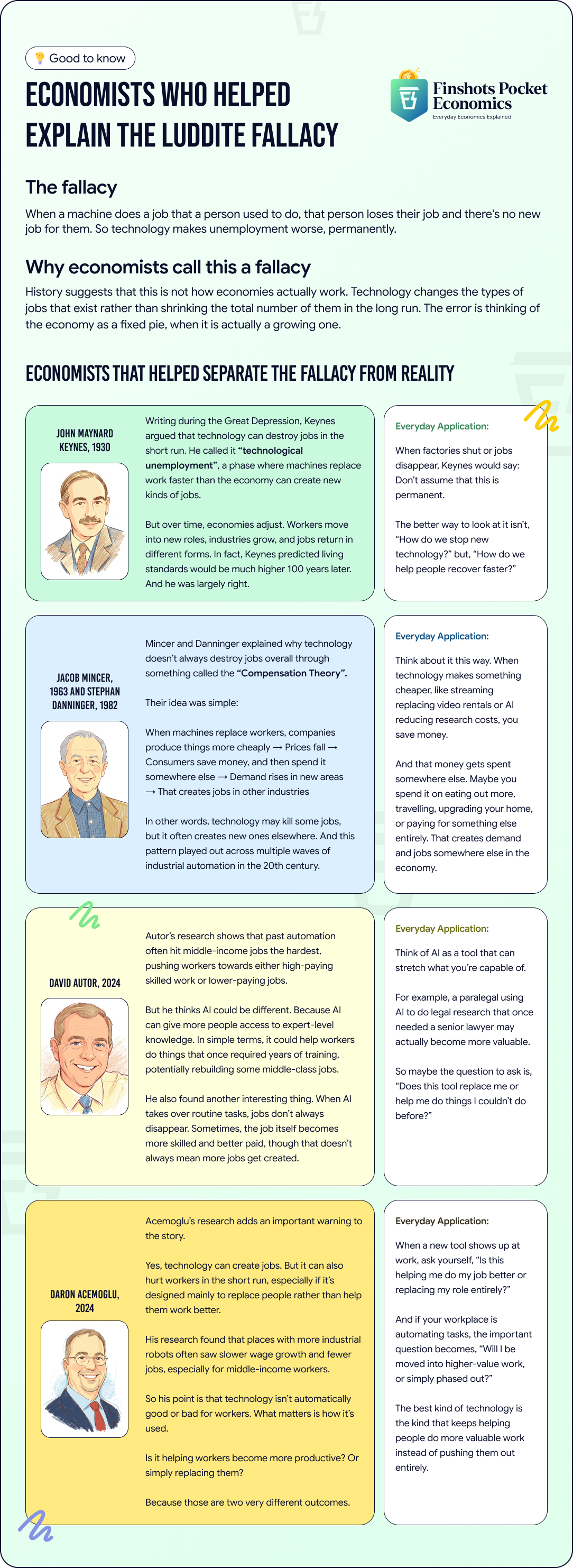
Phew! Now that you know the basics of this fallacy, let’s talk about the reality of it all minus the economists, research papers or theories.
Let me begin by asking you one question. When I told you earlier that I could possibly put my househelp out of work by replacing her with a machine, what came to your mind?
Did you think, “Well, she’ll probably find work somewhere else”?
Maybe.
But then what if many people started to think like me? Wouldn’t many workers suddenly find themselves out of jobs and struggle to find new ones?
Well, yes. At least for a while.
But maybe not forever. Let’s talk about my househelp itself. She doesn’t just clean homes. She also does tailoring. Sometimes, she stays overnight at a neighbour’s house because there’s an elderly aunty living alone who needs care. And honestly, there are many homes like that in my town where older people struggle to find reliable caregivers.
So even if machines reduce one kind of work, people often move into other kinds of jobs. Maybe nearby, maybe somewhere completely different. And a very similar thing may be playing out in our lives today.
A lot of us fear that AI will automate our jobs and replace us. And to be fair, that fear isn’t entirely untrue. Some jobs and tasks will change and some may entirely disappear.
But remember? The Luddites went through something similar. Yet the economy eventually created jobs and industries no one could imagine back then.
We may be in a similar phase right now.
Think about ATMs. They didn’t eliminate banking jobs. They changed them. Computers reduced the need for typists, but also created new kinds of work in IT, software, design, and digital marketing. The internet disrupted libraries, threatened kirana stores, and wiped out DVD rentals, while creating entire industries of its own.
So maybe the real question that you should ask yourself isn’t “Will my job disappear?”, but “Which parts of my job will change, and what can I learn to stay valuable?”
And to answer that, here are three simple steps:
One simple way to think about this is to list 3–5 things you do every day at work. Of these, which tasks could AI automate first? Let’s assume 20–30%?
Now ask yourself, “What happens if I get better at (upskill) the remaining 70%?”
Take call centres, for example, one of the jobs people fear AI will hit hardest. And that’s true because chatbots are already handling routine customer queries.
But that also creates room to move into other areas. For instance, companies building AI chatbots often value people with customer support experience because they already understand conversations. They know what a frustrated customer sounds like, when a query needs escalation, and how much empathy a conversation needs, even if the bot itself isn’t emotional.
That opens doors to roles like prompt engineering, conversation design, AI training, or managing chatbot systems. And then there are the kinds of messy, complex customer issues that AI still struggles to handle, which creates room for escalation specialists too.
Or take developers wondering whether learning to code still makes sense when AI can generate modules in seconds. The Luddite Fallacy would probably say that’s the wrong question to ask in the first place.
Routine coding may get automated. But someone still has to design systems, review AI output, catch bugs, understand business needs, and make judgment calls. In many ways, the role may shift from writing every line of code to supervising and improving what AI produces.
The same may apply to creative work too. Yes, AI can write stories and generate designs. But if everyone starts using the same tools, much of what gets created may start looking and sounding similar, no? Which means original ideas, taste, context, and human judgment could become even more valuable.
And finally, think about all the things AI still can’t easily do at scale. Like starting and running local businesses. By that, I don’t mean a flashy Bengaluru startup with a billion-dollar idea. I mean things we’ve probably stopped thinking about. Like organic farming if you have access to family land, opening a hardware or construction materials shop, or even something quirky like an ice cream parlour where AI helps you test and create new flavours.
All of this tells you that sometimes, surviving disruption is simply about figuring out where demand may shift and learning how to move with it.
So yeah, unlike the Luddites who destroyed looms, we’ll probably have to learn how to weave with them. Because if we don’t, the Luddite Fallacy may stop feeling like a fallacy, at least for us.
And that wraps up today’s FPE edition. We’ll see you again next Saturday!
Until then, tell us what you thought of today’s edition and if you learnt anything that might help you think more clearly about technology replacing jobs, including your own. Just hit reply to this email (or if you’re reading this on the web, drop us a message at morning@finshots.in).
Or even better, share it with your friends and family on WhatsApp, LinkedIn, and X.
Finshots Weekly Quiz v2.0 🧠
As you probably already know, the Finshots Weekly Quiz has a new avatar. If you missed out on it in the last couple of months, don’t worry. Click here to check out the rules and set a reminder to participate consistently starting next month!
Next, let’s move on to the top scorers from our previous weekly quiz. There were a whole bunch of you who participated, and many of you ended up with the same scores. So we’re calling you Bulls, Bears, Unicorns, Blue Chips, and Rising Stars. Here’s how the leaderboard looks right now:


If your name has been featured on the leaderboard, then congratulations! If not, don’t lose hope. If you attempted last week’s quiz, keep at it and answer all the weekly quizzes this month. You never know when the turntables! Click on this link to take this week’s quiz, which is open till 12 noon, Friday, 29th of May, 2026. The more answers you get right, the better your chances of appearing on the Finshots Weekly Quiz leaderboard. We’ll publish it every Saturday in this edition. And the winner will be announced in the first week of June.