
Is the MSCI EM Index still an emerging markets index?
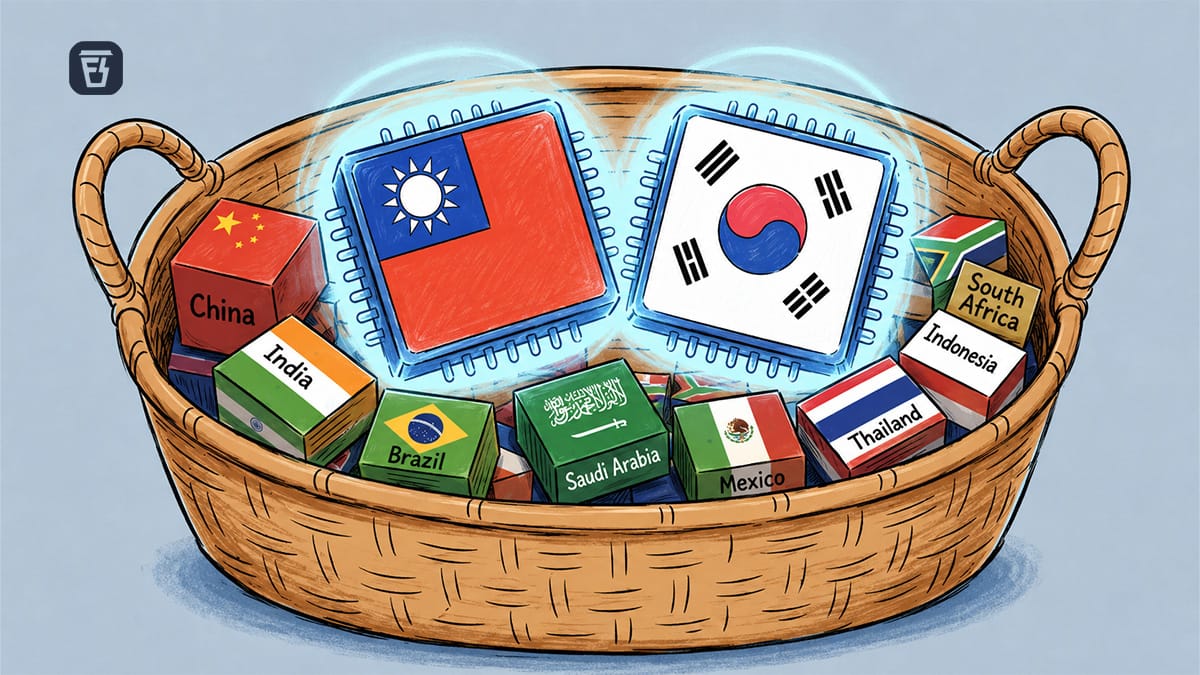
In today's Finshots, we explain what India's fall in the MSCI Emerging Markets Index reveals about the benchmark itself.
But here’s a quick sidenote before we begin. We’re looking for a business writer to join Finshots’ newsletter team. If you’re someone who can tell compelling stories and explain financial concepts in plain English without drowning readers in jargon, do consider applying through the link here. Or share this with someone who might be a good fit for the role.
With that out of the way, let’s dive into today’s story.
The Story
Imagine you're a global fund manager sitting in New York. Your job is to invest in emerging markets like India, China, Brazil, South Korea, Taiwan, and other large emerging markets. You pick the traditional route and avoid individual stocks. Instead, you just buy the index. Specifically, the MSCI Emerging Markets (EM) Index, one of the most widely tracked benchmarks in global investing.
Now here's the thing about MSCI index investing. It decides how much goes into India or China based on one simple thing – a ‘free float-adjusted market capitalisation’. In simple words, the companies with the largest market value get the highest weights in the index.
Which is why what happened this week is so interesting.
For the first time since at least 2000, not a single Indian company featured among the top 10 constituents of the MSCI EM Index. HDFC Bank and Reliance Industries have slipped to 11th and 12th place, from 7th and 8th as recently as March. And their individual weights have both fallen below 0.8%.
So what exactly happened?
Now the obvious assumption is that Indian stocks underperformed. While that is true, the bigger story is that Taiwan and South Korea have risen much faster, and the top 10 companies in the MSCI EM Index are now dominated almost entirely by AI and semiconductor-related stocks.
Source: MSCI Emerging Markets Index Factsheet
TSMC, Samsung, SK Hynix, and Tencent alone account for 30% of the entire benchmark. Add in a few more Chinese tech companies and roughly 70% of the index is dominated by Taiwan, South Korea, and China. And that's where this stops being a story about India.
If you bought an EM index fund this year thinking you were getting broad exposure to developing economies, you were really just getting a large bet on the global semiconductor supply chain.
And it’s not hard to see why. Every AI model, data centre and LLM runs on chips. TSMC builds most of the world’s advanced processors, and Samsung and SK Hynix supply components that power them.
So naturally India, which has no real presence in that supply chain, got left on the sidelines. You can see that in the numbers. The MSCI EM Index has returned over 25% in just the first five months of 2026. India's Nifty, over the same period, is down 11%. So India's weight in the index hasn't just suffered from its own stocks falling. It's also suffering from everything else rising faster.
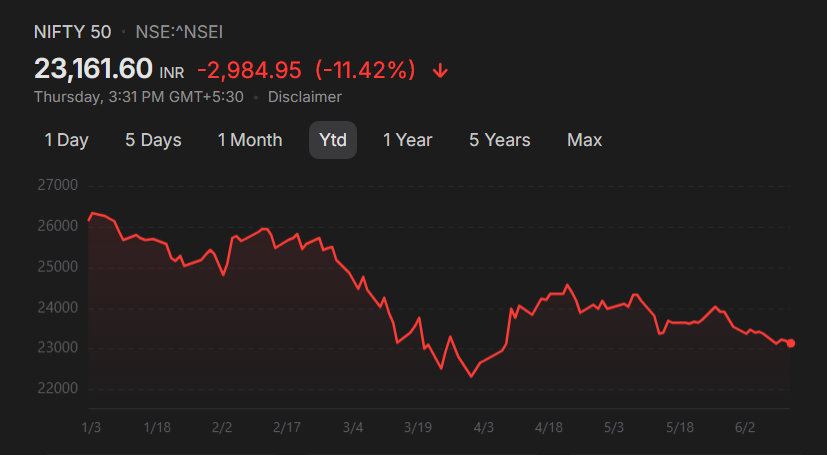
The result is that India's share of the MSCI EM Index has dropped to 10.8%, which is a six-year low and roughly half the weight it held in 2024.
Because as you probably know, foreign portfolio investors (FPIs) have pulled nearly ₹2.8 lakh crore out of Indian equities this year, on top of ₹1.66 lakh crore of outflow last year. Some of that is deliberate selling.
The same effect plays out in actively managed EM funds too, just more quietly. Since fund managers benchmark themselves against the MSCI EM Index, when India's weight falls because of its overall market capitalisation, fund managers don't have to own as much of it anymore. That means even investors who are positive on India can end up owning less of it.
But none of this is really India's fault. Sure, India doesn't have a TSMC, Samsung, or SK Hynix. It's still catching up in the technologies that have captured global investors' attention.
But India's large-cap stocks have had their own challenges. The bigger force at work is that the MSCI EM Index has become heavily concentrated in a single theme.
Which also raises a more uncomfortable question: is the MSCI EM Index still a useful benchmark for diversifying into emerging markets?
Maybe it is still useful for something. But maybe that “something” is no longer broad emerging-market diversification.
At today’s weights, the MSCI EM Index may be a useful benchmark for Asian technology, AI hardware and semiconductor supply-chain exposure. But that is a very different product from what the label suggests.
Because right now, the risk profile of the MSCI EM Index is much more tied to the global AI capex cycle than many investors probably realise. If the AI spending boom continues, the benchmark can keep looking brilliant. But if that cycle cools, an emerging-market investor could take a hit for reasons that have little to do with emerging-market consumers, commodity demand or domestic growth.
Another point is that the issue might not be that the MSCI Emerging Markets Index no longer looks like an emerging markets index.
After all, the term was coined in the 1980s to describe economies that were still catching up to the developed world. The assumption was that these countries shared certain characteristics: faster growth, less mature capital markets, higher risk, and lower income levels.
Investors still talk about "emerging markets" as if they are buying exposure to a single economic story. But Taiwan's role in the global semiconductor industry has very little in common with India's consumption story, Brazil's commodity cycle, or Saudi Arabia's capital spending plans.
The category lumps together countries that increasingly occupy very different positions in the global economy.
South Korea is the perfect example. It remains in MSCI’s Emerging Markets bucket, even though its companies sit at the centre of the global AI supply chain. And that classification may not last forever. In fact, there’s more than 60% probability that South Korea will be added to MSCI’s Developed Markets watch list this month.
If that happens, it would only make the contradiction sharper: one of the most important “emerging market” drivers of 2026 may be on the path to leaving emerging markets altogether.
Which means the MSCI EM Index may not be failing at all. It may simply be reflecting a world in which some emerging markets have already emerged.
And if that's true, then India's disappearance from the top 10 tells us something bigger than who won or lost this year's market race.
It tells us that the line between "developed" and "emerging" may be becoming harder to draw than investors realise.
For now, India is out of the top 10. But the bigger story isn't who left the list. It's what's taking over the benchmark.
Until next time…
Liked this story? Share it with a friend, family member or even strangers on WhatsApp, LinkedIn and X.
🚨 ATTENTION: FINSHOTS FAMILY
This weekend we’re hosting a free 2-day Insurance Masterclass that helps you build real financial security by understanding health and life insurance the right way.

📅 Saturday(tomorrow), 13th June at 11:30 AM: Life Insurance
How to protect your family, choose the right cover amount, and understand what truly matters during a claim.
📅 Sunday, 13th June at 11:30 AM: Health Insurance
How hospitals process claims, common deductions, the mistakes buyers usually make, and how to choose a policy that won’t disappoint you when you need it most.