
How real is a ₹150 dollar?
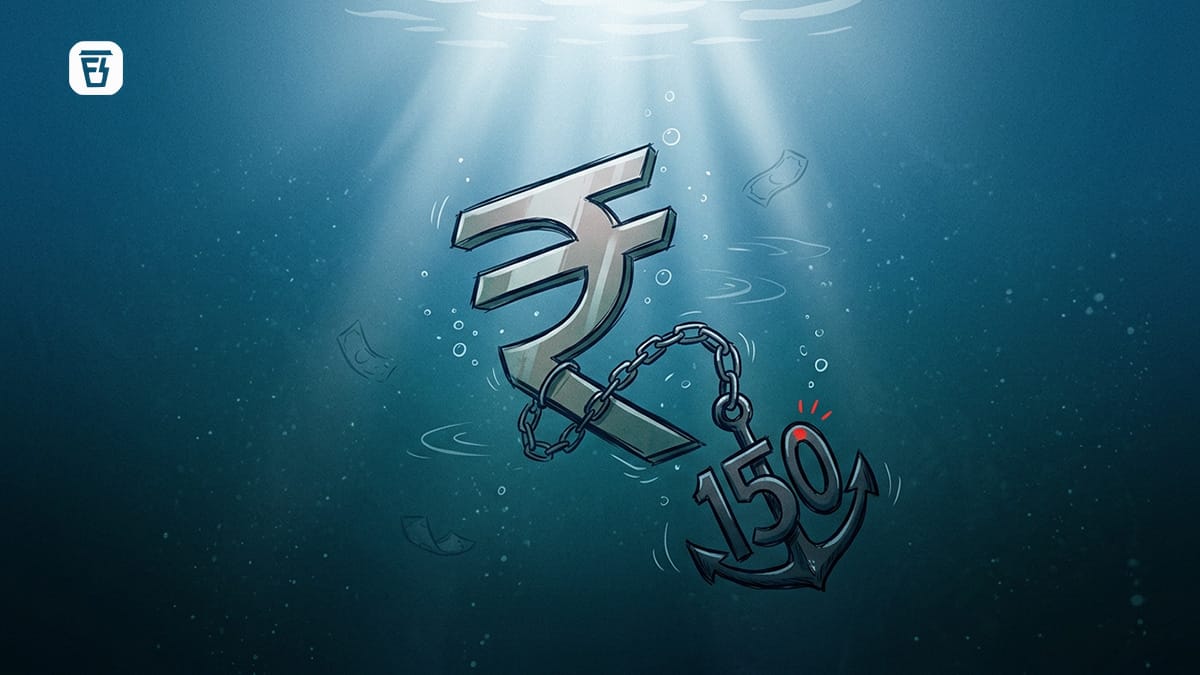
In today’s Finshots, we try to make sense of whether the rupee could hit ₹150 per dollar in the near future.
But here’s a quick sidenote before we dive in. We’re hiring a Content Writer at Ditto Insurance. If you like turning messy, complex topics into clear, helpful content that actually ranks (and gets read), and enjoy going beyond surface-level research, this might be for you. Check out our careers page for more or share it with someone who’d be a great fit.
Now on to today’s story.
The Story
There is one number that has suddenly begun making Indians pretty nervous.
150.
As in, ₹150 to buy one US dollar. Not too long ago, that exchange rate would have sounded ridiculous. But today, it’s a number people are seriously discussing. So how did we get here? And more importantly, could it actually happen?
Well, as of today, the rupee is hovering around ₹96 to the dollar. That’s a record low. In 2026 alone, it has already lost over 7% of its value, making it the worst-performing currency in Asia this year.
And there’s the noise around it. If you’ve been scrolling through social media or tuning into podcasts lately, you’ve probably seen influencers talking about the rupee’s fall too. That’s what has fuelled this big question floating around everywhere. If things keep moving in this direction, could the rupee really crash to ₹150 a dollar?
To understand where the rupee could be headed, you first have to understand where it has been.
See, when India liberalised its economy in 1991, one US dollar cost about ₹17. By 2025, that same dollar cost nearly ₹90. That’s a fall of more than 80% over 34 years. But strangely, it never quite felt like a crisis because it happened slowly and steadily, at an average pace of roughly 4.5% a year.
And to be fair, this isn’t all that unusual. Currencies do lose value over time, especially when one country consistently has higher inflation than another. India, for instance, has historically seen prices rise faster than America, barring a brief phase during the post-pandemic recovery. Which means the rupee tends to lose purchasing power faster than the dollar. Over time, exchange rates adjust to reflect that reality.
Economists have a fancy term for this ― the Purchasing Power Parity (PPP) effect. It’s like saying that a cup of tea keeps getting more expensive in India year after year, while prices in the US rise more slowly. Eventually, it takes more rupees to match the value of one dollar.
Now, if you simply extend that historical trend of around 4.5% depreciation a year from today’s levels, the rupee could touch ₹150 in roughly a decade.
But here’s the thing. We’re not exactly living through normal conditions. Several forces have come together in 2026, making the rupee’s fall faster and far more worrying than what history would normally suggest.
For starters, oil is getting more expensive thanks to the West Asia crisis. As you already know, India imports around 85% of the crude oil it needs. So when oil prices shoot past $110 a barrel, India suddenly needs a lot more dollars to pay the bill.
And here’s the problem. To buy those dollars, companies and the government sell rupees. More dollars being bought means more rupees flooding the market. And when more rupees chase the same number of dollars, the rupee weakens.
That, in turn, widens India’s current account deficit (CAD) or the gap between the dollars flowing out of the country and the dollars coming in. Right now, India’s CAD is still at a fairly comfortable level of under 1% of GDP, which is healthy for a fast-growing economy.
But it could go up to 2% because apart from oil there's another pressure point: foreign investors heading for the exit.
Now, there are broadly two kinds of foreign money coming into India. One is FDI (foreign direct investment), where companies like Apple invest to build factories or infrastructure. The other is FII or FPI (foreign institutional or portfolio investment), where global investors buy Indian stocks and bonds.
And right now, it’s the second category that’s turning into a headache. FPIs have already pulled out over ₹2.17 lakh crore from Indian markets this year, compared to ₹1.66 lakh crore in all of 2025. When they sell Indian assets, they convert rupees back into dollars and take the money out. That means yet another wave of dollar buying and rupee selling hitting the market.
And this isn’t entirely surprising. Even though the US Federal Reserve hasn’t raised interest rates recently, investors still see American government bonds as a safer place to park money during uncertain times. They offer stability, liquidity, and decent returns. India, on the other hand, cut interest rates in December and kept its stance unchanged in the latest RBI meeting, which has made Indian assets relatively less appealing for some global investors.
At the same time, India’s net FDI flows have weakened too. For context, before the pandemic, India relied on capital inflows worth roughly 2.6% of GDP. But last year, those flows almost dried up, despite India receiving a record $81 billion in FDI in FY25, which is about 14% higher than the previous year.
The reason?
Many foreign firms that invested heavily in India over the last decade are now taking profits back home. And Indian companies are investing more overseas too by setting up businesses abroad. So while money is still coming in, a lot is flowing out as well.
Put all of this together and you’ll see why India suddenly has fewer dollars available just when it needs more of them. And it is in the effort to bridge that gap that the rupee weakens further.
But there are also two other very important factors that might not look as obvious at the surface level as oil prices or foreign investments leaving the country.
And that is firstly, the RBI’s “hidden debt” in forward markets.
To put things in perspective, when too many people want dollars to pay for oil imports, foreign travel, or foreign debt, the RBI doesn’t always sell dollars immediately because that drains reserves. Instead, it sometimes steps into what are called forward markets, essentially saying, “Don’t panic. We’ll supply dollars later.”
But those future promises eventually become due. And then the RBI has to deliver those dollars, roll over contracts, or carefully manage the unwind.
In fact, just a couple of weeks ago, the RBI’s net short dollar position crossed a record $100 billion for the first time. Which means one of the tools used to protect the rupee today could create pressure on it tomorrow.
The other thing is how much value the rupee is actually losing.
Now, we know we said the rupee has fallen about 7% this year. But that’s just a number you see at face value. Economists call this the Nominal Effective Exchange Rate (NEER).
But there’s another measure called the Real Effective Exchange Rate (REER), which adjusts for inflation differences between countries.
Let’s explain. Suppose inflation in both India and the US is 10% this year. Everything becomes 10% more expensive in both countries. In that case, even if the rupee-dollar exchange rate stays stuck at ₹96, nothing has really changed in terms of what people can buy relative to each other.
But now imagine India has 10% inflation while the US has only 5%. Prices in India are rising much faster. So even if the rupee has fallen only 7% on paper, your real purchasing power relative to Americans may have weakened by far more because your money is losing value faster at home too.
And that’s exactly what the REER captures.
The worrying bit though, is that India’s REER has fallen to its lowest level since 2014 this year. And if inflation rises further because of everything we discussed earlier — expensive oil, imported inflation, and pressure on the rupee, the real erosion in value could end up looking worse than what the nominal fall alone suggests.
So, after looking at all these moving pieces, let’s finally come back to the question we started with. Will the rupee hit ₹150 per dollar?
Well, yes. At some point. But the real question is, when?
If today’s unusual conditions stick around, the rupee’s pace of decline could speed up from its long-term average of about 4.5% a year to something closer to 6–7%. And at that pace, the ₹150 mark may not arrive in 2036 but could come much sooner, potentially within the next five years.
Now, to be clear, that’s not a prediction. The rupee will likely touch ₹150 someday simply because currencies tend to weaken gradually over time. The real uncertainty is how fast we get there. That depends on whether things improve or whether today’s pressures become harder to shake off. That said, many mainstream forecasters already see the rupee breaching ₹98 per dollar and inching towards the psychological ₹100 mark by 2027, especially if oil prices climb further.
Which means ₹150 is no longer some fantasy number floating at the edge of imagination. It’s a destination at the end of a road India is already walking down. The only question is whether the journey stays slow and steady, or suddenly hits the accelerator.
Until then…
Liked this story? Share it with a friend, family member or even strangers on WhatsApp, LinkedIn, or X.
📢 Ready for the second edition of Finshots Pocket Economics?
Last week, we kicked off Finshots Pocket Economics (FPE), a new series where we break down economic theories and show you how they quietly shape the choices you make every day.
Missed the first edition? Catch up here before the second edition drops tomorrow.