
Can India afford to stop exporting sugar?
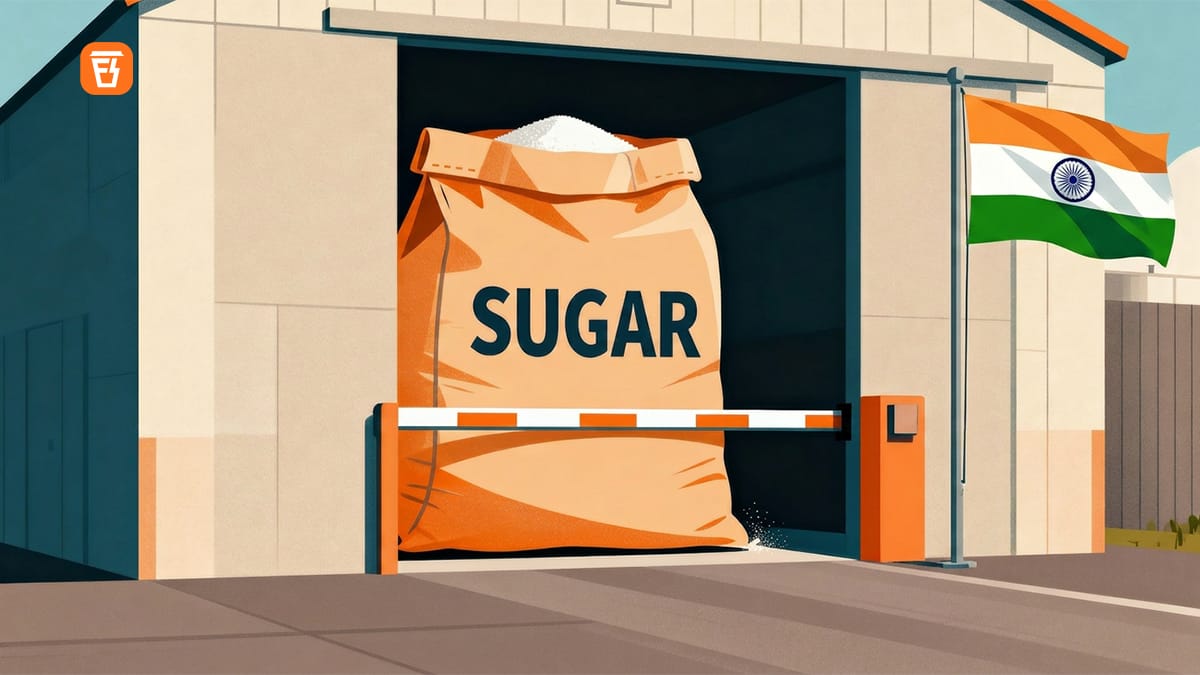
In today’s Finshots, we tell you why the Indian government has paused sugar exports until the end of September and what it could mean for the economy.
But here’s a quick sidenote before we begin. We’re hiring a Content Writer at Ditto Insurance to create high-quality, search-first content that genuinely helps people make better decisions. If you care about strong research, sharp insights, and clear writing, this could be the role for you. Find more details here or share it with someone who’d be a great fit.
Now onto today’s story.
The Story
India is the world’s second-largest sugar producer and exporter after Brazil. So when a country like India suddenly says, “We’re not exporting sugar for now”, it raises eyebrows.
And that’s exactly what happened a few days ago.
The government has paused exports of raw, white, and refined sugar until the end of September, which means that traders can’t send sugar abroad for now. There are a few exceptions though. Sugar exports promised earlier to the US and the EU can continue, shipments already being loaded or cleared before the announcement can still go ahead, and exports requested by foreign governments for food security reasons are also allowed.
If you’re wondering why, just understand that India doesn’t feel as comfortable about its sugar stockpile right now.
For context, India’s sugar production for the 2025–26 sugar season (which runs from October to September) is expected to touch 283 lakh tonnes. That’s actually 11% higher than last season’s 254 lakh tonnes.
But the problem is that it’s still 4% lower than what the government had expected earlier.
You could blame the unseasonal showers in October 2025 that triggered flowering in sugarcane crops in Maharashtra and Karnataka. This essentially lowers sugar recovery rates, meaning you get less sugar from the same crop. Add to that disruptions in fertiliser supplies caused by the West Asia crisis, and suddenly production estimates began looking weaker than expected.
That also affects the closing stock of sugar we have left until the next sugarcane crushing season begins, which is expected to be around 4 million tonnes. That’s roughly equal to 1.5 months of consumption. And while that may not sound alarming, it’s still the lowest closing stock in nine years. Besides, India’s five-year average buffer stock has typically been enough to cover around 2.5 months of demand.
So from the government’s perspective, this level may simply feel too close for comfort.
And when governments feel supply could tighten, they usually prefer caution. Instead of letting sugar flow overseas, they’d rather preserve a buffer for domestic consumption.
The other thing is that sugarcane is also used to make ethanol, which India blends into fuel. Now we know that some people, especially those with older vehicles, have experienced reduced fuel economy or compatibility issues because of ethanol-blended fuel (P.S. The government says there’s no evidence to back this up). But for the government, ethanol is an easy way to rely less on imported oil. And with oil prices climbing due to the West Asia crisis, that has become even more important. Because if India exports too much sugar and later finds itself short on ethanol feedstock, it may have to buy more fuel from abroad, adding pressure to costs.
So in many ways, this temporary export ban looks like the government trying to avoid multiple fresh bouts of inflation at a time when fuel, fertiliser, and food prices already feel uncertain.
And that logic makes sense for two big reasons.
First, for industries that use sugar as a raw material, like FMCG companies, beverage makers, confectionery brands, and even pharmaceutical firms, this move could help prevent a sharp rise in costs. Especially with the festival season a few months away, when sugar demand typically shoots up.
But there’s another reason too. India’s sugar exports were already becoming a bad deal.
Yup, you read that right. You see, Indian sugar mills sell sugar domestically at prices shaped partly by government policy and partly by market conditions. So for exports to make sense, they need to earn enough overseas to at least match what they would make selling sugar at home. By some estimates, they needed to earn 17 cents per pound on raw sugar exports just to break even.
But global markets had other plans. Brazil had already flooded the market with supply, enough to keep prices low. So on average, Indian mills were effectively losing around 3 cents per pound, or nearly $66 per tonne globally on raw sugar.
Even if you look at refined or white sugar, where India has traditionally done better, especially in nearby countries like Sri Lanka, Somalia, Djibouti, and Afghanistan that depend on imported finished sugar, export margins had become quite thin.
So you could say that the government was effectively just hitting pause on something that wasn’t really working out anyway.
The proof is in the pudding. By the time the ban was announced, many mills had already stopped chasing fresh export contracts because the economics no longer added up. If exports were profitable, India would probably have shipped close to the 20 lakh tonnes the government had permitted for the 2025–26 season. Instead, actual exports stood at only around 7.5–8 lakh tonnes, much of which had already been shipped or was already in the pipeline.
So yeah, from the government’s perspective, this looked like hitting two birds with one stone.
But there’s a catch. Hitting pause on sugar exports can create a fresh problem for the sugar industry itself because here’s the thing. When exports stop, more sugar stays within India than expected. And basic economics tells us that when supply rises, prices tend to fall.
Now imagine being a sugar mill that was hoping export prices would improve or was counting on export orders to support revenues. Suddenly, that option disappears. And when revenues get squeezed, mills can run into cash flow problems. And when that happens, one of the first things to suffer is payments to sugarcane farmers. Delays become more common.
Now, this isn’t exactly a new problem. Sugar mills in India have a long history of delaying payments to farmers, creating what are called cane arrears or unpaid dues that sometimes pile up for months. In fact, these arrears have touched a whopping ₹16,087 crore as of February 2026, nearly 32 times higher than in 2024–25! So if export restrictions squeeze mill revenues again, the fear of more and bigger delays becomes very real for farmers.
Take Maharashtra, for instance. Mills there still reportedly had 30–40% of their export quotas left unused when the ban kicked in. But those exports are now effectively frozen, creating a cash flow problem at a particularly bad time.
And when farmers worry about delayed payments, they often start looking for alternatives.
One such alternative is jaggery. Instead of sending sugarcane to mills, farmers may divert it to make jaggery either themselves or through nearby local processors because it often fetches quicker payments and sometimes even better returns.
That’s because jaggery is much simpler to make than refined sugar. You crush sugarcane, boil the juice, and let it solidify into blocks or powder. You don’t need a large industrial refining process or chemicals. Just basic equipment like a crusher and a large iron pan over a fire.
More importantly, jaggery traders often pay farmers immediately or within days. Sugar mills, on the other hand, are legally supposed to pay farmers within 14 days of receiving cane. But when mills face cash problems, that timeline can stretch.
In some cases, jaggery can also be more profitable. For instance, estimates from Karnataka suggest farmers could earn about ₹3,450 per tonne after expenses, compared to roughly ₹2,850 per tonne from sugar mills.
So, if more farmers begin diverting cane towards jaggery production, sugar mills get less cane to crush into sugar and ethanol. That means lower sugar output and weaker ethanol production in the next season.
And suddenly, we’re back to square one. The government may once again face the same dilemma of whether it should make do with thinner sugar buffers or hit pause on exports all over again.
That kind of becomes a vicious cycle — one India has seen before, with repeated export restrictions whenever output weakens or supply concerns rise.
The real saviour could simply be a timely and favourable monsoon next season. Because without that, someone always ends up paying the price, whether it’s sugar mills, farmers, or consumers dealing with inflation.
Until then…
Liked this story? Share it with a friend, family member or even strangers on WhatsApp, LinkedIn, or X.
Message to all the Breadwinners
You work hard, you provide, and make sacrifices so your family can live comfortably. But imagine when you're not around. Would your family be okay financially? That’s the peace of mind term insurance brings. If you want to learn more, book a FREE consultation with a Ditto advisor today.