
The India-UK FTA just hit a steel wall
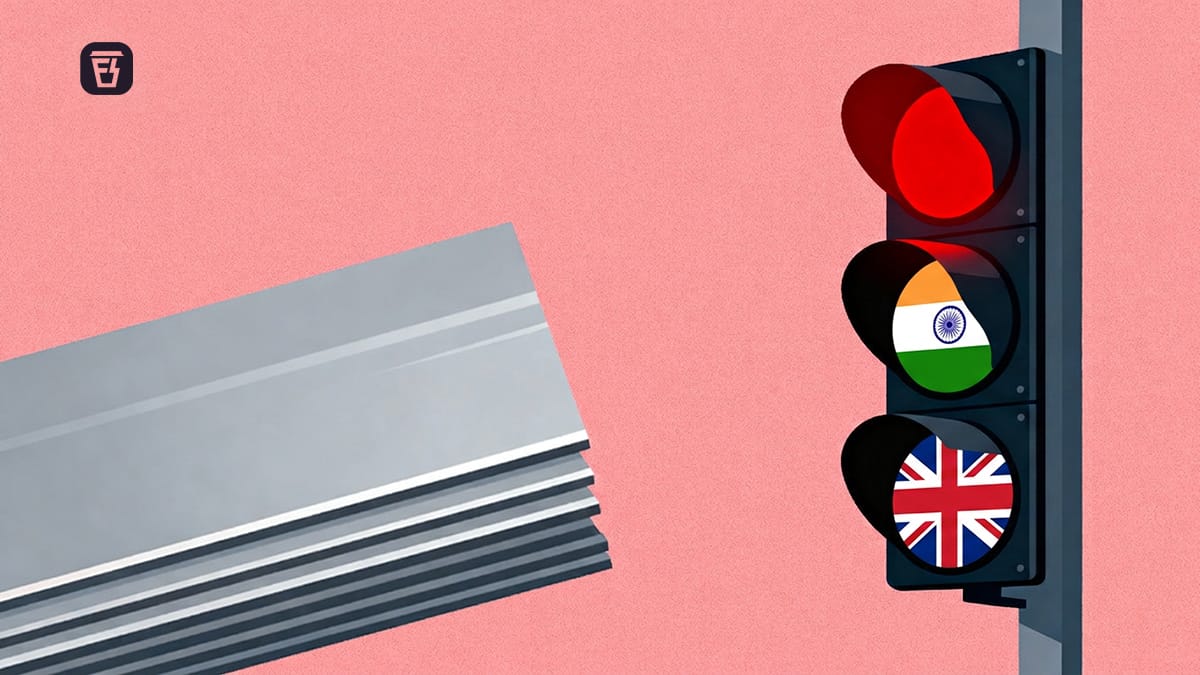
In today’s Finshots, we tell you why steel is complicating the India-UK free trade agreement.
Before we begin, if you're someone who loves to keep tabs on what's happening in the world of business and finance, then hit subscribe if you haven't already. We strip stories off the jargon and deliver crisp financial insights straight to your inbox. Just one mail every morning. Promise!
If you’re already a subscriber or you’re reading this on the app, you can just go ahead and read the story.
The Story
Last year, when US President Donald Trump’s tariff wars sent a shock to everyone, countries were scrambling for secure trade agreements wherever they could.
The logic is simple. If the world is becoming more protectionist, having trusted trading partners becomes far more valuable.
Which is partly why India and the UK finally pushed through their long-negotiated free trade agreement in 2025. For the UK, it was another major post-Brexit partnership. For India, it was a chance to deepen access to a large developed market while expanding its global trade footprint.
The deal promised easier market access across sectors ranging from automobiles and textiles to whisky, pharmaceuticals and professional services. It was a landmark trade deal that would push bilateral trade to $120 billion by 2030, up from around $57 billion today.
On paper, the agreement looked like it would increase trade and strengthen economic ties.
But trade, as it turns out, rarely stays on paper for long.
Less than a year after the ink dried, one commodity is threatening to unravel the goodwill the deal was built on. We’re talking about steel.
As of July 1, 2026, the UK is rolling out a new set of steel safeguard measures. It’s slashing tariff-free import quotas by 60% and slapping a 50% tariff on any volumes above that threshold. Which means that this is a gut punch for India, whose steel exports to the UK had been steadily growing. And the market the FTA was supposed to open wider is suddenly seeing the door slammed shut.
To be fair, the UK’s steel safeguards aren’t new and were in place even before this.
These measures were introduced years ago as temporary protections against sudden rises in imports. Under the older system, countries could export a certain quantity of steel into the UK tariff-free. Any volumes above that quota faced a 25% tariff.
But the new framework is far tougher.
So what happened? And how did a landmark trade agreement between two willing partners run into a steel wall barely a year in?
To understand why steel is important enough to pause a multi-billion dollar trade deal, it helps to look at it from the ground level.
Picture one sheet of steel. On its own, it looks simple, grey, metallic and unremarkable. But to an industrialist, an economist or even the leaders of two major countries, that single sheet represents much more. It could become the next pillar holding up an industrial park. Or the body of the next car rolling off an assembly line. Or even a wartime asset used to make artillery shells, tanks or military equipment.
Steel sits quietly beneath modern economies. Which is exactly why countries become extremely sensitive when global markets around it begin to break.
And that sensitivity has only grown over the past few years.
According to the Organisation for Economic Co-operation and Development (OECD), global steelmaking capacity is expected to hit 2.55 billion metric tonnes. That is the fastest expansion since 2009. But demand hasn’t kept pace. In fact, surplus capacity alone was estimated at nearly 680 million tonnes in 2025.
Much of that excess sits in China. See, China built its steel industry to feed one of the greatest construction booms in history ― factories, highways, railways, apartment buildings. For decades, the country consumed steel at a pace the world had never seen. So Chinese steelmakers built capacity to match. Then the boom ended.
China's real estate market collapsed. Construction slowed dramatically. The demand that had justified all that capacity simply wasn't there anymore. But here's the thing about steel mills — you can't just switch them off. The costs of keeping them running are often lower than the costs of shutting down. So the mills kept going, producing steel that China no longer needed.
That steel had to go somewhere. And in 2025, it went everywhere. China exported a record 119 million metric tonnes of steel. At prices so low that steelmakers in Europe, the UK, and across Asia couldn't come close to competing. The Chinese government was subsidising them so heavily that market logic simply didn't apply.
So when millions of tonnes of cheaper steel start flooding global markets, governments everywhere begin worrying about the same thing: What happens to their steel industries?
That fear has triggered a domino effect across the global economy.
The US was among the first to tighten tariffs on steel imports again. The European Union followed by strengthening its own safeguard measures, worried that steel blocked elsewhere would simply get redirected into European markets instead.
And that’s exactly the problem with global steel oversupply. When one country shuts the door, the excess steel doesn’t disappear. It simply looks for another destination.
The UK now fears becoming one of those destinations.
Especially because Britain’s own steel industry has been under pressure for years. UK steel production has fallen sharply from its historical highs, energy costs remain among the highest in Europe and domestic producers have repeatedly warned that another wave of cheap imports could send parts of the industry closer to collapse.
But there’s another reason this crisis is exploding now specifically.
Under World Trade Organization (WTO) rules, the UK’s earlier steel safeguards legally could not continue beyond June 2026. Because under the rules, emergency safeguard measures are meant to be temporary. That means countries can’t keep extending the same safeguards without justification. Since the UK’s earlier steel protections had already been extended multiple times, Britain eventually needed a replacement framework.
That forced Britain to design an entirely new protection framework from scratch, which ended up being much stricter.
Which means two completely different policy timelines are unfortunately colliding at the exact same time.
On one side sits the rollout of the India-UK free trade agreement — a deal designed to lower barriers and increase trade. On the other sits Britain’s new steel safeguard regime designed to do almost the opposite.
And the consequences of this may stretch far beyond trade itself.
To begin with, green steel. As important as it might be, steel production is responsible for roughly 7-9% of global carbon emissions, making it one of the most polluting industrial sectors in the world. To fix that, companies across Europe and Asia have been investing heavily in “green steel” technologies that produce steel with lower emissions.
But many of those projects are now slowing down. Nearly one-fifth of planned low-carbon steel projects have already been delayed or suspended because cheap steel imports are crushing profit margins and making green investments harder to justify.
In other words, what began as a trade crisis is quietly becoming a climate problem too.
For now, both India and the UK are still trying to find a workaround. One possibility is an India-specific quota within the UK’s new framework that would protect a certain volume of Indian steel exports.
But this does not mean the trade deal itself is falling apart.
Despite the tensions, neither India nor the UK actually wants this dispute to derail the FTA itself. Which is why both sides are still negotiating instead of walking away.
But there’s an irony worth noting here.
India doesn’t want to be pushed out of a market where it has been steadily growing. But at the same time, it’s also rapidly expanding its own steel production capacity.
We want to produce 300 million tonnes of steel a year by 2030 from 160 million tonnes today. Which means India too will eventually need large export markets to sell all that steel.
In other words, the same pressures around excess steel exports and market flooding that India and the world is struggling against today could someday become pressures it creates for other countries tomorrow.
So yeah, even if countries want free trade, when strategic industries like steel are involved, protectionism rarely takes a back seat even in trade deals that promise openness.
Until next time…
If this story helped you understand why steel is complicating the India-UK FTA, share it with a friend, family member or even strangers on WhatsApp, LinkedIn and X.
How Strong Is Your Financial Plan?
You've likely ticked off mutual funds, savings, and maybe even a side hustle. But if Life Insurance isn't a part of it, your financial pyramid isn't as secure as you think.
Life insurance is the crucial base that holds all your wealth together. It ensures that your family stays financially protected when something unpredictable happens.
If you’re unsure where to begin, Ditto's IRDAI-Certified insurance advisors can help. Book a FREE 30-minute consultation and get honest, unbiased advice. No spam, no pressure.