
How is SpiceJet still surviving?
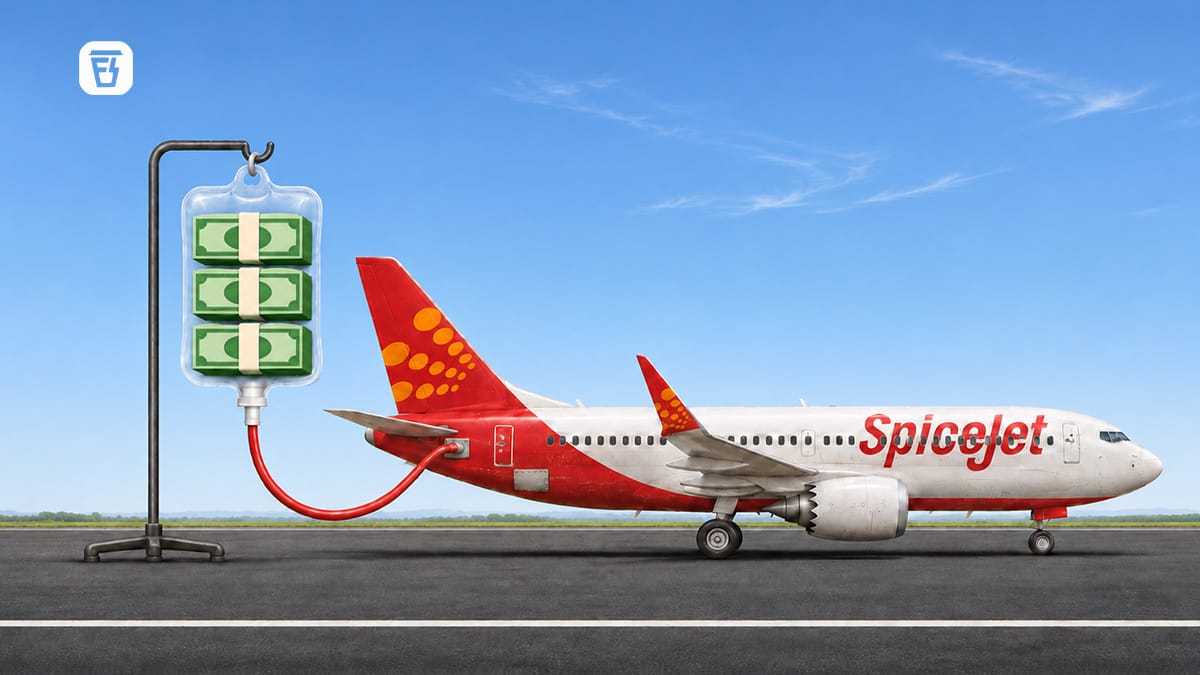
In today's Finshots, we look at how SpiceJet continues to operate despite a shrinking fleet and why creditors settle rather than force insolvency.
But here's a quick side note before we begin. If people depend on your income, you need to read this.
Most first-time earners skip insurance entirely or buy the wrong thing because someone sold it to them. Both are expensive mistakes.
Our free 2-day Insurance Masterclass will help you figure out what to buy, how much cover you need, and how to avoid common mistakes.
📅 Saturday, 28th November at 10 AM: Life Insurance
📅 Sunday, 29th November at 11 AM: Health Insurance
👉 Click here to reserve your spot today.
Now, onto today's story.
The Story
India's aviation industry is preparing for a remarkable expansion. The government expects passenger traffic to grow sixfold to around 1.1 billion by 2040, creating room for more airlines, aircraft and better connectivity across the country.
Yet, one airline seems to be moving in the opposite direction. And if you haven’t guessed it already, it’s the infamous airline with red and orange livery that is struggling. And it's not Air India. Since our title gave it away, you obviously know it’s SpiceJet.
Its domestic market share peaked at about 21% in July 2014. By September 2026, it had fallen to just 0.6%. The airline carried roughly 73,000 domestic passengers that month, compared with nearly 5.9 lakh in just January this year.
That contrast makes SpiceJet's story particularly interesting because the airline has survived several financial crises, the Boeing 737 Max grounding (which was about a fifth of its fleet at the time), raised thousands of crores, negotiated with aircraft lessors and repeatedly promised to rebuild its fleet.
For a brief moment, the numbers appeared to suggest that a turnaround was underway. SpiceJet reported a standalone net profit of ₹58 crore for FY25, and its net worth turned positive at ₹683 crore as of March 31, 2025.
However, that improvement was largely an accounting reprieve. The airline still recorded an operating loss of around ₹470 crore in FY25. Its accumulated losses were still substantial, and auditors continued to flag “material uncertainty” about its ability to operate as a going concern.
Sidebar: “Going concern” is an accounting principle assuming a business will keep operating in the foreseeable future without liquidating or significantly downsizing.
So how does an airline with a shrinking fleet and mounting unpaid bills keep running?
Well, the answer may be simpler than we think. But first, let’s understand where SpiceJet keeps getting money from, considering it has been loss-making for several years.
In September 2024, the company raised a ₹3,000 crore QIP. A QIP, or Qualified Institutional Placement, allows a listed company to raise money by issuing fresh shares or securities to large institutional investors such as mutual funds, banks and insurance companies. This was supposed to give the airline enough financial breathing room to restore its operations. But by March 2025, it had already used around ₹2,699 crore of the proceeds.
This money went toward a range of obligations, including statutory dues, creditor settlements, airport charges, employee-related payments, aircraft maintenance, and ungrounding its fleet. The company also reallocated ₹300 crore originally earmarked for new fleet induction, shifting ₹150 crore to general corporate purposes and another ₹150 crore to settle more outstanding creditors.
But who exactly are these creditors?
Well, they include aircraft lessors such as Carlyle Aviation, Aircastle and Genesis, which lease planes and engines to SpiceJet, as well as airport operators, ground handlers, smaller suppliers and banks.
In fact, between April and September 2026, the airline owed small businesses ₹123 crore, of which ₹63 crore remained unpaid for more than 45 days. Some of its disputes with lessors have also involved sizeable sums. Carlyle Aviation, for instance, agreed to restructure around $90 million (₹830 crore) in lease arrears through a combination of write-offs, convertible debentures, and equity. Aircastle and Genesis have settled with similar arrangements too.
And this borrowing and settling creates a vicious cycle. Without enough operational aircraft, SpiceJet cannot generate the revenue needed to pay its suppliers, lessors, and employees on time. When payments are delayed, service providers become reluctant to extend credit and more aircraft risk remaining grounded. The airline then needs another round of funding just to keep its existing operations going.
Which is exactly what happened last week. SpiceJet's board approved raising up to ₹5,500 crore through instruments that could include equity shares, debt and convertible instruments. It also approved a proposal to increase its authorised share capital (the maximum share capital that it can legally raise) from ₹2,000 crore to ₹7,500 crore, subject to shareholder and regulatory approvals.
Now, there is no guarantee that they will raise the money. But makes you ask, why do creditors keep agreeing to settlements instead of pushing SpiceJet into insolvency?
At first glance, these settlements can look like votes of confidence in the airline's future. But there is another, more practical explanation.
Creditors could believe that negotiating with SpiceJet offers a better chance of recovering some of their money rather than taking the company through a lengthy insolvency process.
To understand why, consider how India's Insolvency and Bankruptcy Code distributes money when a company is liquidated. Insolvency costs are paid first, followed by certain workmen's dues and secured creditors who relinquish their security. Employee dues and unsecured financial creditors come next, followed by government dues and secured creditors. Other debts, which can include claims from ordinary creditors such as suppliers and service providers, rank lower in the hierarchy.
This means that a creditor's recovery depends on where its claim sits in this payment waterfall and how much value remains in the company after the higher-ranking claims are settled. Aircraft lessors can also have contractual and repossession rights that make their position different from that of an ordinary unsecured supplier.
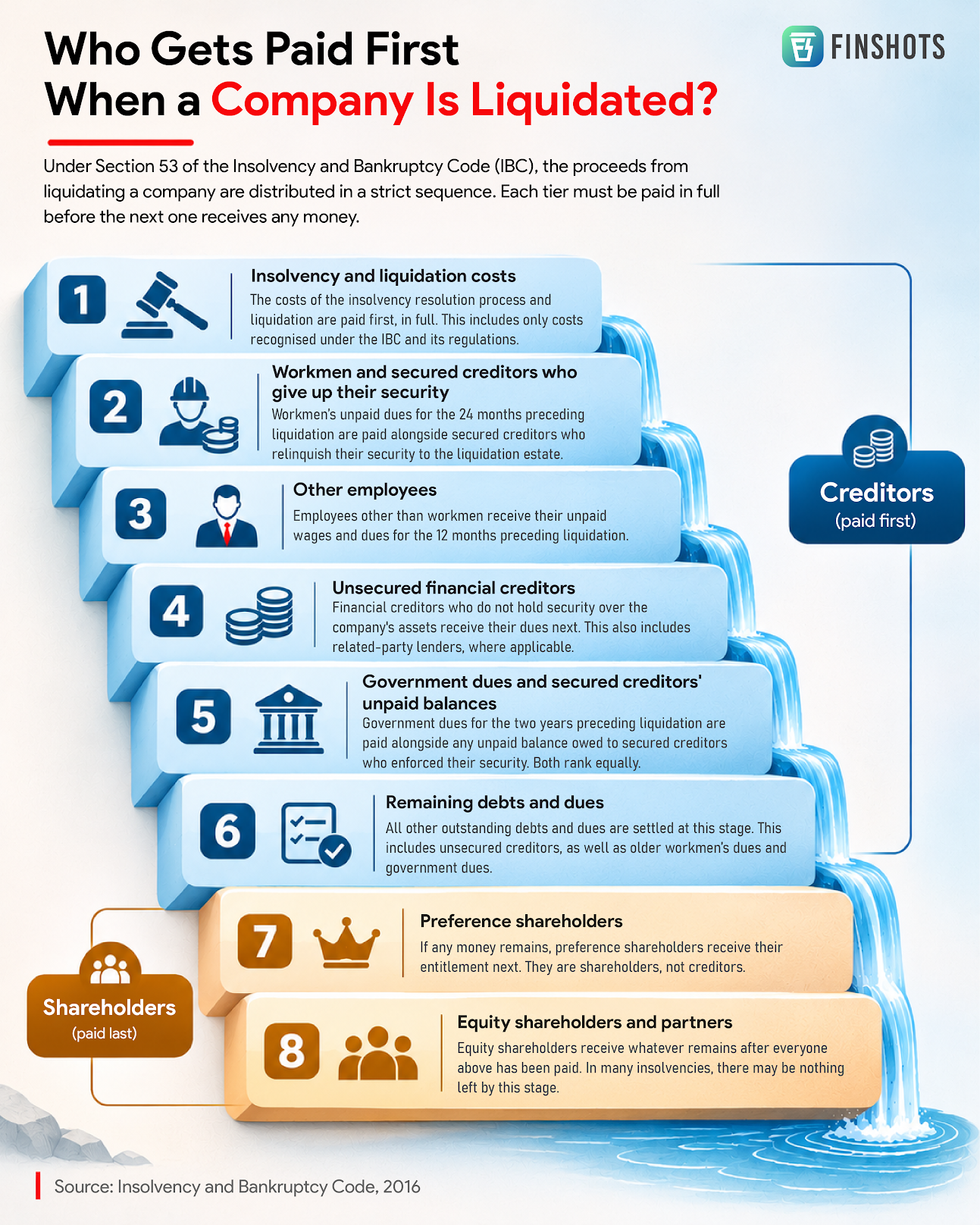
So, not every creditor faces the same outcome in insolvency. But the broader incentive remains that a negotiated settlement can be more attractive than taking the risk of recovering very little after a long insolvency process.
The proposed fundraise could also create room for debt-to-equity conversions with creditors, but as we’ve mentioned before, equityholders get paid last. And that revival depends on getting more planes back in the air and running flights reliably.
After all, creditors may agree to wait for their money. Passengers waiting for a flight might be less forgiving. Which brings us to the airline’s operational problems that are becoming increasingly difficult to hide.
In November 2026, the DGCA issued SpiceJet a show-cause notice over repeated flight delays and cancellations, and the large number of grounded aircraft. The regulator also raised concerns about uncertainty around mandatory insurance renewal and the airline's failure to submit a credible plan to return grounded aircraft to service.
This shows that SpiceJet's difficulties are no longer confined to its finances. They are affecting its ability to deliver the service it is obligated to provide safely.
And that brings us to the role of the regulator. India has already seen Jet Airways and Go First collapse, leaving passengers, employees, lenders and lessors to deal with the consequences. SpiceJet's disappearance would further concentrate an already consolidated aviation market, where the duopoly, IndiGo and the Air India group account for the overwhelming majority of domestic traffic.
So, there you have it, folks. This is probably why SpiceJet has survived so far.
The real question now is whether another round of financial engineering can finally reverse the airline's demise. After all, without the next round of funding, they may be sure to go down, and with it, there’s a small sliver of possibility that they live to fly another day.
Until then…
If you liked this story about how SpiceJet is still in the air, feel free to share it with your friends, family, or even strangers on WhatsApp, LinkedIn, or X.
And if you’re someone who loves keeping tabs on the world of business and finance, hit subscribe if you haven’t already. And if you’re already a subscriber, thank you! Maybe forward this to someone who’d enjoy our stories but hasn’t discovered us yet.