
Why would a country ask to stay least developed?
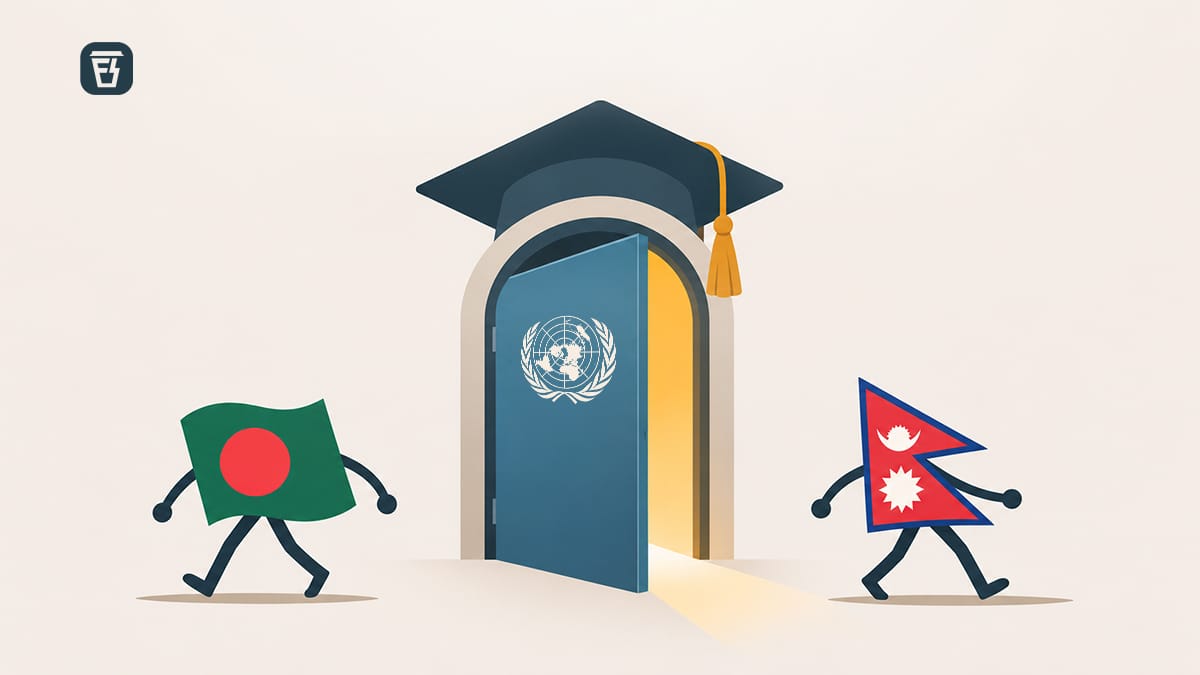
In today’s Finshots, we explain why the United Nations agreed to extend the deadline for Bangladesh and Nepal to give up their least developed country status.
But here’s a quick sidenote before we begin. Ask anyone about insurance and they’ll tell you about their health plan. Almost nobody mentions term.
Health insurance protects you during a medical emergency. Term insurance protects your family’s entire financial future if you're no longer around. One covers a hospital bill. The other replaces your income for years.
Both matter. And surprisingly, one of them costs far less than you’d think.
Our free 2-day Insurance Masterclass will help you figure out what to buy, how much cover you need, and how to avoid common mistakes.
📅 Saturday, 28th November at 10 AM: Life Insurance
📅 Sunday, 29th November at 11 AM: Health Insurance
👉🏽 Click here to reserve your spot today.
Now on to today’s story.
The Story
Imagine a country being told that it has made enough progress not to be labelled poor any more. It should be good news, right?
But Bangladesh and Nepal have a slightly different view of this milestone. Both were scheduled to leave the United Nations’ (UN’s) list of least developed countries (LDC) this week. But instead of celebrating the achievement, they asked the UN for more time. And on October 29th, the UN General Assembly agreed to give it to them. They got another three years, which means that now they’re officially scheduled to exit this list in November 2029.
Which begs the question, why would countries want to hold on to a label that essentially describes them as economically disadvantaged?
To understand this, we first need to look at what the LDC category actually means.
The UN created it in 1971 to recognise countries that face development challenges. And it isn’t simply a list of countries with low incomes. The UN looks at three things before deciding whether a country belongs here.
The first is Gross National Income (GNI) per capita, or the average income earned by a country’s residents and businesses. The second is human assets, which looks at things such as improvements in health, nutrition, education and literacy. And the third is economic and environmental vulnerability, which measures how exposed a country is to external shocks such as natural disasters and unstable exports.
If a country crosses a GNI per capita threshold of $1,306, has a Human Assets Index of 66 or above, and an Economic and Environmental Vulnerability Index of 32 or less, or even meets any two of these three criteria in two consecutive UN reviews conducted three years apart, it qualifies for something called graduation. That is to say, it has made sufficient economic progress to gradually become less dependent on special assistance from other countries.
Now this doesn’t mean that if a country qualifies, it immediately loses its LDC status. It normally gets some time to make the transition. And so far, since the category was created, only nine countries including Botswana, the Maldives and Bhutan have graduated from this list.
But the thing about being an LDC is that it comes with certain economic advantages. One of the biggest ones is preferential access to international markets. When a country exports goods to another country, the importer may charge a duty or tariff on them, increasing their final cost. But many developed countries offer LDCs lower or even zero tariffs on certain exports, making their products cheaper and more competitive.
LDCs also receive certain benefits in the form of aid and special treatment under international trade rules. So graduating means gradually losing some of these advantages.
You could look at Bangladesh to begin with. The country has built a large export industry around ready-made garments. Clothing accounts for roughly 80% of its merchandise exports, making it one of the world’s biggest garment exporters. And a large part of this business depends on preferential access to markets such as the European Union (EU).
In fact, estimates suggest that around 73% of its exports benefit from LDC-specific preferences. So once these benefits disappear, exporters could face higher tariffs, averaging 12.5%, which could translate into a potential annual loss of more than $17.5 billion.
There’s a reason this is worrying. Take a European retailer placing an order for shirts. If buying from Bangladesh suddenly becomes more expensive because of higher import duties, the retailer could simply shift the order to another country, even if the tariff difference is small.
Nepal’s situation is somewhat different. More than two-thirds of its exports go to India. And thanks to a bilateral trade treaty, these exports don’t depend on Nepal retaining its LDC status. So the impact of graduation on its trade with India, you could say, is limited. If we were to put a number to it, the potential export losses in the EU could account for less than 5% of Nepal’s total exports.
But that doesn’t mean Nepal has nothing to worry about. It still risks losing preferential access to some other markets and other forms of international support.
And both countries have another problem. Their economies may have qualified for graduation, but their ability to absorb the resulting shocks remains questionable.
For instance, Bangladesh’s government revenue is only around 6.8% of its GDP. Meaning there’s very little money left to invest in infrastructure and public services. Interest payments also consume a large share of its tax collections. And its banking sector is weighed down by bad loans. Even business investment appears to have weakened. Capital goods imports, which include plant, machinery and equipment imported from other countries to produce goods or provide services locally, and are often used as a proxy for investment, fell from $5.1 billion in 2019 to $2.8 billion in 2024.
Nepal, meanwhile, is dealing with a different set of issues. Remittances account for roughly a third of its GDP, which means its economy depends heavily on money sent home by citizens working abroad. So any disruption to employment or economic activity in countries where Nepalis work, particularly in the Gulf, can affect household incomes and domestic spending back home.
By the Asian Development Bank’s estimates, Nepal’s economy grew by just 3.9% in FY26, down from 4.4% the previous year. Then you also have political unrest caused by the Gen Z protests, the conflict in West Asia and weather-related disruptions, which added to the pressure.
All of this explains why, while both countries have technically qualified for graduation, their governments argue that they don’t want to graduate just yet.
But before you are convinced that it’s a fair argument, wait until you hear the other side of it because neither country is asking for more time for the first time. Bangladesh had already received an extended five-year preparatory period because of the pandemic. And Nepal had previously secured an extension after the devastating 2015 earthquake.
Yet, despite the extra time, both countries still have considerable work left to do.
Bangladesh has signed a couple of trade agreements with Japan and South Korea to get duty-free market access for its exports. But these haven’t yet come into force. Its strategy to transition towards graduation has also faced criticism for slow implementation and poor coordination between government departments. Nepal, on the other hand, has barely begun implementing its transition strategy. It has also struggled to negotiate alternative trade arrangements with important partners such as China, the US and Japan.
This raises another fair question. Are these countries genuinely unprepared, or are they becoming too comfortable with the benefits of remaining LDCs?
Well, it’s hard to dismiss the possibility entirely because exporters have an obvious reason to lobby for more time when their businesses benefit from lower tariffs. Governments, too, may find it easier to postpone difficult reforms involving taxation, banking and infrastructure than to undertake them.
But it would be unfair to say that they’ve made absolutely no effort at all. Bangladesh has made substantial progress and was the only country to meet all three graduation criteria in the UN’s 2018 and 2021 reviews. Nepal, too, has consistently met the human assets and vulnerability criteria, and later the income criterion in 2025.
So rather than saying that these countries haven’t developed, the problem seems to be that their economies haven’t become resilient enough to comfortably absorb the loss of international support. Besides, both countries have far larger populations than any of the countries that have graduated so far, which makes the transition even more challenging.
And that’s what the next three years should be about. Bangladesh, in particular, needs to protect its export competitiveness by not just bringing its existing trade agreements into force, but also negotiating new ones and diversifying beyond garments.
Nepal needs to improve how effectively it spends its capital budget, particularly on roads and other infrastructure. It can also strengthen its electricity exports to India, where demand for hydropower offers an opportunity to earn foreign exchange without depending on preferential tariffs.
Because ultimately, the LDC label was created to help countries overcome structural disadvantages, not to give them a permanent economic cushion. So both countries would benefit if they treat this three-year extension as a deadline for reform, rather than another opportunity to postpone it.
The test, then, is simple. Will Bangladesh and Nepal be able to make their economies less dependent on the crutches of international support and tariff concessions by 2029?
If not, they may come asking for another extension. And by then, the UN may have run out of reasons to say yes.
Until then…
If you liked this story, feel free to share it with your friends, family or even strangers on WhatsApp, LinkedIn or X.
And if you’re someone who loves keeping tabs on the world of business and finance, hit subscribe if you haven’t already. And if you’re already a subscriber, thank you! Maybe forward this to someone who’d enjoy our stories but hasn’t discovered us yet.