
Why is the Indian Railways abandoning Tatkal?
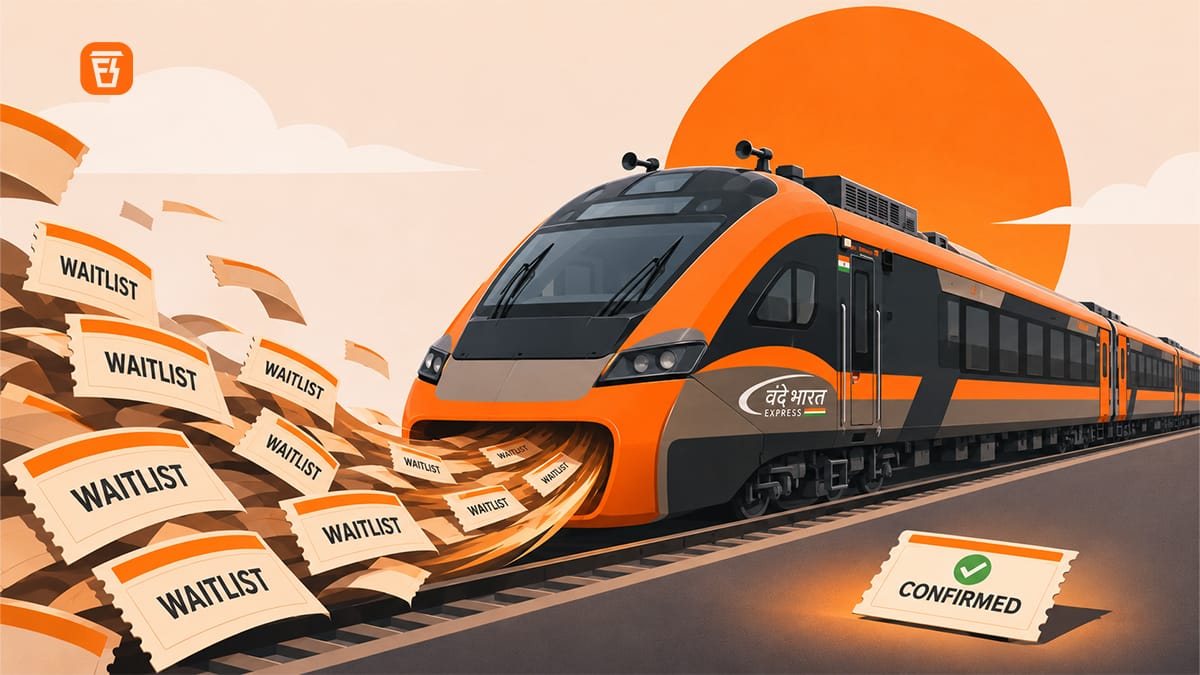
In today's Finshots, we explain why Indian Railways excluded the Tatkal quota from its Vande Bharat Sleeper trains and how they can earn more revenue.
But before we begin, if you love keeping up with the buzz in business and finance, make sure to subscribe and join the Finshots club, loved by over 5 lakh readers.
Already a subscriber or reading this on the app? You’re all set. Go ahead and enjoy the story!
 Love our insights? Add Finshots as a Preferred Source on Google ⭐
The Story
If you’ve ever tried booking a train ticket during Diwali, summer holidays, or a long weekend, you probably know how it usually goes. You open the IRCTC app or website, hoping to find a seat, only to discover that the train is already full. You then try your luck under Tatkal, and suddenly the same journey costs considerably more. Sometimes, the fare can even come close to what you would pay for a flight. Naturally, social media fills up with screenshots of expensive train tickets and complaints about Indian Railways charging passengers more, precisely when they need to travel the most.
But here’s the thing. Indian Railways has spent years keeping passenger fares relatively affordable, even though the cost of running trains is considerably higher. For context, in FY25, passenger and other coaching services incurred an operating loss of ₹63,721 crore. Freight services, meanwhile, generated an operating profit of ₹50,505 crore. So, the government uses profits from moving goods to help cover losses from carrying people. This is known as cross-subsidisation, and it has been the norm for several decades.
Which brings us to an interesting decision. The Indian Railways' new premium overnight service, the Vande Bharat Sleeper, does not have a separate Tatkal quota. Instead, its berths are available under the general reservation quota from the beginning. The service has also done away with the Reservation Against Cancellation, or RAC.
At first glance, this seems counterintuitive. If passenger operations are already making losses, why would Indian Railways give up an opportunity to charge more from people booking at the last minute?
After all, Tatkal tickets bring in additional revenue. And if there is one service where passengers might be willing to pay a premium, surely it is a modern, air-conditioned overnight train. Right?
Well, the answer becomes clearer when you look at what happened the last time Indian Railways tried to make its premium trains earn more through dynamic pricing.
There are two systems worth distinguishing here, because they are often confused.
The first is Tatkal, which is a separate reservation quota that opens shortly before a train's departure. Passengers pay an additional charge to secure a ticket at short notice.
Flexi-Fare, on the other hand, was Indian Railways' attempt to introduce dynamic pricing. This was launched in September 2016 on Rajdhani, Shatabdi and Duronto trains. This simply increased fares as more seats were booked.
But the results were not quite what Railways had hoped for. In a 2018 audit, the Comptroller and Auditor General (CAG) found that Flexi-Fare had affected occupancy in some premium trains. In AC 3-tier, for instance, the proportion of vacant berths rose from 0.66% to 4.46% after the scheme was introduced. And the number of passengers travelling on the affected premium trains also fell by 6.75 lakh during the period examined.
The CAG found another issue when it compared fares across 13 air-rail travel sectors. On several overlapping routes, flights became cheaper than premium train tickets once the latter reached the higher Flexi-Fare slabs. That put Railways in a difficult position because passengers were being asked to pay more for a journey that could take considerably longer than a flight. And unlike an airline ticket, paying a higher fare for a waitlisted railway ticket still did not guarantee a confirmed berth.
In effect, dynamic pricing was making some passengers reconsider whether they wanted to travel by train at all.
So, following passenger feedback and the CAG's findings, the Ministry of Railways withdrew the scheme from 15 trains that had average monthly occupancy below 50%. The maximum fare multiplier (or the maximum you can be charged as a multiple of the original ticket price) was also reduced, while discounts of up to 20% were introduced for trains with lower occupancy.
This is particularly relevant for Vande Bharat Sleeper. Because, unlike many conventional trains, it is being positioned as a premium overnight service. Someone planning an overnight journey is effectively deciding whether to spend the night on a train, take a bus, or fly to save time. A predictable fare could therefore be a competitive advantage.
There is a supply-side reason for this decision as well. Vande Bharat Sleeper has 823 berths, of which nearly three-fourths of its berths are concentrated in AC 3-tier.
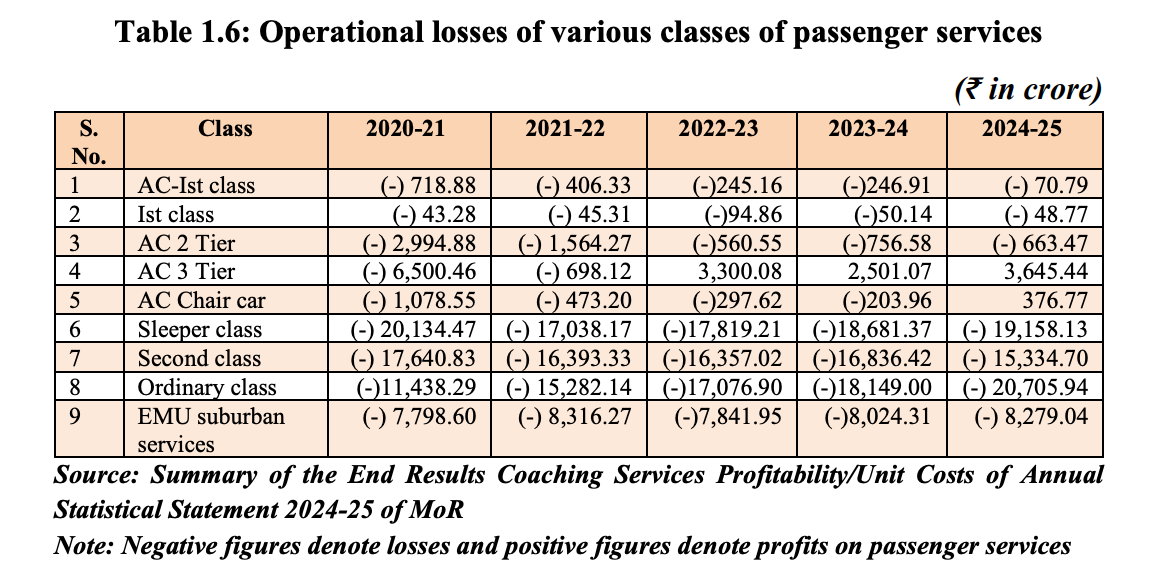
And the reason we’re highlighting this is because AC 3-tier is one of the more important classes for Indian Railways' finances. According to the CAG's 2026 report, AC 3-tier generated an operational surplus of ₹3,645 crore in FY25. Sleeper Class, by comparison, incurred an operational loss of ₹19,158 crore. So, filling those AC 3-tier berths is important because they make money.
This also possibly gives us a clue as to why Vande Bharat Sleeper doesn't have a Tatkal quota. Railways may be giving up the opportunity to collect an additional premium from a passenger booking at the last minute. But it is also trying to make the service more predictable and encourage advance bookings. For a train with hundreds of berths to fill, keeping occupancy high could be more profitable than extracting a little extra from a smaller pool of last-minute passengers.
But what could Indian Railways do beyond filling more berths? After all, there is only a finite number that can be filled.
This is where we look East because Japan, Hong Kong and Singapore offer good examples. Japan Railway East (JR East), one of the operators of the Shinkansen bullet train, has a rather interesting business model. The company does not depend entirely on passenger fares. Rather, it earns money through shopping complexes, station retail, real estate and hotels. In FY25, transportation accounted for roughly 67% of its consolidated operating revenue. Retail and services, real estate and hotels, and other businesses contributed the remaining 33%.
Something similar works in Hong Kong too, albeit with its metro (MTR). Hong Kong understood something many cities ignored for decades. Railways do not just move people. They also create land value.
Under its famous “Rail Plus Property” model, the government grants MTR development rights for land around proposed stations and depots. These rights are priced before the railway arrives, and values jump. The MTR can then partner with private developers to build residential towers, shopping centres, office complexes, and mixed-use districts above or beside stations. Once the metro opens and the area becomes more attractive, the value rises sharply, and MTR captures a meaningful share of that uplift.
So while passengers pay for tickets, tenants in malls and office towers are also helping fund the railway.
And perhaps that is the larger lesson.
A railway does not necessarily make more money by charging passengers more. Sometimes, it just makes more sense to keep fares predictable, fill the berths and look at slightly unconventional sources of revenue.
Until next time…
If you liked this story about Indian Railways' decision to abandon Tatkal, feel free to share this with your friends, family or even strangers on WhatsApp, LinkedIn or X.
A message to all breadwinners
You work hard, you provide, and make sacrifices so your family can live comfortably. But imagine when you're not around. Would your family be okay financially? That’s the peace of mind term insurance brings. If you want to learn more, book a FREE consultation with a Ditto advisor today.