
Why is India distributing free rations if poverty is falling?
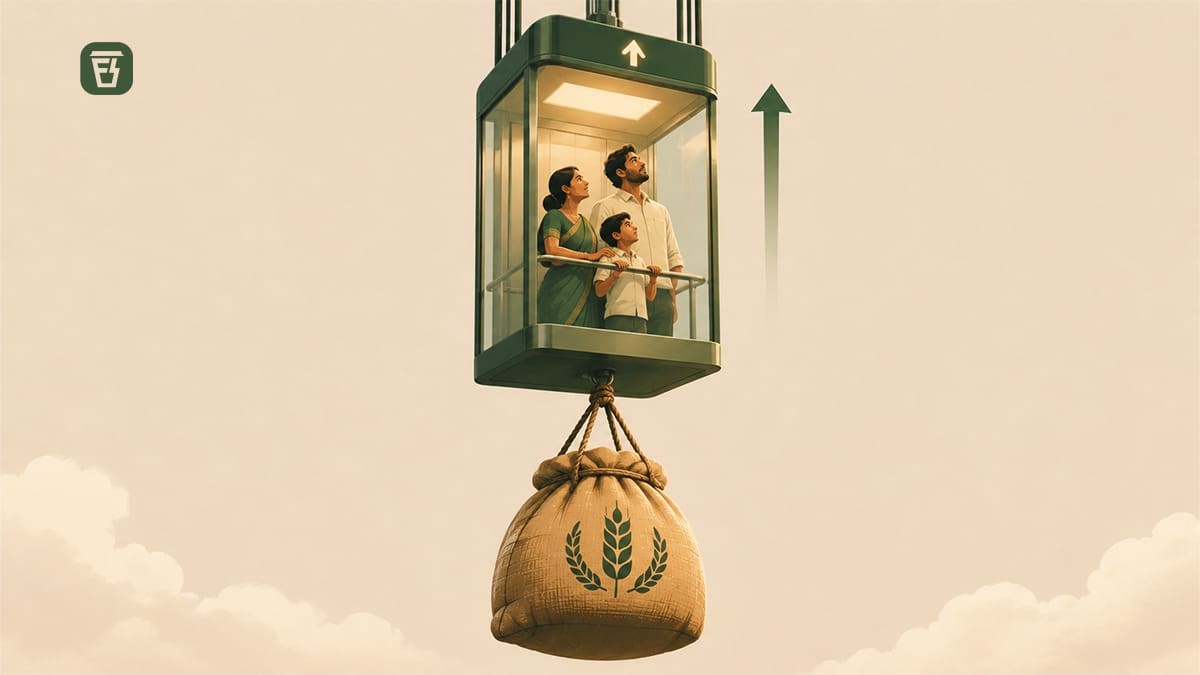
In today’s Finshots, we look at how one of the fastest poverty-reducing countries is burdening an overly broad free-foodgrain distribution programme.
 Love our insights? Add Finshots as a Preferred Source on Google ⭐
The Story
India has made remarkable progress in reducing poverty. And that’s not just us saying it. A recent World Bank report shows that the share of India’s population living in extreme poverty (on less than $3 a day) fell from 27.1% in 2011 to just 2.6% in 2023. The share living on less than $4.2 a day also dropped from 57.7% to 16.1% over the same period. All in all, around 50 crore Indians have come out of poverty. And that’s quite remarkable.
But this got us thinking. If poverty has fallen so sharply over the years, why does India still provide free foodgrains to more than half its population through the Public Distribution System (PDS)?
First, a quick look at how the PDS became a thing in India. It all goes back to colonial times when the British government introduced a formal rationing system in 1939, starting with Bombay (now Mumbai). Thanks to the Second World War that created food shortages and compelled the government to begin distributing fixed quantities of foodgrains through ration shops. This was scrapped after the war.
After Independence, though, India was grappling with rising inflation, which forced the government to bring back rationing in 1950. From then on, it became part of India’s Five-Year Plans and economic development policy.
By the end of the Second Five-Year Plan, the PDS had evolved into a social safety net. It helped households buy foodgrains at affordable prices and prevented traders from artificially pushing up food prices.
The system got another boost in 1965 with the establishment of two important institutions: the Food Corporation of India (FCI) and the Agricultural Prices Commission (now known as the Commission for Agricultural Costs and Prices). They helped the government support farmers by announcing minimum support prices (MSP) for wheat and paddy and procuring foodgrains when market prices fell below these levels.
The government then used these grains to supply ration shops and maintain buffer stocks to deal with shortages. And if domestic stocks weren’t enough to meet demand, it would import additional foodgrains.
And then came the reforms. The PDS was revamped in 1992 and then overhauled in 2013 with the National Food Security Act (NFSA), which turned access to subsidised foodgrains into a legal right. To put that in perspective, the Act requires the government to cover up to 75% of the rural population and 50% of the urban population. Based on the 2011 Census, that’s roughly 81 crore people.
But mind you, these are maximum limits, not a requirement to provide foodgrains to everyone. So the government identifies eligible households within them. And since January 2023, these beneficiaries have been getting their monthly foodgrain entitlements entirely free under the PM Garib Kalyan Anna Yojana. That’s 5 kg per person or 35 kg per household, depending on the category they belong to.
Now, you might wonder why the government covers such a large share of the population. The thinking is simple. It’s better to include a few households that can afford foodgrains than risk leaving out a family that genuinely needs them. Something similar to the criminal justice principle as formulated most famously by English jurist William Blackstone in the 1760s: “It is better that ten guilty persons escape than that one innocent suffer”.
Besides, the World Bank measures poverty based on household consumption during a particular period. But just because a household is above the poverty line today doesn’t mean it will stay there throughout the year.
For instance, a daily-wage worker might earn enough to stay above the poverty line when surveyed. But what happens if they suddenly lose work or face an unexpected medical expense? Their financial situation could change overnight, pushing them back into poverty. Economists call these movements into and out of poverty transient poverty. This uncertainty is another reason the government prefers to keep the ration system broad.
Another thing is that removing families from the scheme, even if they no longer need it, can be politically expensive. A household has to be actively removed from the beneficiary list, and the family that loses its ration is far more likely to protest than the government is to celebrate the savings.
And finally, you also have to remember that distributing free foodgrains gives the government a reliable outlet for the grains it procures from farmers. If the PDS is reduced, the government could end up with excess stocks that are expensive to store. To avoid that, it may have to cut back on procurement. That could hurt farmers, especially in states like Punjab and Haryana, and invite political backlash too.
But keeping the coverage this broad comes with its own problems. It means even households well above the poverty line can continue to benefit from the scheme. We’re talking about families with cars, air conditioners, houses with three or more rooms, or even members of the household employed in government jobs.
A recent government-commissioned survey found that around 13% of people receiving free foodgrains were ineligible. In fact, the figure was over 35% in West Bengal, Tripura and Tamil Nadu.
And this isn’t just about a few families getting free foodgrains when they don’t need them. The cost of this entire exercise is ultimately borne by taxpayers since it’s the Centre that allocates foodgrain stocks to states, which then distribute them to beneficiaries. That’s money that could otherwise go towards infrastructure, employment generation and other development needs (we’ve also written about this earlier here).
So how do we build a cleaner food security system that can adapt over time, you ask?
Well, the first step is to get the population numbers right. And that depends on the Census, which was due in 2021 but has been delayed for years. The enumeration work has only begun now and will take a few more months to complete.
But even with updated population figures, there’s another issue to address. A High Level Committee on Restructuring of FCI, set up in 2015, had recommended reducing NFSA coverage to around 40% of the population because it believed the existing coverage was too broad.
At the same time, it suggested increasing the monthly foodgrain allocation for poor households from 5 kg to 7 kg per person. That’s because, under the earlier targeted PDS, people below the poverty line were entitled to 7 kg per person. The current allocation of 5 kg actually leaves them with less. For context, as of FY23, an average person consumed 9.6 kg of cereals a month in rural areas and 8.1 kg in urban areas. So better targeting, combined with a higher allocation for the poorest, could help them save more on food and spend on other essentials.
This would allow the government to protect the most vulnerable while periodically reviewing whether other households still need the support.
Cash assistance could also complement this system. It would reduce the cost of storing and transporting grain while giving households more choice. But fixed cash payments may lose value when food prices rise, and remote areas may not have reliable markets. That’s why a mix of foodgrains and cash, depending on local conditions, may work better.
Savings from better targeting and procurement could then go towards healthcare, education, nutrition and social security. Because a welfare state shouldn’t just ensure that the needy have enough to eat. It should also help them and others lead better lives by providing access to the infrastructure and development that everyone deserves.
Until then…
If you liked this story, feel free to share it with your friends, family or even strangers on WhatsApp, LinkedIn or X.
And if you’re someone who loves keeping tabs on the world of business and finance, hit subscribe if you haven’t already. And if you’re already a subscriber, thank you! Maybe forward this to someone who’d enjoy our stories but hasn’t discovered us yet.
Trust Finshots for Finance? You'll love Ditto for insurance.
Built by the same four friends behind Finshots, Ditto is here to make insurance simple. No spam, only honest advice to help people make smart insurance decisions.
✅Backed by Zerodha
✅Rated 4.9 on Google (36,000+ reviews)
✅Over 7 lakh customers advised