
Air India's hard luck
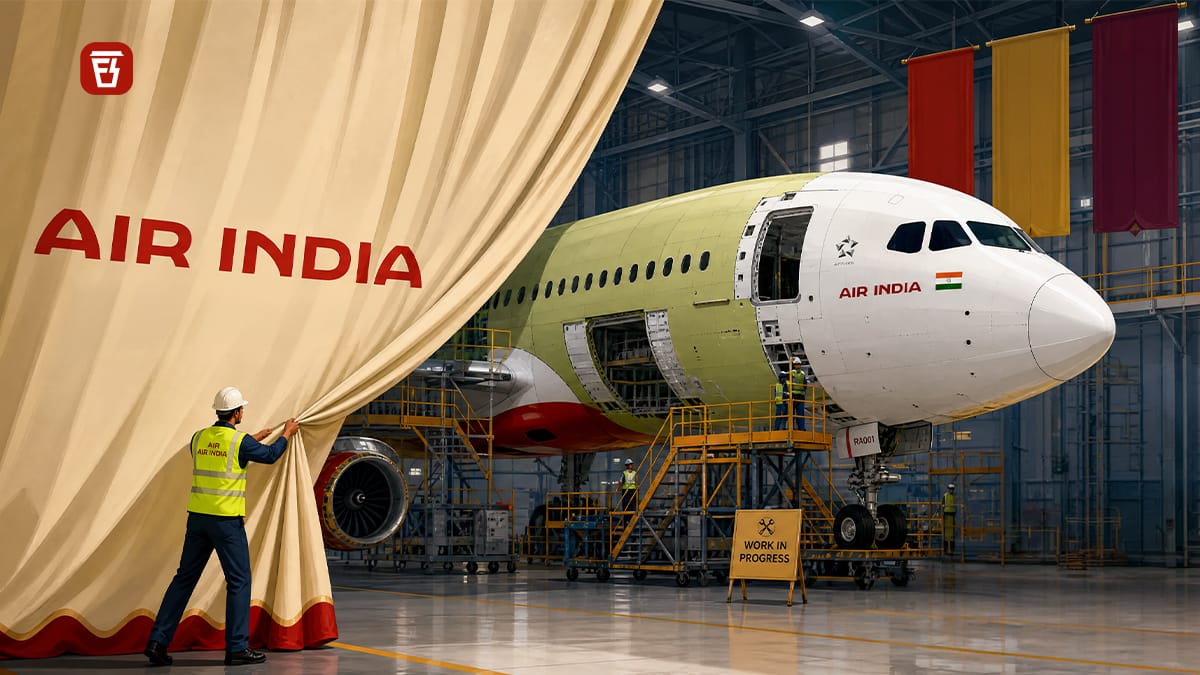
In today’s Finshots, we explain why Air India’s turnaround has taken longer than expected despite having the Tata name behind it.
But here’s a quick sidenote before we begin. We’re looking for a business writer to join Finshots’ newsletter team. If you’re someone who can tell compelling stories and explain financial concepts in plain English without drowning readers in jargon, do consider applying through the link here. Or share this with someone who might be a good fit for the role.
Now onto today’s story.
The Story
27th January, 2022.
That was the day the Tata Group reclaimed Air India from the Indian government, buying back the airline for ₹18,000 crore.
Air India as you know, was JRD Tata’s baby. It was once admired by airlines across the world for its high standards and exceptional service. But in 1953, the government nationalised it under the Air Corporations Act, taking over nine private airlines, much to Tata’s dismay and despite his strong opposition.
His fears, unfortunately, came true.
JRD Tata had warned that the government had no experience running an airline and that nationalisation would bring bureaucracy, low employee morale and poorer passenger service. And over the next seven decades, that’s exactly what happened.
The government eventually handed back a broken Air India to the Tatas. And of the ₹18,000 crore they paid, only about 15% went to the government, while the rest was used to take over the airline’s debt
But the Tatas believed they could revive it. They launched a five-year transformation plan called Vihaan.AI, inspired by the Sanskrit word meaning “the dawn of a new era”. The plan promised to expand Air India’s fleet and network, improve punctuality and customer satisfaction, drive innovation, return the airline to profitability, and capture at least 30% of India’s domestic aviation market.
And Air India wasted little time putting that blueprint into action.
It started with a complete brand makeover, unveiling a new logo while retaining the iconic Maharaja mascot. It then placed a record order for 470 aircraft from Boeing and Airbus, leased and bought more widebody planes to strengthen its long-haul network, and began refurbishing older aircraft with brand-new seats and cabins.
The airline also set about simplifying its business. It brought together Air India, Vistara, Air India Express, and AirAsia India under one umbrella before merging them into two brands — one full-service and one low-cost. It believed that this would create a much stronger airline group with a significant presence across both domestic and international markets.
At the same time, Air India more than doubled its workforce from around 11,000 employees to over 24,000, while also doubling its pilot and cabin crew strength.
Behind the scenes, it overhauled its technology, upgraded its finance and crew management systems, added a new global booking platform, improved revenue management, strengthened training facilities and launched new ancillary products.
And all these efforts slowly began paying off, helping Air India grow its domestic market share to 24% or in other words three times what it was when the Tata Group took it over.
But despite all that, with just six months left before the fifth anniversary of the Tata takeover, Tata Sons Chairman N. Chandrasekaran admitted a few days ago that turning Air India around could take as long as a decade, instead of the five years that Vihaan.AI had originally envisioned.
And honestly, he probably didn’t even have to say it because the numbers tell the story. Air India’s revenue has climbed from ₹19,800 crore at the time of the takeover to ₹70,000 crore in FY26. But that’s still lower than last year’s ₹76,700 crore. More worryingly, its losses have ballooned to ₹22,200 crore, which is more than double last year’s losses and far higher than when the Tatas first took over.
So what’s exactly holding back Air India’s turnaround, even with the Tata Group in the pilot’s seat?
Well, the first thing to remember is that you can’t undo seven decades of mismanagement overnight.
In fact, Vihaan.AI isn’t even the first grand plan to revive Air India. There was the government’s Turnaround and Financial Restructuring Plan, which auditors later found had missed most of its targets. Before that came a government bailout roadmap in 2012, and even earlier, an SBI-backed recovery plan in 2009. Depending on how you count them, Vihaan.AI is the fourth or fifth attempt to revive the airline. So perhaps expecting a world-class airline to emerge in just five years was always a little too optimistic.
And then there’s the aviation business itself. Airlines operate on razor-thin margins, weighed down by high taxes on jet fuel, expensive airport charges, and dollar-denominated aircraft leases and fuel costs, while most of their revenue comes in rupees. A new owner can improve the brand, service and technology, and Tata certainly has. But it can’t, by itself, fix the industry’s economics or an operating environment that has squeezed nearly every full-service Indian airline not named IndiGo.
Besides, Air India’s revival couldn’t have picked a worse time to take off. Almost every major setback that could hurt its business and reputation arrived just as it was trying to get back on its feet.
For starters, aircraft makers like Airbus and Boeing, along with engine suppliers, have continued to grapple with supply chain disruptions long after the pandemic. Deliveries across the industry have been delayed. Even the new seats needed to refresh the ageing interiors of Air India’s Boeing 777 and 787 fleet were held up by one to two years as seat manufacturers struggled with post-pandemic labour shortages.
Then you have the tragedy that’s still fresh in everyone’s mind: the unfortunate crash of Air India Flight AI-171 last year. It happened just as the airline had made meaningful progress, cutting its losses by 61% in FY25 (the fiscal year before the accident) compared to FY24. That threatened to undo the momentum Air India had been building, bringing enormous costs beyond the human tragedy, including compensation, insurance claims, legal proceedings, fleet inspections, and years of painstaking brand rebuilding.
And as if that wasn’t enough, aviation turbine fuel prices surged as the West Asia conflict escalated. Air India’s wide-body international fleet was hit especially hard because flights were already taking longer detours due to the continued closure of Pakistan’s airspace.
And the uncertainty isn’t over yet. Campbell Wilson, the CEO who has led Air India’s transformation since Tata took over, is stepping down by the end of September 2026, with no successor announced so far.
There’s also growing chatter that the Tata Group may be quietly shifting its strategy from “grow at all costs” to “stop bleeding money”.
That’s not us saying it but a Bloomberg report which suggests that the group has asked Air India’s management to focus more on reducing losses than chasing growth. If true, that could mean deferring aircraft deliveries, slowing domestic and international expansion, and cutting costs. Air India is also seemingly in talks with Airbus and Boeing to delay the delivery of hundreds of aircraft.
But there’s also another way to look at it. That this may simply be a slowdown rather than a failure. After all, Vihaan.AI couldn’t have anticipated many of the disruptions that hit the aviation industry after 2022.
As an Economic Times story puts it,
Despite the setbacks, it would be premature to conclude that the turnaround is failing. Air India’s narrow-body fleet refurbishment programme is complete. Wide-body retrofits are underway and expected to continue through FY28. New aircraft continue to enter the fleet and technology systems have been upgraded. Customer satisfaction metrics have improved from the levels seen during the final years of government ownership. Management also argues that several operational indicators are moving in the right direction even if financial performance remains weak.
So yeah, nobody really knows how quickly the next phase of Air India’s revival will unfold.
But perhaps the one positive is that the Tata Group has stopped pretending that rebuilding an airline weakened over seven decades could ever have been achieved in just five years.
Until then…
If this story helped you understand the issues plaguing Air India’s ambitious turnaround, spread the knowledge by sharing it with others who may find it useful on WhatsApp, LinkedIn, and X. Because sharing is caring. 🙂
🚨 ATTENTION: FINSHOTS FAMILY
This weekend, we’re hosting a free 2-day Insurance Masterclass that helps you build real financial security by understanding health and life insurance the right way.

📅 Saturday, 1st August at 11:00 AM: Life Insurance: How to protect your family, choose the right cover amount, and understand what truly matters during a claim.
📅 Sunday, 2nd August at 11:00 AM: Health Insurance: How hospitals process claims, common deductions, the mistakes buyers usually make, and how to choose a policy that won’t disappoint you when you need it most.