
FPE #1: Why economics can explain your love life

In today’s Finshots Pocket Economics (FPE), Edition #1, we’re telling you how economics plays a role when you shop, date, or go job hunting.
But before we begin, here’s a quick recap of what we wrote over the past week. On Monday, we explained why SEBI is overhauling India’s share buyback rules. On Tuesday, we did a story on the strange economics of data centres. On Wednesday, we wrote about why gold worries the Prime Minister. On Thursday, we told you why Royal Enfield set up its first plant outside Tamil Nadu. And on Friday, we broke down how German FMCG giant Henkel AG ending its Pril and Fa licensing deal could affect Jyothy Labs, the makers of Ujala.
With that out of the way, let’s dive into FPE, Edition #1.
Hey folks!
A few months ago, I was browsing the internet looking for a gift for my newborn niece. And in Indian households, any auspicious occasion usually means just one thing for gifts — gold.
Now, gold prices have touched the sky. So naturally, like any rational person trying to find something that looked great while still fitting the budget, I began searching for lower-karat options. It took me two whole days to find something acceptable — a pretty baby bracelet with a fairy on it and her initial, the letter “A”, that could also be personalised, despite it being slightly over budget. Then came the final hurdle: getting approval from the real decision-makers at home, my parents-in-law.
And just when I finally decided to buy it, I realised it was gone. Out of stock. Vanished!
Little did I know that it was probably the last piece available (the website never mentioned it). Which meant that I now had to settle for something I liked less, and do it much faster because I was running out of time.
A few days later, I stumbled upon a podcast that said you could understand the world differently and make better everyday decisions if you simply started thinking like an economist. And that’s where the inspiration for this series came from.
Because, as it turns out, even the gift I eventually settled for could be explained using an economic principle called search theory.
Which made me go, “It’s been a while since we tried something new at Finshots. Why not explain how economic theories quietly shape everyday life and how understanding them could help you make better decisions?”
So, welcome to the very first edition of a new series we’re calling Finshots Pocket Economics. And to kick things off, we’re talking about search theory, that funnily enough, can also explain your love life and dating scene.
Wait… what?
Yup. Economists may have something to say about why you keep swiping left, swiping right, or wondering if you should settle down with the person you’re already with. We’ll come back to that a little later.
But before we get there, what exactly is search theory?
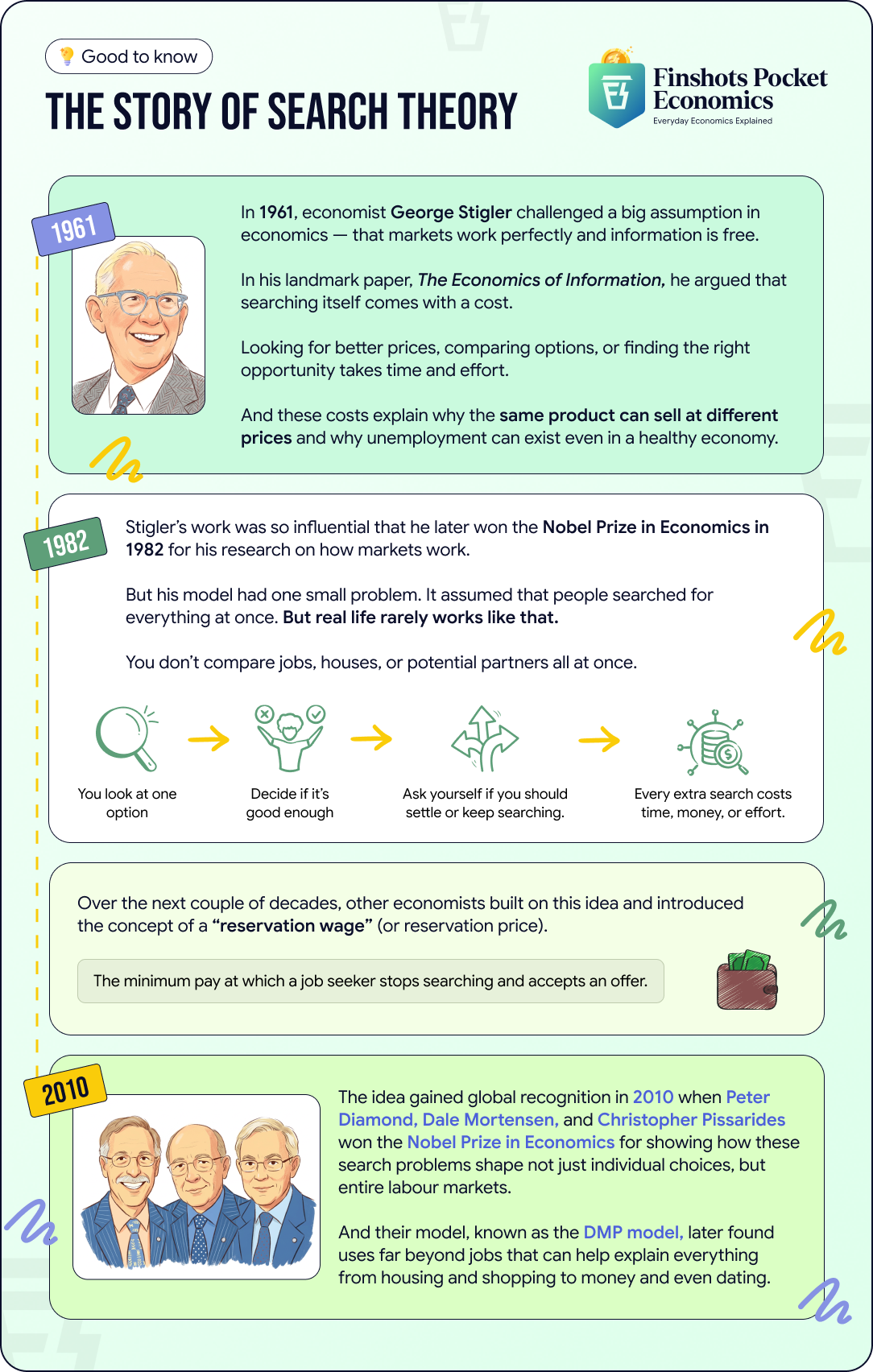
See, in a perfect world, buyers and sellers would find each other instantly. But that’s not possible in reality because information is incomplete, people are in different places, prices vary, and negotiations take time. Search theory is simply the study of that gap or, essentially, the economics of how long to keep looking before you settle on something.
And there are four factors that decide how long you search:
- Reservation Price
This is your personal cut-off price — the minimum you’ll accept or the maximum you’ll pay. You keep searching until you find something good enough within that limit. Think of it like this. You’re buying a second-hand car and your budget is ₹4 lakh. You keep searching until you find a car of decent quality at or under that price. That ceiling is your reservation price.
- Costs
If the costs keep increasing or the stakes keep reducing the longer you search, your search time will automatically become shorter. Basically, the more painful the search itself becomes, the sooner you’ll settle. Say you’re looking for a job in the IT or finance sector, but new skills keep emerging every day. Like AI in data analysis or coding, and you’re not familiar with them. You may simply accept a job offer sooner because your existing skills could become outdated quickly compared to someone with more future-proof skills.
- Difference in price and quality
This is about how different the options are from one another. If every job offer you get is roughly the same, there’s no point holding out. But if offers vary wildly in salary and quality, it may feel worth waiting because the next one could be dramatically better.
- Risk aversion
This is how much uncertainty you can handle. A long job search often means burning through savings. If that scares you, you’ll settle faster because the anxiety of continuing to search can keep growing.
And now that you know the basics, we know what you’re waiting for. How does search theory show up in real life and how can I actually use it?
Well, let’s start with the most obvious example — job hunting.
Imagine you’ve quit your current job and started applying for a new one. The first offer comes in quickly. It’s decent, but not great. Do you take it or keep looking?
Most people usually get this wrong in one of two ways. Either they panic and take the first offer because job hunting is stressful, or they keep rejecting offers while chasing some perfect job that may not even exist. And honestly, both can be costly.
So how do you decide?
Search theory says there’s no perfect answer, but there is a useful rule of thumb. Decide your minimum acceptable salary or your reservation wage before you begin searching, not when you’re already stressed a few months in. Then treat your first few interviews as a way to understand the market. Here, you’re not trying to accept anything immediately, just learning what companies are actually willing to pay.
Let’s take a simple example. Say you’ve resigned from your current job. Your notice period is 2 months and your savings can support you for another 2 months. So, effectively, you have 4 months to find a job.
You currently earn ₹10 lakh a year and hope for ₹13 lakh. But that’s your expectation, not your reservation wage. Your reservation wage could instead be the minimum raise that makes switching worthwhile. Let’s assume that is ₹11 lakh.
Now imagine that by the end of month one, you already have three offers: one at ₹11 lakh and two at ₹12 lakh. And based on what you’re seeing, companies don’t seem eager to offer a 30% hike. So, do you accept ₹12 lakh or continue searching?
Search theory suggests comparing the value of accepting now versus continuing to search. Basically, you ask yourself two practical questions:
- How likely is a ₹13-lakh offer?
If the market isn’t handing out 30% hikes easily, it may not be very likely, no?
- Second, what’s the risk of waiting?
If you reject ₹12 lakh, you might find ₹13 lakh later. But you could also end up with another ₹12-lakh offer or worse, nothing better, while burning through time and savings.
And remember, waiting has a cost. As your 4-month runway shrinks, financial stress and the pressure to accept a weaker offer can grow.
So, if you already have offers above your reservation wage and one clearly stands out, say ₹12 lakh, it may make sense to accept it, especially if the market doesn’t seem likely to offer ₹13 lakh anytime soon.
This doesn’t mean that you’re “giving up” on ₹13 lakh. You’re simply locking in a good outcome today and can always aim for more later in your career.
But there’s also another interesting scenario you can end up with. Even after mentally accepting one ₹12-lakh offer, you still have another ₹12-lakh offer in hand. Maybe both companies are very similar in terms of culture and growth prospects. But while one company isn’t willing to negotiate, the other is open to discussion. If they raise it to ₹12.5 lakh, great! You can take it. If not, you still have a solid fallback option.
That fallback is what’s called a BATNA (Best Alternative To a Negotiated Agreement). In simple terms, it’s the backup option that gives you the confidence to walk away if negotiations don’t work out.
Next, the one we promised we’d explain at the start — finding a potential match, whether while dating or looking to get married.
Think about how most people use apps like Hinge or Bumble today. They swipe for weeks, go on a handful of dates, feel exhausted, and either give up or settle for someone who seems “fine”.
So how do you work this out?
Well, it’s surprisingly similar to job hunting.
Just like you have a reservation wage in a job search, you could think of a reservation standard in dating. This is the minimum threshold of compatibility, values, humour, attraction, and shared goals that someone must meet before you seriously consider them.
If your standards are very high, you’ll search longer and reject more people. If they’re lower, you may settle sooner. And while dating apps have made searching almost effortless, they’ve also created a problem: the feeling that the “perfect person” is always one swipe away.
Another thing to remember is that once you reject an option, you often can’t go back to it.
So, to decide when to stop searching and commit, you could use something interesting called the secretary problem, which we briefly touched upon in the job-hunting example. The idea is simple. Don’t rush into a decision immediately. Spend the early part of your search just learning what’s out there and calibrating your standards.
Some mathematicians even suggest a rough rule. Use the first 37% of your dating pool as a learning phase and don’t commit during that period. Then, choose the next person who feels better than everyone you’ve met so far.
Now, you’ll probably ask us, why such a specific number, 37%?
Well, it’s not something we whipped out of thin air. Mathematicians tested this problem thousands of times and found that if you spend too little time searching — say just the first 10% of options, you haven’t seen enough to know what “good” really looks like. You’ll likely settle too early.
But if you spend too much time searching — say over 50%, you may understand the market really well, but you’ve probably already rejected some fantastic options and don’t have enough chances left to find something better.
So there has to be a sweet spot between “too early” and “too late”. And when mathematicians modelled this trade-off, the answer landed at an oddly precise number: 36.8%, usually rounded to 37%.
Now, before you panic, no, this doesn’t mean rejecting your soulmate because they showed up “too early”. The point is to simply understand that big decisions often need a fair amount of time.
And if you find yourself endlessly rejecting people, search theory would say something else. Maybe it’s time to lower your reservation standard a little. Instead of looking for someone who ticks every single box — say someone of a certain height, who loves pets, shares your hobbies, and has the same sense of humour, focus on what matters most. Maybe compatibility, shared values, and whether you genuinely enjoy spending time together.
Also, unlike job hunting, this is one place where you probably shouldn’t use a BATNA, folks. Keeping someone around as a backup while waiting for a “better option” rarely ends well.
So yeah, maybe Indian Matchmaking’s Seema aunty wasn’t entirely wrong when she told people to “adjust” and say yes if 60–70% of expectations matched. Maybe she was unknowingly quoting economics after all!
And finally, you can definitely apply search theory while shopping. To give you an example, let’s say you need a new phone. So you search and scroll through Amazon, Flipkart, some review sites, watch three YouTube comparisons, read a Reddit thread, and two hours later you’re more confused than when you started and you haven’t bought anything. A week later you panic-buy something mid-range that you're not even sure about.
That’s what you call “the paradox of choice”. More options exhaust your decision-making capacity. So you either freeze or grab something random at the end.
The solution here is almost embarrassingly simple. Before you open a single tab, write down your budget ceiling and two or three things the product must have. Not a wish list, but a minimum bar. Then buy the first thing you find that clears that bar.
Stop there.
Because research consistently shows that people who do this end up happier with their purchases than people who spend hours optimising, because the optimisers are haunted by everything they didn’t buy.
With that, that’s a wrap. And all of this probably explains why I didn’t end up buying the bracelet I originally liked for my niece and had to settle for another option that I liked less. Ironically, despite working on this series for weeks and clearly defining my reservation bar upfront, I kept looking for better options. And when I finally found it, the bracelet had gone out of stock. I also had no clear BATNA to fall back on, or even the time to start shopping all over again, so I had to make a quicker compromise than I’d planned.
But now, you tell us. Would you use search theory to make better job, dating, or shopping decisions?
We’ll see you next Saturday!
Until then… tell us what you thought of today’s edition. Just hit reply to this email (or if you’re reading this on the web, drop us a message at morning@finshots.in).
Or even better, share it with your friends and family on WhatsApp, LinkedIn, and X.
Finshots Weekly Quiz v2.0 🧠
Hey folks! As you probably already know, the Finshots Weekly Quiz has a new avatar. If you missed out on it in the last couple of months, don’t worry. Click here to check out the rules and set a reminder to participate consistently starting next month!
Next, let’s move on to the top scorers from our previous weekly quiz. There were a whole bunch of you who participated, and many of you ended up with the same scores. So we’re calling you Bulls, Bears, Unicorns, Blue Chips, and Rising Stars. Here’s how the leaderboard looks right now:

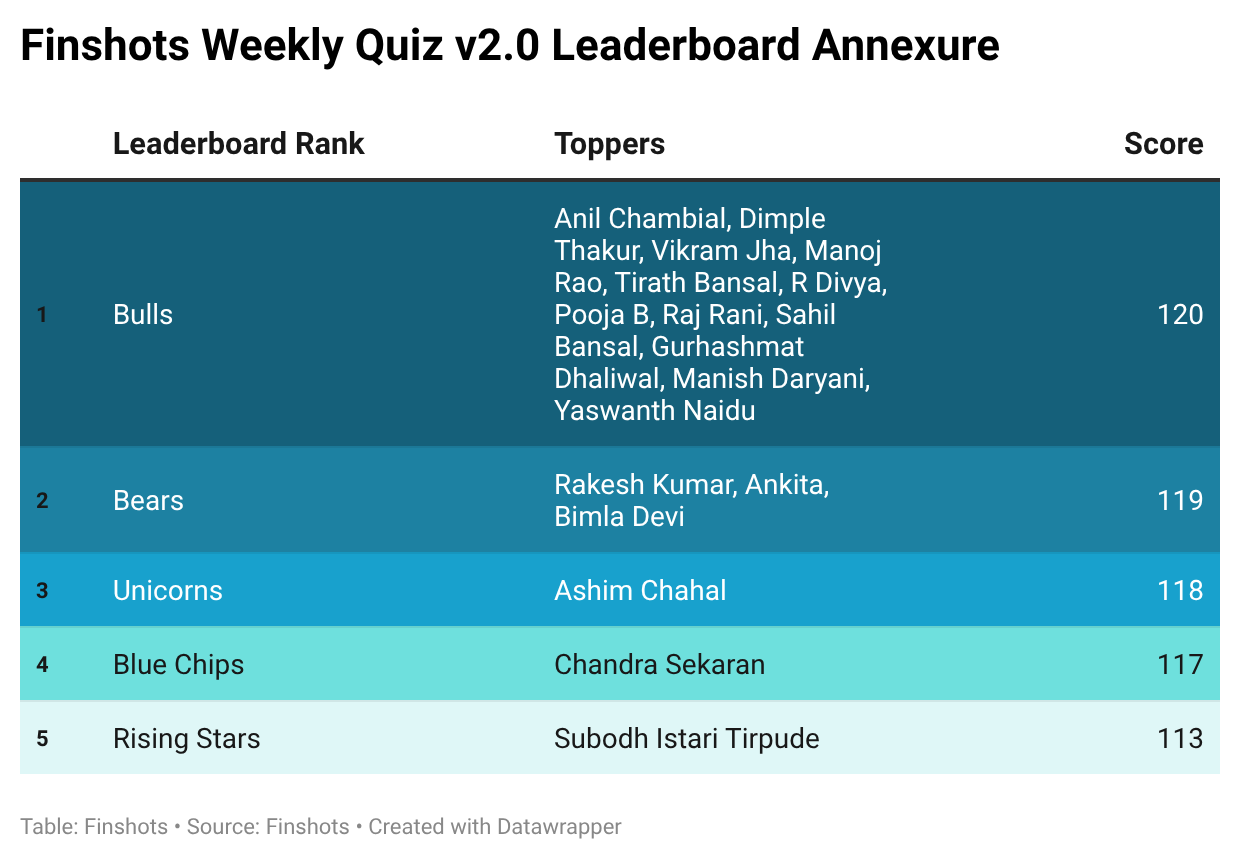
If your name has been featured on the leaderboard, then congratulations! If not, don’t lose hope. If you attempted last week’s quiz, keep at it and answer all the weekly quizzes this month. You never know when the turntables! Click on this link to take this week’s quiz, which is open till 12 noon, Friday, 22nd of May, 2026. The more answers you get right, the better your chances of appearing on the Finshots Weekly Quiz leaderboard. We’ll publish it every Saturday in this edition. And the winner will be announced in the first week of June.