
The Ujala maker just lost Pril. What now?
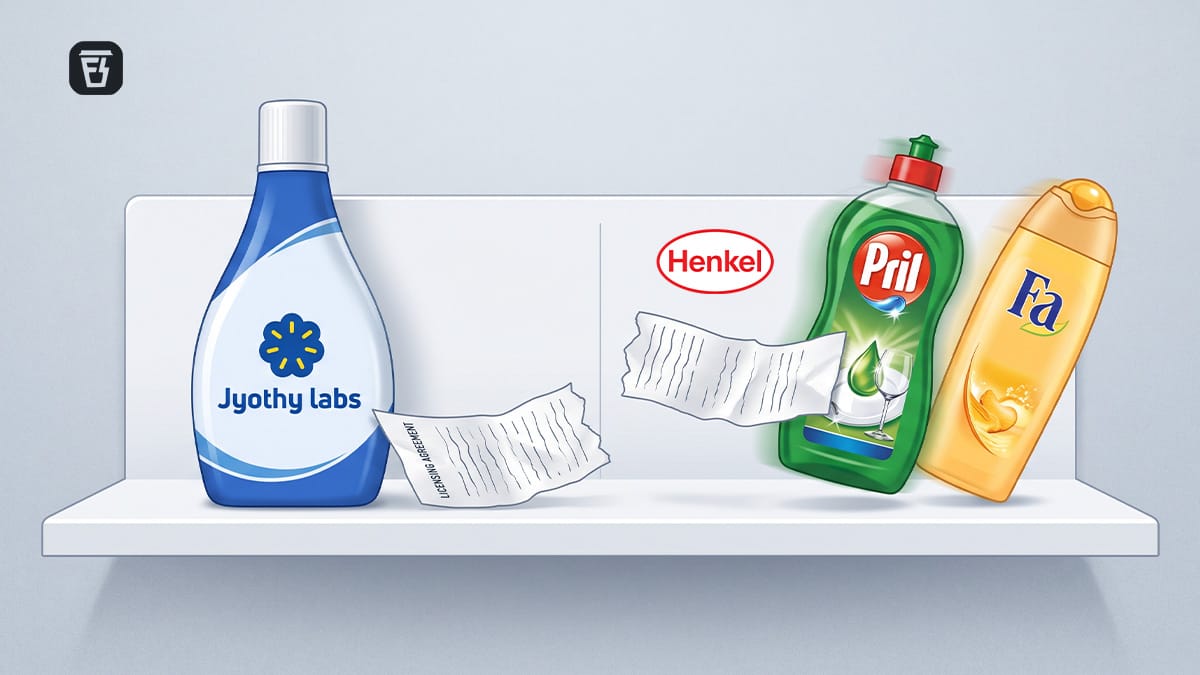
In today’s Finshots, we explain how Jyothy Labs built a business on borrowed names like Henko, Mr. White, Pril, and Fa, and what happens now that a couple of them are gone.
But here’s a quick sidenote before we begin. This weekend, we’re hosting a free 2-day Insurance Masterclass that helps you build real financial security by understanding health and life insurance the right way.
📅 Saturday (tomorrow), 16th May at 11:30 AM: Life Insurance
How to protect your family, choose the right cover amount, and understand what truly matters during a claim.
📅 Sunday, 17th May at 11:30 AM: Health Insurance
How hospitals process claims, common deductions, the mistakes buyers usually make, and how to choose a policy that won’t disappoint you when you need it most.
👉🏽 Click here to register while seats last.
Now onto today’s story.
The Story
On Monday, shares of Jyothy Labs fell over 11% in a single session. That’s a brutal one-day fall for a stock that had already crashed more than 55% from its all-time peak.
The trigger?
German FMCG giant Henkel AG told Jyothy Labs that it would not renew the licensing agreements for the Pril dishwash and Fa personal care brands after May 31st, 2026.
To give you some quick context, back in 2011, Jyothy Labs acquired Henkel’s India consumer business through a long-term deal. The arrangement allowed Jyothy to use Henkel’s brands and assets while also running the India operations.
But 15 years later, Henkel has decided to walk away from the partnership. And as you can see, the market doesn’t seem happy.
To understand why, you first need to understand how Jyothy Labs actually makes money.
See, Jyothy Labs began in Kerala in 1983 when M. P. Ramachandran started the business with a single product. And if you’re a millennial, there’s a good chance you already know the name — Ujala, the royal blue fabric whitener.
Back then, Ramachandran started with a capital of just ₹5,000 and a lot of hustle, formulating Ujala himself and going door-to-door to market it.
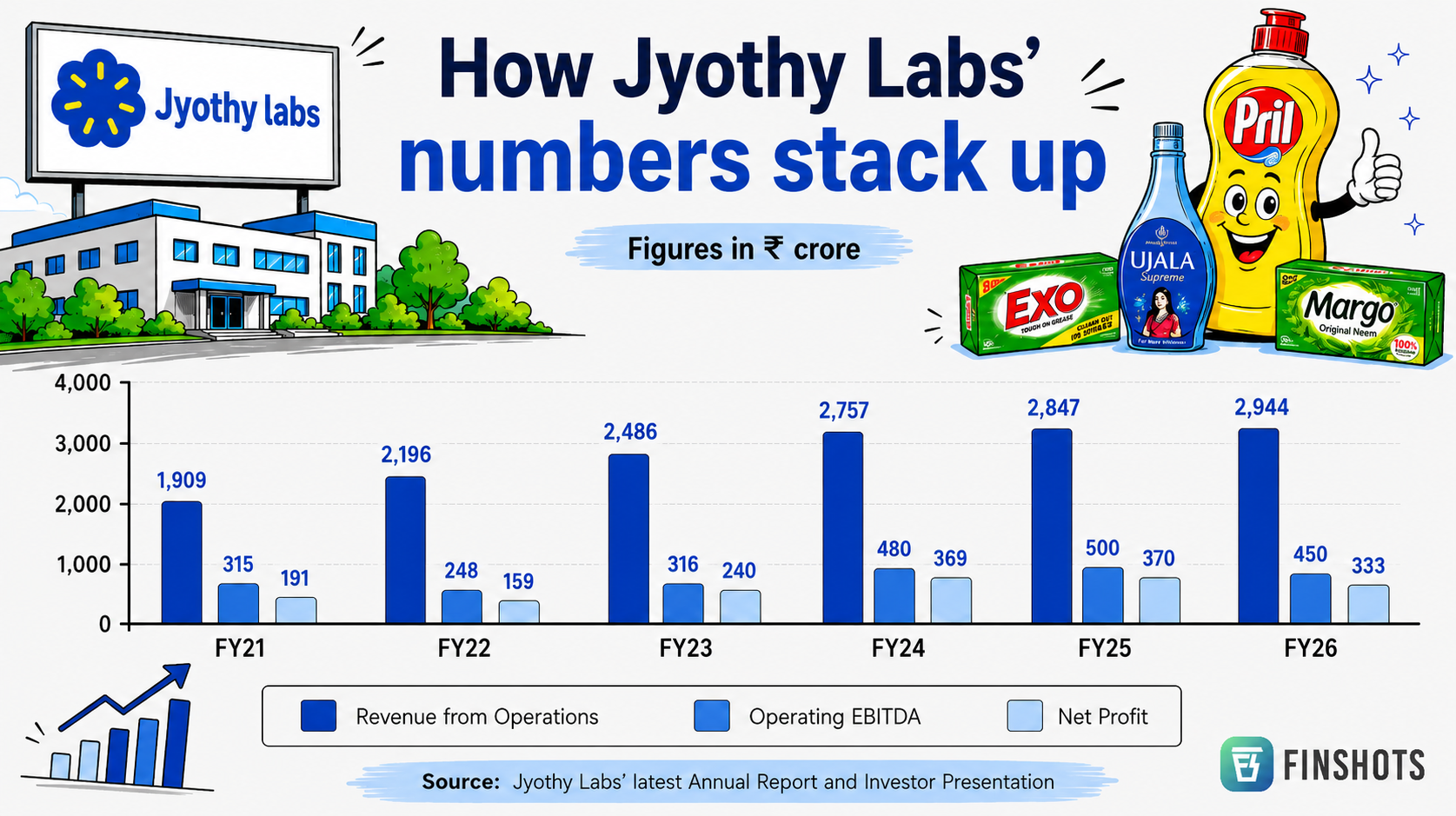
But that tiny operation has since grown into a mid-cap FMCG company that clocked ₹2,944 crore in revenue in FY26.
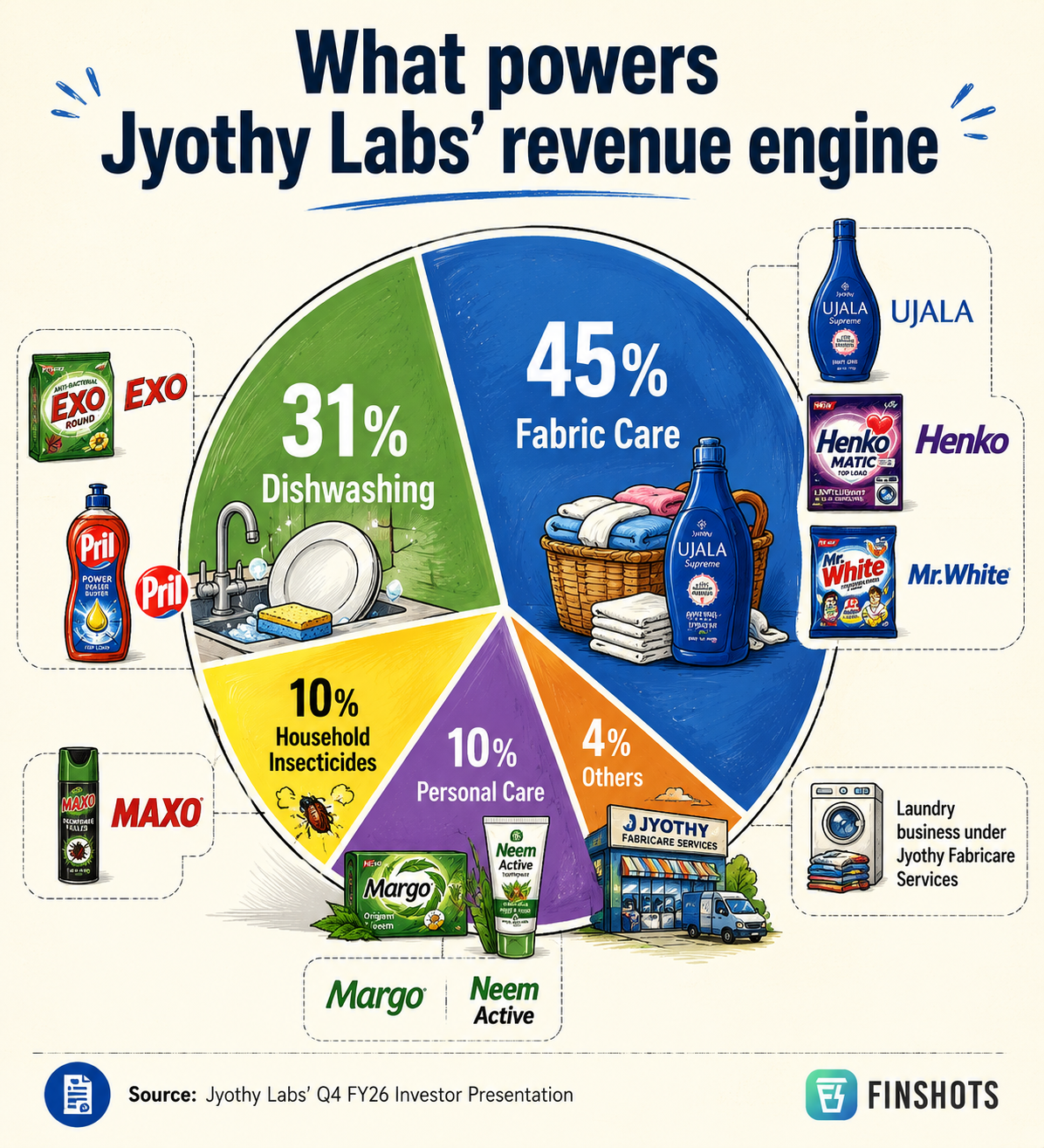
Today, Jyothy Labs makes money across four major segments: Fabric Care, Dishwashing, Household Insecticides, and Personal Care. And these businesses are anchored by six “power brands” — Ujala, Exo, Maxo, Margo, Henko, and Pril, which together contribute 82% of the company’s total revenues.
Among them, dishwashing is Jyothy Labs’ second-largest business after fabric care, contributing nearly a third of total revenues. And within that segment, Pril was the premium liquid dishwash brand. As of FY25, Pril commanded a 13% market share in the liquid dishwash category, which also happens to be the fastest-growing segment in dishwashing, thanks to rising urbanisation and consumers increasingly moving towards premium products. Exo, meanwhile, held a strong position in the dishwash bar category with a 14% market share.
Together, Pril and Exo helped Jyothy Labs become the second-largest player by value in India’s dishwashing market, giving it close to a 30% share pan India.
And that, as you can imagine, wasn’t built overnight.
But here’s the catch. Pril was never really Jyothy’s brand to begin with.
To put things in perspective, when Jyothy Labs acquired a 50.97% stake in Henkel India in 2011 for ₹118.7 crore, the deal was structured in three layers.
Some brands such as Margo, Neem Toothpaste, Tuhina, and Chek laundry detergent were fully acquired by Jyothy Labs. Some others, like Henko and Mr. White, came through lifetime licensing agreements. And then there were Pril and Fa. These brands were licensed only for a fixed period, with Henkel AG continuing to retain global ownership. Jyothy got the rights to manufacture, market, sell, and distribute Pril and Fa in India, but not permanently. Just for 15 years.
And here’s something you should know about this deal. Back then, some of the brands that are market leaders today, including Margo and Pril, were actually struggling brands. Henkel, being a foreign company, was still trying to figure out the Indian FMCG market. And because it did not trust the quality consistency of raw materials across India, it operated with just one manufacturing plant in Karaikal, Puducherry, to serve the entire country.
That turned into a logistical nightmare. Transporting products across India ate up nearly 10% of its profit margins, making the business increasingly difficult to scale. This eventually meant that Henkel simply wanted an exit from a market where it had failed to crack the FMCG game.
And that’s when Jyothy Labs stepped in. Over the next 15 years, it poured money into advertising, expanded distribution aggressively, built operational scale across 23 manufacturing plants, and slowly transformed Pril into a premium urban dishwash brand.
But now, Jyothy has to hand it back.
Because legally, Pril and Fa still belong to Henkel. So when the licensing agreement ends, those brands simply walk out the door.
That isn’t good news for Jyothy Labs because, as we mentioned earlier, Pril dishwash liquid alone contributes a meaningful chunk of the company’s revenues.
And more importantly, it’s a business that worked far better than Exo simply because Exo built its identity around dishwash bars. But in the dishwashing business, liquids are where the real money is.
Dishwash liquids typically command much higher profit margins because they are sold in bottles and pump formats that automatically feel more premium to consumers. People also see them as cleaner and easier to use. So companies can charge significantly more for a liquid product even if the actual cleaning function is not dramatically different from a bar.
But here’s the thing. Even when companies price dishwash liquids nearly three times higher than bars, the liquid often doesn’t last longer, which means that consumers end up replenishing them frequently.
That makes liquid dishwash a high-realisation, low-grammage category — exactly the kind FMCG companies love because it drives stronger margins and repeat purchases.
This is why losing Pril hurts Jyothy far more than the headline revenue numbers suggest. For context, analysts at Equirus Securities estimate that the loss of Pril and Fa could shave off 6–8% of Jyothy’s FY27 revenues. But the impact on EBITDA could be much sharper at 14–16%. Meanwhile, Motilal Oswal has already cut its Earnings Per Share (EPS) estimates for Jyothy Labs by around 8% for the next couple of years.
And that seems to come at a time when Jyothy’s margins are already under pressure. Its EBITDA margin fell to 15.3% in FY26 from 17.6% a year earlier as crude-linked raw material costs surged. These include surfactants, chemicals, and polymer packaging materials, which together make up nearly 50–60% of the company’s total input costs.
Sure, Fa, the deodorant and personal care brand, barely contributed much to revenues on its own. But together, Pril and Fa accounted for a high single-digit share of Jyothy Labs’ revenues and roughly 10% of EBITDA. So while Fa barely moved Jyothy’s profit and loss figures, the real damage comes from losing Pril.
Which makes you ask, how does Jyothy Labs navigate through this storm now?
Well, the company’s answer seems to be Exo itself, Pril’s dishwash cousin.
Despite being very different from Pril, over the last few years, Jyothy’s management has quietly been trying to scale up Exo in the liquid dishwash category as well, even though Exo Liquid has technically existed in the company’s portfolio for nearly two decades.
The problem, however, is positioning. Exo has long been sold as an affordable alternative to premium brands like Vim bar, especially in kirana stores across Tier 2 and Tier 3 cities. And turning that into a premium liquid brand is not just about tweaking the formula or changing the packaging. It requires changing consumer perception itself, which is never easy.
That said, Jyothy still retains one genuine structural advantage — distribution. The company’s products are sold across nearly 4 million outlets nationwide. It directly reaches around 1.4 million outlets and works with more than 10,000 channel partners across urban and rural India.
So if Jyothy can quickly redirect its salesforce, advertising spend, and marketing efforts towards Exo Liquid, it still has a fighting chance to recover a meaningful portion of volumes, even if it sacrifices some premium positioning along the way.
Another silver lining that can make this possible is its cash balance of nearly ₹997 crore and an almost debt-free balance sheet which gives Jyothy enough firepower to aggressively push Exo Liquid if it chooses to.
But there’s another side to this story too. Henkel AG walking away from the licensing agreement may also signal a possible return to India’s consumer market. And that isn’t just our wild guess. Over the past few years, Henkel has already started rebuilding its presence in India by launching Schwarzkopf hair care products and gradually re-establishing a direct consumer business after its soft exit back in 2011. And now, with Pril returning to its hands, Henkel suddenly has a strong brand to re-enter the market with.
Which means Jyothy may not just be losing Pril. It may soon have to compete against Pril too.
So yeah, what Jyothy Labs is really betting on now is its ability to prove that it can build a premium franchise entirely from scratch, without relying on a borrowed European brand name.
Whether that bet pays off is something only time will tell.
Until then…
Liked this story? Share it with a friend, family member or even strangers on WhatsApp, LinkedIn, or X.
📢Are you ready for our new series?
If you thought economics was just inflation charts and RBI policy updates, then think again.
Because economics has quietly been explaining:
• your toxic ex
• your EMI purchases
• your freeloading flatmate
• and your “stock market expert” friend
So we made something for it.
Introducing Finshots Pocket Economics — a new weekly series where we break down economic theories and show you how they influence the decisions you make in everyday life.
Starts tomorrow (May 16th). So if you haven’t subscribed to Finshots yet, hit subscribe so you don’t miss a new edition every Saturday. 📚