
Why Royal Enfield didn’t really leave Tamil Nadu
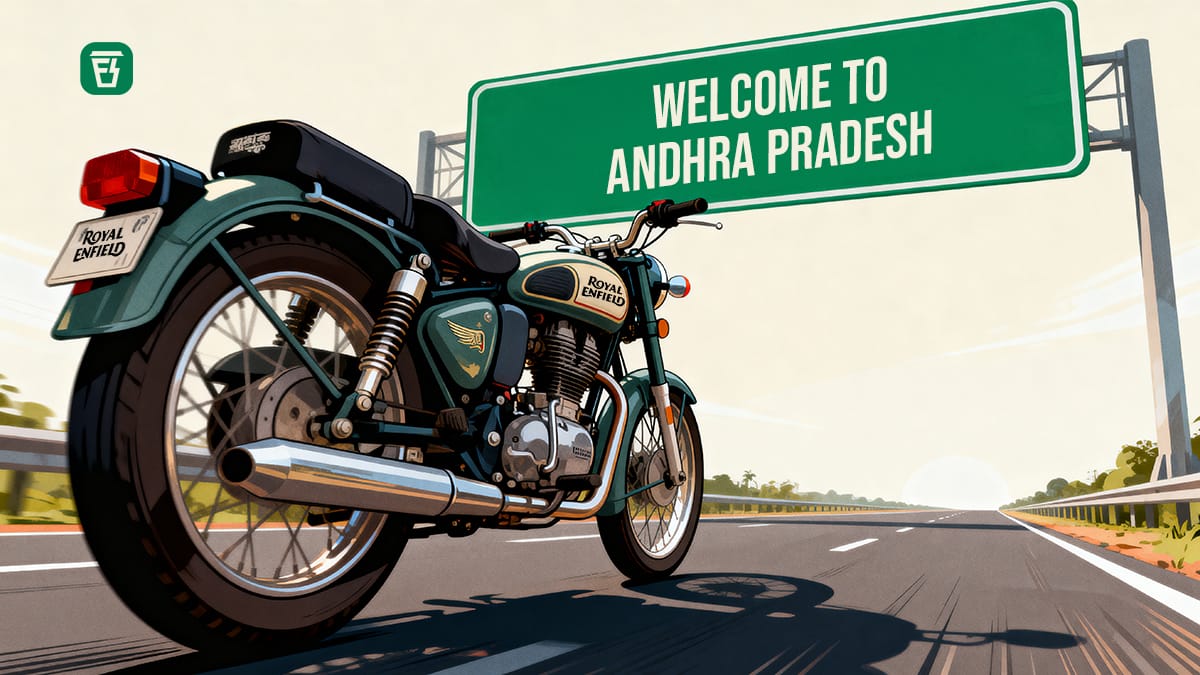
In today’s Finshots, we talk about why Royal Enfield set up its first plant outside Tamil Nadu.
But here’s a quick sidenote before we begin. This week, we’re hosting a free 2-day Claims Webinar Series, where we break down how claims are processed in the real world, why delays and rejections happen, and what truly makes a difference when it matters most.
📅 Friday (tomorrow), 15th May at 6:30 PM: Life Insurance
How to protect your family, choose the right cover amount, and understand what truly matters during a claim.
📅 Saturday, 16th May at 10:00 AM: Health Insurance
How hospitals process claims, common deductions, the mistakes buyers usually make, and how to choose a policy that won’t disappoint you when you need it most.
👉🏽 Click here to register while seats last.
Now onto today’s story.
The Story
If you ever wanted to understand where Royal Enfield came from, the answer was quite simple: Tamil Nadu. Now sure, its origin story was tied to the UK but that was so long ago, it feels like a different lifetime.
The company began assembling motorcycles in Chennai (then Madras) in 1955 to supply bikes to the Indian Army and police forces. Over time, entire supplier networks, factory towns and generations of skilled workers grew around that ecosystem. So deeply, in fact, that for most of modern Royal Enfield's existence, almost every motorcycle the company ever made came out of Tamil Nadu.
And to be fair, Royal Enfield wasn’t alone.
Inside Tamil Nadu sits the Hosur-Chennai-Oragadam belt, and this is quite literally where the magic happens. This is one of Asia’s densest auto-manufacturing corridors.
It’s a triangle of manufacturing with Hosur sitting just inside Tamil Nadu's border, Oragadam 40 kilometres southwest of Chennai, and Vallam Vadagal completing the arc near Kancheepuram.
Sundaram Fasteners, Brakes India, Rane Group, Lucas TVS — the companies that make Indian motorcycles are all clustered here.
And that isn’t by chance. Over many decades, the region became deeply specialised in making automobiles. It may have started with one company setting up a plant. That would have slowly attracted parts suppliers to move nearby. Skilled workers relocated there because jobs were available. And over time, entire towns emerged around these factories as thousands of people began working there.
Which is why Royal Enfield’s latest move feels so unusual. After spending nearly seven decades inside this ecosystem, the company’s next factory will sit in Satyavedu, just 15 kilometres across the Andhra Pradesh border.
But why move at all, you ask?
Afterall, Royal Enfield could have built another plant right here in Tamil Nadu and continued to enjoy the benefits of the belt. So almost everything that made the earlier plants work would have worked for a fourth one too.
Here’s the catch though. Royal Enfield had already tried the obvious solution: expand inside Tamil Nadu itself.
Just three months ago, Eicher Motors approved a ₹958 crore brownfield expansion at Royal Enfield's Cheyyar facility, increasing total production capacity from 14.6 lakh motorcycles annually to 20 lakh units by FY28.
That simply tells you that the company wasn’t running out of manufacturing capacity inside Tamil Nadu, but was actively doubling down on it.
So, if production capacity was the only problem, Cheyyar had already solved much of it.
Which means that there’s probably a different problem it’s trying to solve.
Consider what has happened to Royal Enfield's export business in the past seven years. In FY19, the company shipped fewer than 20,000 motorcycles out of India. Compared to its overall sales volume of about 8 lakh motorcycles at the time, that was a rounding error.
But by FY25, that number had crossed 1 lakh units. That’s a 400% surge since FY19 and a 29.7% jump over the previous year. By FY26, exports had reached 1.3 lakh units, accounting for 12.5% of total turnover. So what was once a footnote in the annual report has become an important part of the business.
But the plants that built that export business were designed for a very different Royal Enfield — one focused mainly on India’s domestic motorcycle boom, with exports still playing a small role.
But when exports become significant, it creates a gap and you have to do something about that, no?
Manufacturing efficiency isn’t enough on its own anymore. Port access, container movement, shipping timelines, and logistics infrastructure suddenly become part of the production strategy itself.
And that’s what makes Satyavedu such a strategic choice.
It sits barely 15 kilometres inside Andhra Pradesh, close enough to retain access to the Hosur-Oragadam supplier belt we mentioned earlier, while remaining within trucking distance of Chennai’s export infrastructure.
In other words, the company gets to keep the manufacturing ecosystem it already understands.
But the geography changes in another direction.
If you look southeast from Satyavedu, there’s the answer to the ports problem. Instead of routing exports primarily through Chennai, Satyavedu suddenly places Royal Enfield within reach of four major ports at once: Chennai, Ennore, Kattupalli and Krishnapatnam.
Then there is the inland container depot (ICD) at Satyavedu itself. This detail changes the logistics math significantly as Royal Enfield can containerise motorcycles directly at the factory gate and move them by rail to whichever of the four ports has the best berth availability that week. That way, it can say goodbye to truck queues and the congestion eating into delivery windows.
And Andhra Pradesh understood the opportunity. The state government moved quickly to bring Royal Enfield in, allotting nearly 267 acres in Satyavedu as part of its broader plan to become a manufacturing and logistics alternative to Tamil Nadu.
Besides, Royal Enfield plans to spend around ₹2,200 crore on the facility over the coming years, with the plant expected to create around 5,000 direct and indirect jobs.
When fully operational, the plant is expected to add 9 lakh units of annual production capacity to a current base of around 14.6 lakh units.
But building a factory is only half the problem. The other half is getting your suppliers to show up.
In Tamil Nadu, Royal Enfield's suppliers have spent decades setting up shop nearby. They know the volumes, the requirements, and they've built their entire businesses around being close to the plants. That kind of relationship doesn't pack up and move just because Royal Enfield opens a new address in Andhra Pradesh.
That’s why it's building a dedicated space for its suppliers right next to it — a vendor park, essentially giving them a ready-made reason to relocate. So they’re simply telling suppliers, “Here’s the land, here’s the certainty of orders. Now come build next to us.”
To add to that, 15 kilometres from Satyavedu sits Sri City, a 7,500-acre industrial township and Special Economic Zone that has spent the last decade quietly becoming a serious manufacturing hub. Isuzu assembles vehicles there. Hero MotoCorp has a presence. And importantly, so do TACO, Brakes India and Sundaram Fasteners — some of the very same suppliers that built their operations around Royal Enfield's requirements in Tamil Nadu.
In other words, Royal Enfield isn't asking its suppliers to move into unknown territory. It's asking them to move into a neighbourhood where some of them already live. The vendor park and Sri City together turn what could have been a cold start into something closer to a running start.
And finally, there is one more piece of the story that you should know about.
In 2023, Bajaj Auto began manufacturing Triumph motorcycles in Pune, proving that premium global motorcycles could now be built competitively outside Royal Enfield's traditional Tamil Nadu ecosystem. Bajaj had proved that you didn't need Tamil Nadu, or Royal Enfield's specific ecosystem, to build world-class bikes at scale.
That shift matters because the competition is now much tougher. Royal Enfield can no longer assume its global premium position is secure. It now has to defend that position through better products, manufacturing quality, and by delivering motorcycles faster and more efficiently to the 80+ countries it sells in, especially when rivals are targeting the same markets.
Satyavedu is partly a response to that.
So yeah, Royal Enfield didn’t really leave the state that helped build it. It simply moved to the edge of Tamil Nadu, crossed just far enough to access a different coastline, and will start building again.
And you can’t call that a replacement for Tamil Nadu. It’s simply infrastructure for a different kind of company — one that doesn’t just make motorcycles for India, but exports them to the world.
Until next time…
Liked this story? Share it with a friend, family member or even strangers on WhatsApp, LinkedIn and X.
Also, if you’re someone who loves keeping tabs on the world of business and finance, hit subscribe if you haven’t already. And if you’re already a subscriber, thank you! Maybe forward this to someone who’d enjoy our stories but hasn’t discovered us yet.