
Is India betting on “Cleaner Coal” to solve its energy problem?

In today’s Finshots, we look at whether coal gasification is India’s bridge to cleaner energy or just a smarter way of sticking with coal.
But before we begin, a quick sidenote. We’re hiring a Content Writer at Ditto Insurance to help us scale high-quality, user-first content. If you enjoy breaking down complex topics, digging deep through research, and want to help millions make better insurance decisions, you might be a great fit. Click here to apply or share it with someone who’d be.
Now onto today’s story.
The Story
India’s energy transition story has always carried a built-in contradiction.
On one hand, the country has made ambitious commitments toward renewable energy and decarbonisation. For instance, to solar and nuclear energy through the International Solar Alliance and advances in stage-2 nuclear reactors, respectively. Wind energy production has also scaled rapidly, policy support has strengthened, and global investors increasingly view India as a key part of the clean energy transition.
On the other hand, coal continues to sit at the centre of India’s energy system. It powers around 74% of electricity generation and remains critical for industries such as steel, cement, and fertilisers.
This creates a difficult balancing act, don’t you think?
The country needs to grow, industrialise more, and provide reliable energy to a large population. But doing that without sharply increasing emissions is not straightforward. After all, that’s exactly what the current “global north” has done to modernise its societies.
In a previous story, we mentioned that any energy source that is meant to be widely adopted must satisfy three conditions: it must be predictable, scalable, and have low carbon emissions.
Renewable energy, while expanding quickly, still has not fully ticked the first and second boxes. Coal, on the other hand, despite being a major pollutant, remains dependable, abundant, and relatively cheap.
And this is where the government’s latest push toward coal gasification fits in.
Backed by a ₹37,500 crore incentive scheme, the idea is to move beyond simply burning coal and instead convert it into synthetic gas and chemicals that can be used across industries. On paper, it looks like a way to reduce dependence on imported fuels such as natural gas while making domestic coal more versatile.
To understand whether this is a meaningful shift or just a rebranding of coal usage, it helps to look at what coal gasification actually does.
In a traditional setup, coal is burned in open air to generate heat, which is then used to produce electricity or power industrial processes. Gasification changes that approach. Instead of burning coal completely, it is heated in a controlled, low-oxygen environment. This partial combustion does not produce heat in the conventional sense.
Instead, it breaks coal down into a mixture of gases, primarily carbon monoxide and hydrogen. This mixture, known as syngas, can then be used as a fuel or as a building block for producing ammonia, methanol, and other industrial chemicals.
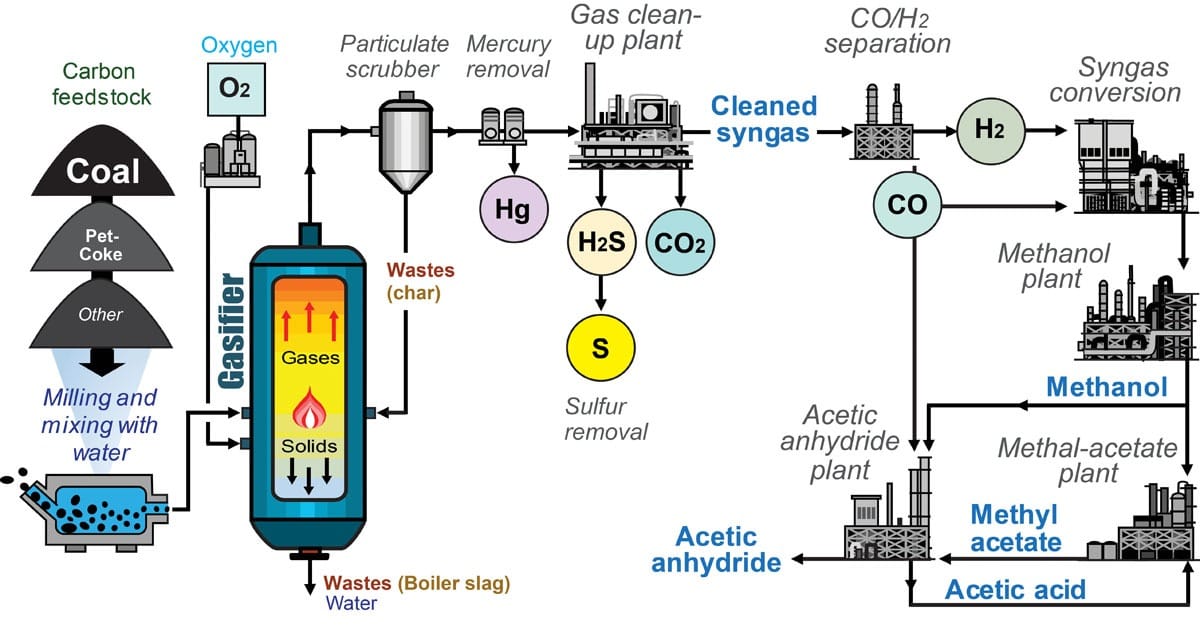
At first glance, this looks like a clear improvement.
Because the process is more controlled, it becomes easier to capture pollutants such as sulphur compounds and particulate matter before they are released into the atmosphere.
This reduces local air pollution compared to traditional coal burning. It also gives industries greater flexibility. So, syngas can, in certain applications, replace imported natural gas, which is particularly relevant for sectors like fertilisers that depend heavily on gas inputs.
But the story does not end there.
Coal gasification does not “remove” carbon pollution from the equation. It simply changes how and when that carbon is released. While some pollutants are easier to manage, the overall carbon footprint remains significant unless additional effort is made to integrate carbon capture into the process as well. And this is expensive, complex, and not yet widely deployed at scale.
The process itself is also energy-intensive. Converting coal into syngas requires substantial input energy, which means the gains are not always as large as they initially appear. In some cases, the total lifecycle emissions of gasified coal can be comparable to or even higher than those of traditional methods if carbon capture is not used.
This is where the tension lies.
Coal gasification improves certain aspects of coal usage, particularly local pollution and industrial flexibility. But it does not fundamentally solve the climate problem associated with coal. It sits somewhere between conventional fossil-fuel use and a fully clean-energy system.
That does not necessarily make it a bad idea.
To see how this plays out at scale, it helps to look at what China has been doing. Unlike India, China has not treated coal gasification as an experimental or transitional technology. It has turned it into a full-fledged industrial strategy. Today, China gasifies an estimated 340 to 350 million tonnes of coal annually, making it the world's largest user of this technology. But interestingly, it is not using this primarily for power generation.
Instead, China has built an entire “coal-to-chemicals” ecosystem around gasification. Syngas derived from coal is used to produce fertilisers, plastics, fuels, and even hydrogen. In fact, around 70% of China’s methanol and over 90% of its ammonia are produced using coal gasification. This feeds directly into its massive manufacturing base, from construction materials to consumer goods. It is also the world’s largest producer of hydrogen, with a significant portion coming from coal rather than natural gas.
There is also a strategic logic behind this. By converting coal into synthetic natural gas and transport fuels, China reduces its dependence on imported oil and gas. In some cases, coal is converted into synthetic gas in resource-rich regions and then transported via pipelines to cities, helping reduce local air pollution caused by direct coal burning.
But China’s experience also reveals the limits of this model.
Gasification is extremely resource-intensive. Many of China’s projects are located in arid regions such as Inner Mongolia and Xinjiang, where they consume vast amounts of water, putting pressure on already scarce local resources. At the same time, the carbon footprint remains significant. Coal-to-chemicals alone accounts for a meaningful share of China’s total emissions, complicating its climate goals. And economically, several projects have struggled to remain viable when global oil and gas prices fall, since synthetic fuels become less competitive without heavy subsidies.
Due to these challenges, they even began pulling back in certain areas. And that’s exactly where the parallel with India becomes important. India’s energy transition is constrained by practical realities.
Renewable energy cannot yet fully replace coal, especially for baseload power and heavy industry. Natural gas, often seen as a transition fuel, is largely imported and subject to global price volatility. In that context, using domestic coal more efficiently while reducing reliance on imports can be seen as a pragmatic step.
Then, there is also a strategic angle.
By converting coal into chemicals and fuels domestically, India can reduce its dependence on global supply chains for products like methanol and ammonia. This has implications not just for energy security, but also for industrial competitiveness. However, there is a risk in how this transition is framed.
If coal gasification is treated as a long-term solution rather than a transitional one, it could lock in new investments in coal-based infrastructure that may become difficult to phase out later. Once plants are built and supply chains are established, shifting away becomes more complex, both economically and politically.
The real test, therefore, is not whether coal gasification is cleaner than burning coal directly. It is whether it is being used as a bridge toward a lower-carbon future or as a substitute for deeper structural change.
But for now, India appears to be choosing the middle path.
It is not abandoning coal, because doing so would risk energy shortages and industrial disruption. It also does not ignore the need to reduce emissions. Instead, it is attempting to make coal more efficient and somewhat less polluting while continuing to invest in renewables.
Whether this approach works will depend on what comes next.
If coal gasification is accompanied by investments in carbon capture, renewable energy, grid upgrades, and storage, it could serve as a transitional tool that buys time for cleaner systems to scale. If not, it risks becoming another layer in an already complex energy system, delaying the inevitable shift away from fossil fuels.
Until then…
If this story helped you understand how India is trying to balance energy security with climate goals, share it with your friends, family, or even strangers on WhatsApp, LinkedIn or X.
Also, if you’re someone who loves keeping tabs on the world of business and finance, hit subscribe if you haven’t already. And if you’re already a subscriber, thank you! Maybe forward this to someone who’d enjoy our stories but hasn’t discovered us yet.
How Strong Is Your Financial Plan?
You've likely ticked off mutual funds, savings, and maybe even a side hustle. But if Life Insurance isn't a part of it, your financial pyramid isn't as secure as you think.Life insurance is the crucial base that holds all your wealth together. It ensures that your family stays financially protected when something unpredictable happens.If you’re unsure where to begin, Ditto's IRDAI-Certified insurance advisors can help. Book a FREE 30-minute consultation and get honest, unbiased advice. No spam, no pressure.