
Board game cafes, astrotourism and more…
Hey folks!
Let’s imagine you’re sitting around a table with your friends, laughing and fighting over the rules of UNO, maybe threatening to leave the game once in a while. Nobody’s on their phone. Everyone’s fully focused on the game, undistracted. And it’s your turn to play a card.
Feels like nostalgia?
We’re sure it does because the average person globally now spends nearly seven hours a day on screens. That’s over 46 hours a week. And the worst part? 81% of Gen Z adults and 78% of millennials say they often wish they could disconnect more easily.
Now, that’s from a study in the US, but it goes to show that even the generation that grew up with technology wants out too.
So what do they do?
They go to a board game café, pay a cover charge, order a latte, and spend three hours arguing over the rules of a game.
And this is a booming industry!
Yup. The global board game café market was valued at around $1.27 billion in 2024 and is on track to hit $2.5 billion by 2032.
But this isn’t really about board games. It’s about digital fatigue quietly turning into a market.
See, tech spent two decades engineering the perfect attention trap — infinite scroll, autoplay, notification pings timed to the millisecond, and strategies designed to keep us hooked. And honestly, it worked a little too well.
Now people are exhausted. So much that they’re willing to pay for relief.
Which is where things get a little ironic. The very act of being offline — once the default state of human existence, has now become a premium offering.
To put this in perspective, high-end resorts now offer “digital detox packages”, where guests are encouraged (or required) to unplug. Some vacation rental platforms have even seen a 17% spike in searches for no-internet properties. Vogue even called being unreachable “the ultimate power move”.
So yeah, an entire tourism industry is quietly being built around the absence of Wi-Fi. The board game café is simply the cheaper, more cheerful version of the same instinct.
And if you zoom out, the whole thing feels oddly circular. The same market logic that built the attention economy is now building the escape-from-the-attention economy.
Here’s a soundtrack to put you in the mood…
Tu Hai Kahan by AUR recommended by our reader Debangshu Lo.
Thank you for this soothing rec, Debangshu!
What caught our eye this week
The business of disappearing stars ⭐
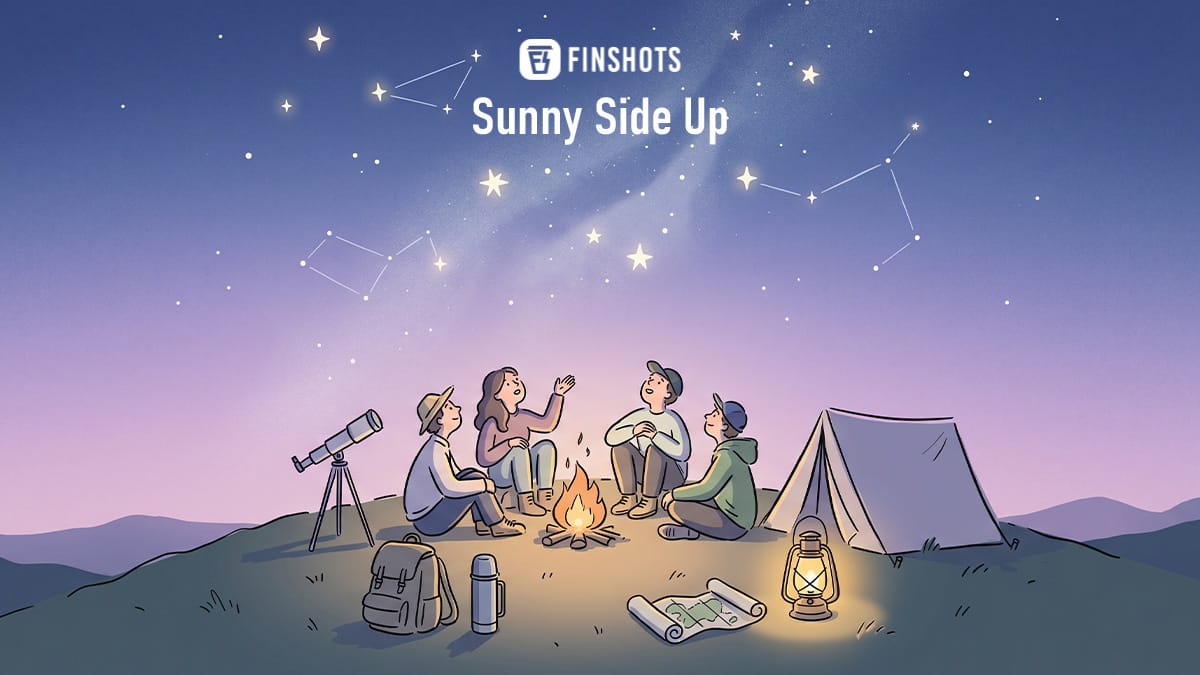
Here's a question nobody asks at dinner parties: when did you last see the Milky Way?
No we’re not talking about photos or your screensaver. Actually, with your own eyes, standing outside, looking up.
If you live in Bengaluru, Mumbai, or Delhi or any major city, you probably haven’t seen the Milky Way in years.
Maybe on a road trip. Maybe that one time the power went out for longer than expected and you wandered outside and looked up and thought, huh. Or maybe never.
And here's the uncomfortable part: it's not going to get easier. For most of human history, the night sky was unavoidable. Every evening, people looked up and saw thousands of stars stretched across the sky. Today, billions of people can’t.
And it’s because of something called light pollution. Over the last few decades, our cities got brighter. Streetlights multiplied. Offices stayed illuminated overnight. LEDs made lighting cheaper. Simply put, buildings and roads started glowing long after people had gone home.
Back in 2016, researchers estimated that more than 80% of the world lived under light-polluted skies, and for more than a third of humanity, the Milky Way is no longer visible from where they live. Since then, the problem hasn’t stood still. A newer study found night skies are getting brighter at roughly 9.6% every year.
At that pace, the sky effectively doubles in brightness roughly every eight years.
Here’s another way to think about it: a place where you could see around 250 stars a decade ago might show barely 100 today.
The stars themselves haven’t gone anywhere. We've just drowned them out.
Which is creating a strange new problem. People are beginning to travel hundreds and sometimes thousands of kilometres… just to see what used to be free.
That trend now has a name: astrotourism.
Entire regions are creating dark sky reserves. Hotels are offering telescope packages. Local guides are building businesses around stargazing. Places once considered “too remote” are becoming destinations precisely because there’s… less there. Or more accurately: Less light.
Now here's the part that would make any economist smile.
We've polluted the night sky so thoroughly that darkness itself has become a luxury good. Something every human being on Earth had for free — for the entirety of human history, has become a premium travel experience.
And the fastest-growing slice of that? Luxury stargazing. Think five-star resorts. Private telescopes. Concierge astronomers. People are paying serious money to see something their grandparents saw every single night from their own backyards.
The more cities glow, the more people will pay to escape it.
And it’s not just a global phenomenon either. India has caught on, and in two very different corners of the country, something quietly interesting is being built.
One of those places called Hanle sits nearly 4,500 metres above sea level in Ladakh.
Hanle isn’t just another Himalayan village. It sits under some of the darkest and clearest skies on Earth. So dark, in fact, that it’s home to the Indian Astronomical Observatory, one of the world’s highest observatories.
Hanle became India’s first dark sky reserve — protected precisely to preserve low levels of artificial light and keep the night sky visible.
And almost immediately, people started building around it.
Locals trained as astronomy guides. Homestays added telescope experiences. And visitors began arriving.
And just last week, Kolli Hills in Tamil Nadu started experimenting with the same idea. Tamil Nadu opened its first Dark Sky Park in the Ariyur Shola forests, turning low light pollution into an attraction.
For most of modern history, no place ever bragged about being dark. Until now.
Because once something becomes scarce, economics takes over. And that’s exactly what has happened with stargazing.
P.S. : If Kolli Hills just made your travel list, remember, the observatory only opens from January 15 to June 15. The stars may be eternal, but apparently visiting hours aren’t.
Infographic

Readers Recommend
This week, our reader Astami Das recommends reading ‘A pair of silk stockings’ by Kate Chopin.
A Pair of Silk Stockings tells the story of Mrs. Sommers, a mother who rarely gets to think beyond expenses and obligations. But after coming into a little extra money, she gives herself permission to enjoy life for a day.
That’s it from us this week. We’ll see you next Sunday!
Until then, send us your book, music, business movies, documentaries, or podcast recommendations. We’ll feature them in the newsletter! Also, don’t forget to tell us what you thought of today's edition. Just hit reply to this email (or if you’re reading this on the web, drop us a message at morning@finshots.in).
Don’t forget to share this edition on WhatsApp, LinkedIn and X.
Also, have you read the second edition of Finshots Pocket Economics (FPE) yet? If not, check it out here. It’s our new weekly series where we break down economic theories and show you how they influence the decisions you make in everyday life. New editions drop every Saturday. And if you want them straight in your inbox and haven’t subscribed to Finshots yet, hit subscribe so you don’t miss an edition.