
African funerals, wired earphones, and more...
Hey folks!
There's a particular kind of pride held by people who never threw away their wired headphones. You know the type — still has a drawer full of tangled earbuds from 2014, refuses to buy wireless on principle, and has been quietly saying "Bluetooth disconnects too much" at every party for the last decade. Well, friends, their moment has finally arrived.
Wired headphones are back. Not in a "oh, a few nostalgic types are buying them" kind of way, but in a sales-up-20%-in-early-2026 kind of way. After five straight years of declining numbers, people are suddenly plugging back in.
The story of how we got here is actually a pretty funny one. Apple yanked the headphone jack from the iPhone back in 2016, and the world and some other phone manufacturers too largely just... went along with it. We as customers grumbled, bought wireless earbuds, lost them, bought another pair, lost those too (somehow), and called it progress. Wireless was the future. The cable was dead.
Except the cable wasn't dead. It was just waiting.
A big part of this revival is pure, old-fashioned frustration. There is something disappointing about lining up the perfect song only for your ears to be greeted with that little robotic message that tells you your headphones have wandered off to reconnect.
Then there's the sound. Audiophiles have been banging this drum for years. A wire sends the signal straight to your ears, no compression, no tiny battery slowly dying inside a bit of plastic lodged in your ear canal. Music just sounds better through a wire, and while Bluetooth has closed the gap enormously, the best wired options still punch harder for the price.
And your wallet notices. A solid pair of wired earphones can cost a fraction of their wireless counterparts — no battery management chips, no Bluetooth hardware, no charging cases. The savings are real, and unlike wireless earbuds whose batteries quietly degrade over a year or two, a wired pair just... keeps working. Continuously. There's something almost radical about owning something that doesn't expire.
But maybe the deepest current running through all of this is nostalgia — a genuine hunger for experiences that feel tangible. The same instinct that's bringing back vinyl records, film cameras, and paperback books. In a world where everything streams invisibly from everywhere, people are quietly moving back toward things they can hold, plug in, and actually feel. A wire is friction, yes — but it's also real.
Which is perhaps the whole point. In a world of seamless, invisible, frictionless technology, sometimes a little wire is a reminder that you're actually listening to something.
Here’s a soundtrack to put you in the mood…
Zulfein by Mehul Mahesh
You can thank our reader Prithavi Chand, for this recommendation.
What caught our eye this week
The economics of “log kya kahenge”?
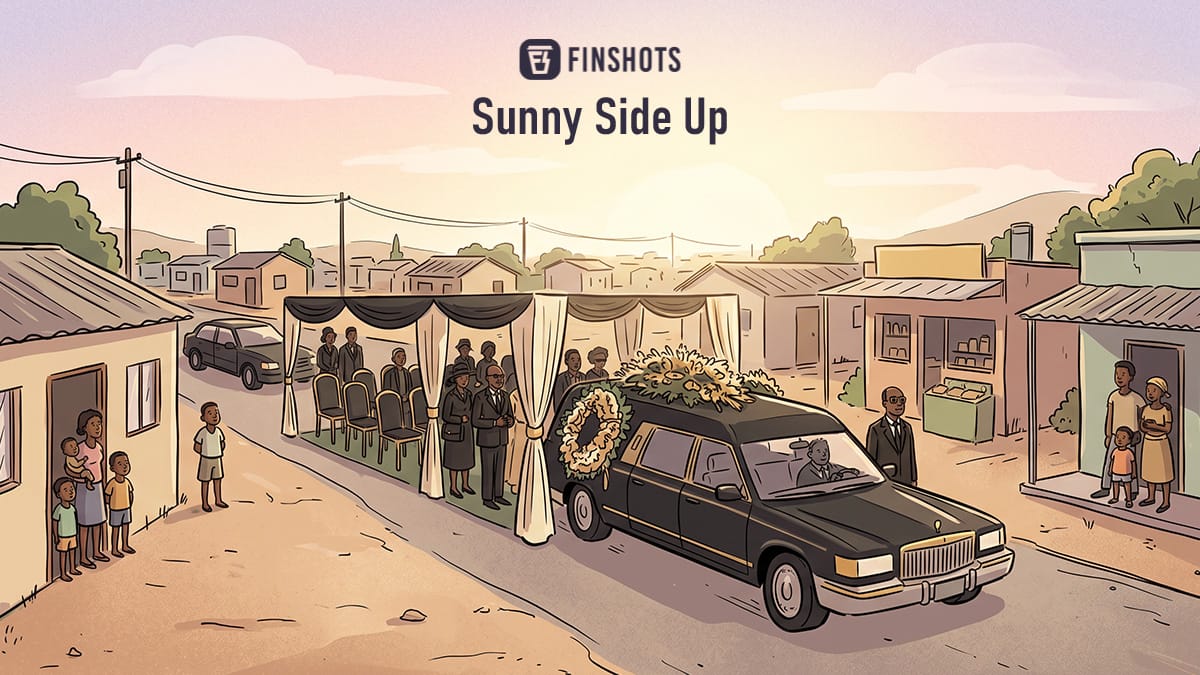
Here’s a did-you-know to get your day started: Funerals in some African cultures are frequently referred to as the “happiest funerals in the world”.
And yes, you immediately thought of the meme, didn’t you? The one where six men in black suits are moving in perfect sync while balancing a coffin on their shoulders? They’re Ghana’s dancing pallbearers, led by Benjamin Aidoo.
Because in places like Ghana, funerals aren’t quiet and private affairs. They’re publicly advertised, with several people attending it, and are considered multi-day social events.
Families spend heavily on food, music, decorations, outfits, and sometimes even “fantasy coffins” custom-shaped like cars, animals, airplanes, or objects associated with the deceased person’s life.
In fact, the average cost of a Ghanaian funeral runs close to $20,000. For context, it is about 40% of the annual household expenditure in some cases.
But the answer becomes clearer once you understand what these funerals are really doing. In many communities, a funeral isn’t just about mourning the dead. It’s about signalling respect, honour, and social standing. A successful funeral is judged not only by the ceremony itself, but by who attends, how many people show up, and how generously they are hosted. In some cases, the food itself becomes the centrepiece of the event.
And if you’re Indian, that logic probably sounds very familiar. Because we’ve built an entire economy around a remarkably similar, but different idea.
You see, India’s wedding industry is worth $130 billion a year, making it the 4th largest industry in the country. In 2024 alone, approximately 4.8 million weddings took place between October and December alone, generating ₹6 lakh crore in spending.
And here is another shocking statistic. A 2024 analysis by Jefferies found that Indian families, on average, spend twice as much on a single wedding as they do on 18 years of their child’s education!
This spending isn’t happening because Indian families are reckless. But primarily because society demands it. In India, weddings are not proportionate to income, they’re proportionate to social pressure. The guest list is the performance of a family’s social connections. The venue, the jewellery, and the outfits are proof of its standing because apparently, every Indian family knows 400 people that they “can’t NOT invite”.
And it’s the middle class that bears the sharpest end of this. For a middle class family, spending even a fraction of their wealth on a wedding can jeopardise their financial security entirely. Unlike Mukesh Ambani whose son's wedding reportedly cost ₹4,000-5,000 crore but amounted to just 0.5% of his net worth, the middle class spending the majority of what they’ve saved for a lifetime, which is brutal.
And the opportunity cost makes it even worse. A middle-class spending ₹30 lakh could have grown that money to ₹2-3 crore over 20 years. The wedding doesn’t just cost money today, it sort of cancels wealth that could have been. Indian weddings are a loud, joyful, and well, slightly unhinged celebration of love, but also one of the most financially consequential decisions a family will ever make.
So next time you find yourself at a shaadi, surrounded by fairy lights and a buffet that has five variations of paneer and wondering how London Thumakda always makes it to the wedding playlist, remember, you’re not merely attending a wedding, you’re witnessing an economy run entirely by emotion and expectations.
Infographic
Readers Recommend
This week, our reader Jitesh Haria, recommends reading Maverick by Ricardo Semler.
It’s about how the author transformed his family business by throwing out traditional management rules and giving employees unusual freedom. Like setting their own salaries, choosing managers, and making decisions. Basically, a story about running a company by trusting people instead of controlling them, and how that surprisingly led to business success.
And here’s what Jitesh has to say about it:
It changed my entire thought process towards work and life — from a controlled, ‘CCTV-style’ leadership approach to a highly decentralised, non-authoritative, ownership-driven leadership style.
Thanks for the recommendation, Jitesh!
That’s it from us this week. We’ll see you next Sunday!
Until then, send us your book, music, business movies, documentaries, or podcast recommendations. We’ll feature them in the newsletter! Also, don’t forget to tell us what you thought of today's edition. Just hit reply to this email (or if you’re reading this on the web, drop us a message at morning@finshots.in).
Correction: An earlier version of this edition mentioned that the Indian wedding industry is worth $130 million instead of $130 billion. We apologise for the oversight and have since corrected it.
Don’t forget to share this edition on WhatsApp, LinkedIn and X.
Also, did you read the first edition of Finshots Pocket Economics (FPE) yet? If not, check it out here. It’s our new weekly series where we break down economic theories and show you how they influence the decisions you make in everyday life. New editions drop every Saturday. And if you want them straight in your inbox and haven’t subscribed to Finshots yet, hit subscribe so you don’t miss an edition.