
FPE #6: Economics is about more than just money
In this final Finshots Pocket Economics edition, we talk about opportunity costs or the economics concept that teaches you how to use not just your money, but also your time.
But before we begin, here’s a quick recap of what we wrote over the past week. On Monday, we explored whether the AI revolution will finally turn Universal Basic Income (UBI) into reality. On Tuesday, we explained why the government is exempting foreign investors from taxes. On Wednesday, we did an explainer on the RBI’s special plan to attract $50 billion into India. On Thursday, we tried to reason how 40 lakh tonnes of coal stocks went missing from SCCL, South India’s primary coal supplier. And yesterday, broke down the business behind the long-awaited NSE IPO.
With that out of the way, let’s get started with FPE, Edition #6.
A few years ago, a couple I know got married. The groom, Anuj, is a banker.
He got married around the time he was due for a promotion. But surprisingly, he decided not to write the exam that would make him eligible for it. Not just once. He did that year after year for three years.
And whenever I casually chatted with Meera, the bride and my friend, she would tell me that Anuj was postponing his promotions because he felt that the first few years after marriage were important for spending quality time together, in fact, too important to sacrifice at the altar of career growth.
Because the moment he’d enter the race for a promotion, and especially if he got one, he would be busier, return home later, and possibly even have to move to unfamiliar places if luck wasn’t on his side. And those weren’t the first memories of togetherness he wanted his spouse to have with him.
Pretty sweet, right?
Right. But maybe you’re also thinking about the money he gave up during those three years.
After all, a promotion usually comes with a pay hike. He could have saved that extra income and done something meaningfully useful with it by now. Maybe put a down payment on a house, bought some gold, purchased a car, or even funded a nice vacation.
You’d be completely right to think that way. And without even realising it, you’ve just understood the central idea behind today’s edition ― opportunity cost.
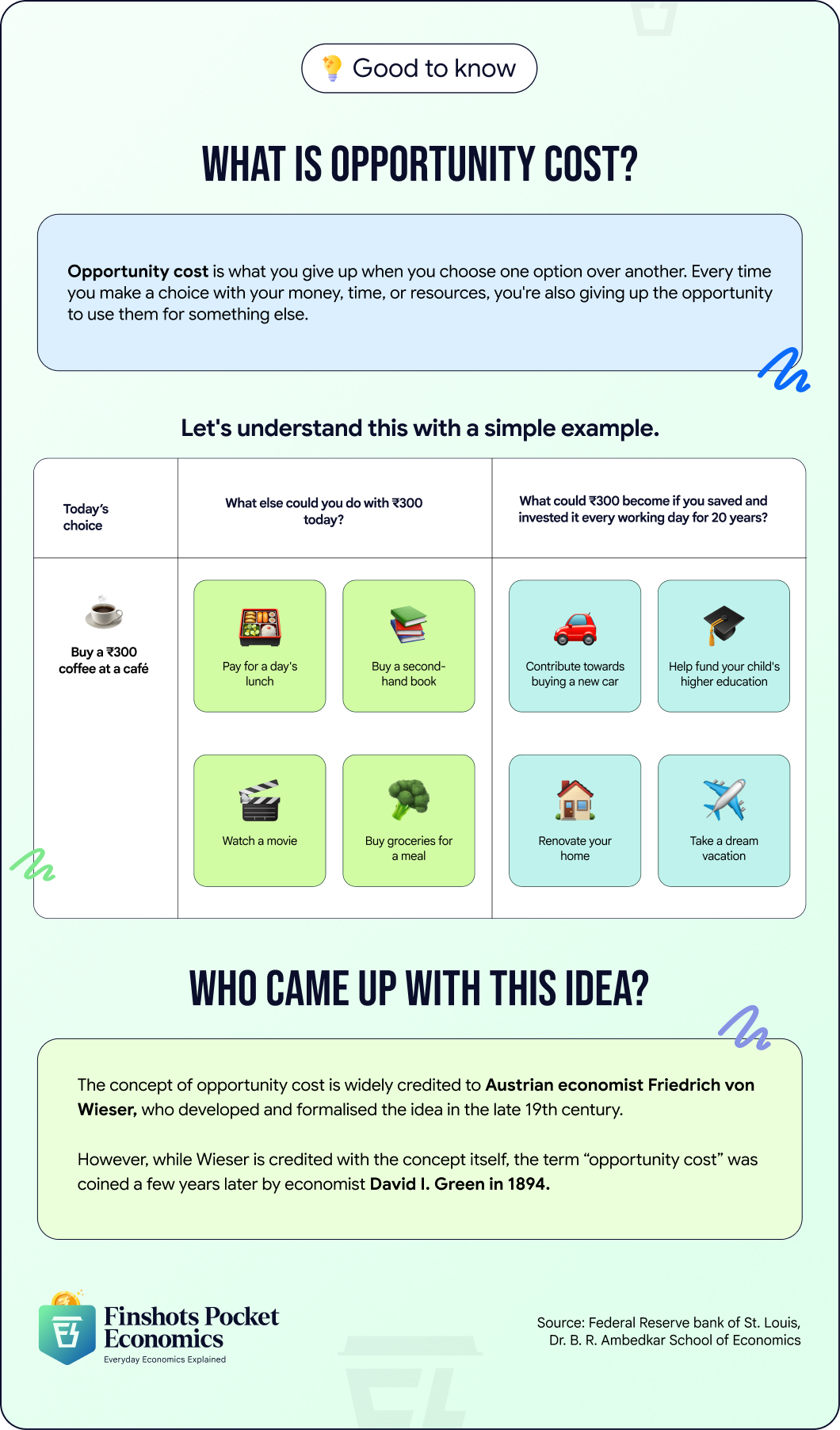
In simple terms, opportunity cost is what you give up when you choose one option over another. Economists define it as the value of the next-best alternative you forgo when making a decision. Because every time you choose how to spend your money, time, or effort, you’re also giving up the next-best thing you could have done instead.
Let’s take a simple example. You could spend ₹300 today on a coffee at a nice café. But that same ₹300 could have bought you a book if you enjoy reading, paid for a meal, covered groceries, or even gotten you a movie ticket.
Or you could have done something much bigger with that money later. Imagine saving that ₹300 every working day and investing it in a fund that earns 12% annually. Over 20 years, it could grow into several lakhs of rupees, which could help fund a vacation, pay for higher education, contribute to your child’s education, or even help buy a car.
Every one of those possibilities carries value. And by choosing one option, you’re giving up the others. That’s opportunity cost.
The end goal, however, isn’t to avoid opportunity costs. That’s not practically possible because every choice comes with one. The real goal here is to make sure what you gain feels more valuable than what you give up.
And that’s the most beautiful thing about this concept. The “best” choice isn’t always the one that makes the most money. Sure, saving ₹300 every day might look like the smartest financial decision. But what if you genuinely can’t afford to save that amount? Or what if that daily coffee is the one small ritual that helps you slow down, clear your head, and take a break from all the stressful things in life?
Those are benefits that don’t come with a price tag.
The same logic applies to time, energy, peace of mind, relationships, and experiences.
And maybe that’s exactly how Anuj saw it. For him, the opportunity cost of delaying promotions was three years of additional income and the things that money could have bought. But in return, he gained something he valued more — quality time, stability, and the chance to build strong foundations during the early years of marriage.
To him and his wife, those years together were priceless. And if that’s what they valued most, then perhaps the opportunity cost was worth paying.
And just like Anuj and Meera, there are countless situations in life where we’re forced to make a choice and weigh the opportunity costs that come with it:
Let’s start with something most of us battle with every night: screen time. Every night at 11 p.m., you feel guilty about scrolling through reels instead of sleeping.
But instead of feeling guilty, take a pause and look at it as an opportunity cost problem. Depending on what you value more in that moment, you could do one of two things.
Option 1: Put your phone down and sleep at 11 p.m.
You wake up refreshed, start your day with more energy, reach the office on time, and stay focused throughout the day. But the opportunity cost might be the FOMO (fear of missing out). You miss the memes, viral videos, and conversations your friends may be talking about during lunch.
Option 2: Keep scrolling
You get a few more minutes of entertainment and instant gratification. But the opportunity cost is tomorrow’s energy and focus. If you choose to pay that price, you risk a sluggish and late start to your day.
Which option seems better here?
Most people would probably pick Option 1, even if it means a little FOMO. But sometimes you might deliberately choose Option 2 because you value those extra moments of relaxation more than an early start the next morning.
And that’s the point. Whatever you choose, you’re not avoiding trade-offs. You’re simply choosing which cost to pay. That’s opportunity cost in motion. There’s often no universally right answer. It mostly comes down to what matters more to you at that particular moment.
Another way opportunity cost shows up in our lives is when we decide whether to do something or not do it.
Take meetings at work, for instance.
Our writing team has an edit call every morning where we discuss stories and ideas. But beyond that, there are plenty of meetings throughout the day. If that’s also how your workday sounds like, how do you decide whether you should attend all these meetings or not? (And no, this doesn’t apply to meetings that HR has marked as compulsory. Don’t try using opportunity cost as an excuse there. 😂)
One way is to use what’s called the hourly wage method. The idea is to simply convert your time into a rupee value by dividing your income by the number of hours you work.
Let’s say you earn ₹1 lakh a month and work 22 days, 9 hours a day. That means your time is worth roughly ₹500 an hour.
Now imagine you’re invited to a two-hour meeting. The meeting isn’t costing you just two hours. It’s costing you time worth about ₹1,000. So the real question is “Will attending this meeting create more value than whatever else I could have done during those two hours?”
Maybe the meeting helps solve a major problem, aligns the team, or helps you make a better decision. In that case, attending is probably worth it.
But if it’s a meeting where you barely contribute and could simply read the notes later, the opportunity cost might be too high. Those two hours could have been spent finishing a project, writing a report, speaking to customers, or doing work that creates more value.
In such cases, if the meeting is avoidable, you could skip it. And if you manage a team, you might even delegate it to someone else.
You can apply the same idea to something as simple as cleaning your house versus hiring a house help. Let’s say cleaning your house every weekend takes about three hours. Now, imagine your time is worth ₹500 an hour based on your salary or earning potential from a freelance project. That means those three hours are worth ₹1,500.
If you can hire someone to do the same job for, say ₹300, the opportunity cost of cleaning the house yourself isn’t just three hours of effort. It’s the ₹1,200 difference between the value of your time and the cost of outsourcing the task.
Those three hours could have been spent working on a side project, learning a new skill, spending time with family, exercising, or simply resting and recharging.
Of course, this doesn’t mean you should outsource everything. Maybe you enjoy cleaning or don’t mind spending your weekend that way. Just that the hourly-rate method gives you a useful framework for deciding whether doing something yourself is truly the best use of your time.
But perhaps the most common use of the opportunity cost concept shows up in the financial decisions we make every day.
Like should you buy a house or continue renting? Should you spend the annual bonus you earned on a vacation or use it to pay down a portion of an outstanding loan? Should you buy an expensive premium phone today to win your friends’ and colleagues’ validation, or invest that money and let it grow?
You could choose to do any of these things. But if you want to evaluate the decision purely from a financial perspective, a useful way to think about opportunity cost is to ask yourself, “What am I giving up by choosing this option?”
Sidebar: Or, in the case of buying versus renting, check out the Finshots Money edition we did on it.
Take the annual bonus example. Suppose you receive a ₹1 lakh bonus and decide to spend it on a vacation. You get memories, experiences, and a break from work.
But the opportunity cost is what that same ₹1 lakh could have done elsewhere. Maybe it could have reduced your loan burden and saved you future interest payments. Or perhaps it could have been invested and grown over time.
For instance, if that ₹1 lakh earned a 12% annual return for 10 years, it would grow to roughly ₹3 lakh. In that case, the opportunity cost of taking the vacation isn’t ₹1 lakh. It’s the future value of the wealth you gave up by not investing it.
Of course, that doesn’t automatically make the vacation a bad decision. Because just like we saw earlier, not every benefit can be measured in money’s worth. The memories you create, the stress you shed, or the time you spend with loved ones may be worth far more to you than the money you could have earned.
Often, we see working couples trying to maximise their income so that their spouses, families, and children can have a comfortable life. But that can also come at a cost.
Longer working hours may mean less quality time with your spouse. Chasing the next promotion may mean missing a child’s school event. Taking on more responsibilities at work may mean not knowing what’s happening in your parents’ lives until much later.
In trying to buy life’s comforts, we sometimes end up sacrificing moments that can never be bought back.
And in situations like these, quantifying the trade-off in money may not be the best way to look at it. Because what is the value of being present when your child takes their first steps? Or having dinner with your parents while they’re still healthy? Or spending an extra hour every evening talking to your spouse?
There’s no formula that can accurately put a price tag on those things. But that doesn’t mean opportunity cost disappears.
It simply means that the opportunity cost isn’t measured in rupees. It’s measured in memories, relationships, experiences, and moments that may never come again.
And that’s what makes opportunity cost such a powerful concept.
With that, we wrap up not just this edition, but this series as well.
We hope you’ve enjoyed reading it as much as we’ve enjoyed putting it together. If you did, we’d love to hear from you. Just hit reply to this email (or, if you’re reading this on the web, drop us a message at morning@finshots.in). Or even better, share it with your friends and family on WhatsApp, LinkedIn, and X.
And if you’d like to revisit any of the topics we’ve covered, you can catch the full series here.
Finshots Weekly Quiz v2.0 🧠
As you probably already know, the Finshots Weekly Quiz has a new avatar. If you missed out on it in the last couple of months, don’t worry. Click here to check out the rules and set a reminder to participate consistently starting next month!
Next, let’s move on to the top scorers from our previous weekly quiz. There were a whole bunch of you who participated, and many of you ended up with the same scores. So we’re calling you Bulls, Bears, Unicorns, Blue Chips, and Rising Stars. Here’s how the leaderboard looks right now:
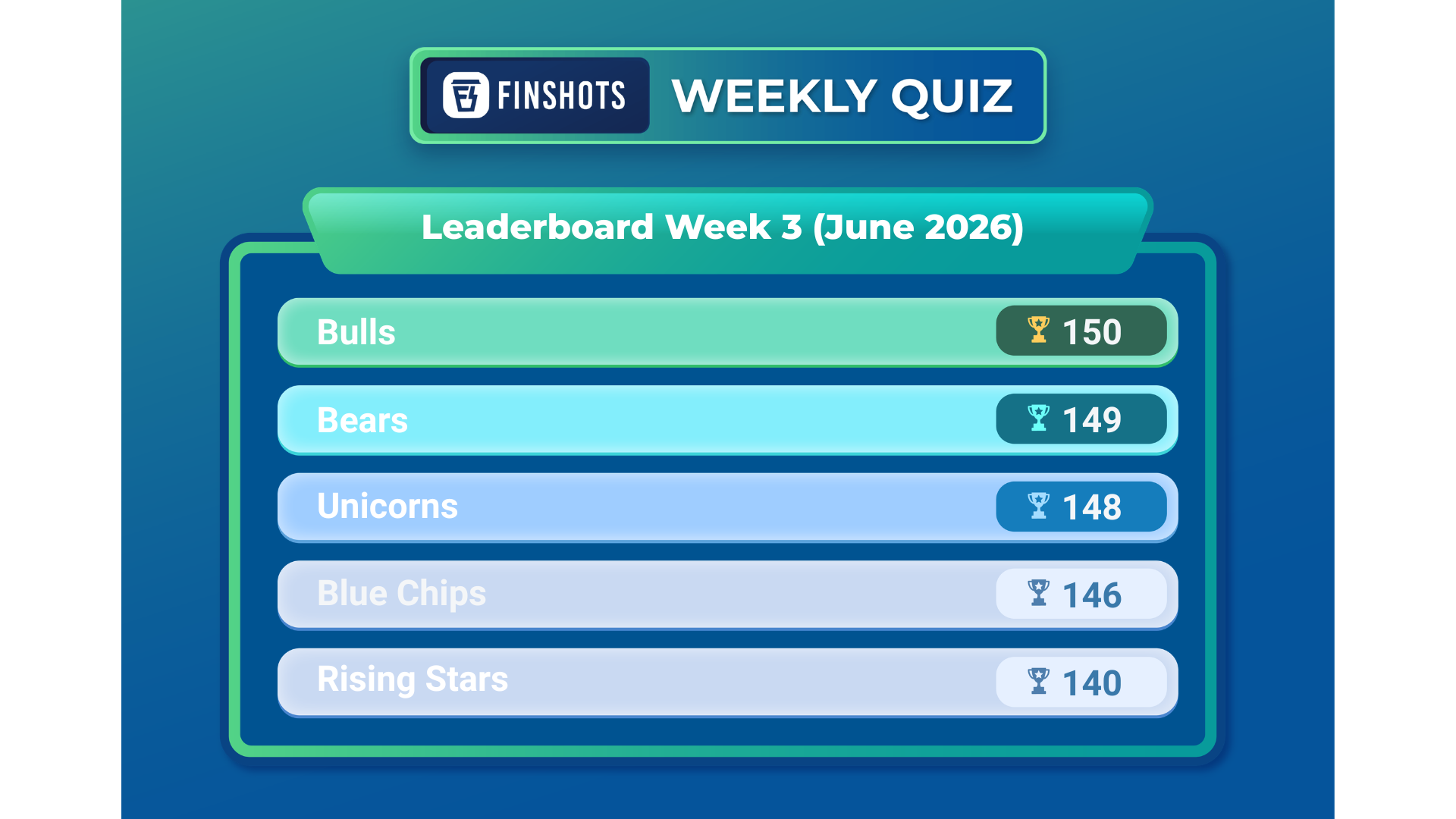

If your name has been featured on the leaderboard, then congratulations! If not, don’t lose hope. If you attempted last week’s quiz, keep at it and answer all the weekly quizzes this month. You never know when the turntables! Click on this link to take this week’s quiz, which is open till 12 noon, Friday, 26th of June, 2026. The more answers you get right, the better your chances of appearing on the Finshots Weekly Quiz leaderboard. We’ll publish it every Saturday in the Weekly Wrapup. And the winner will be announced in the first week of July.