
The missing case of 40 lakh tonnes of coal
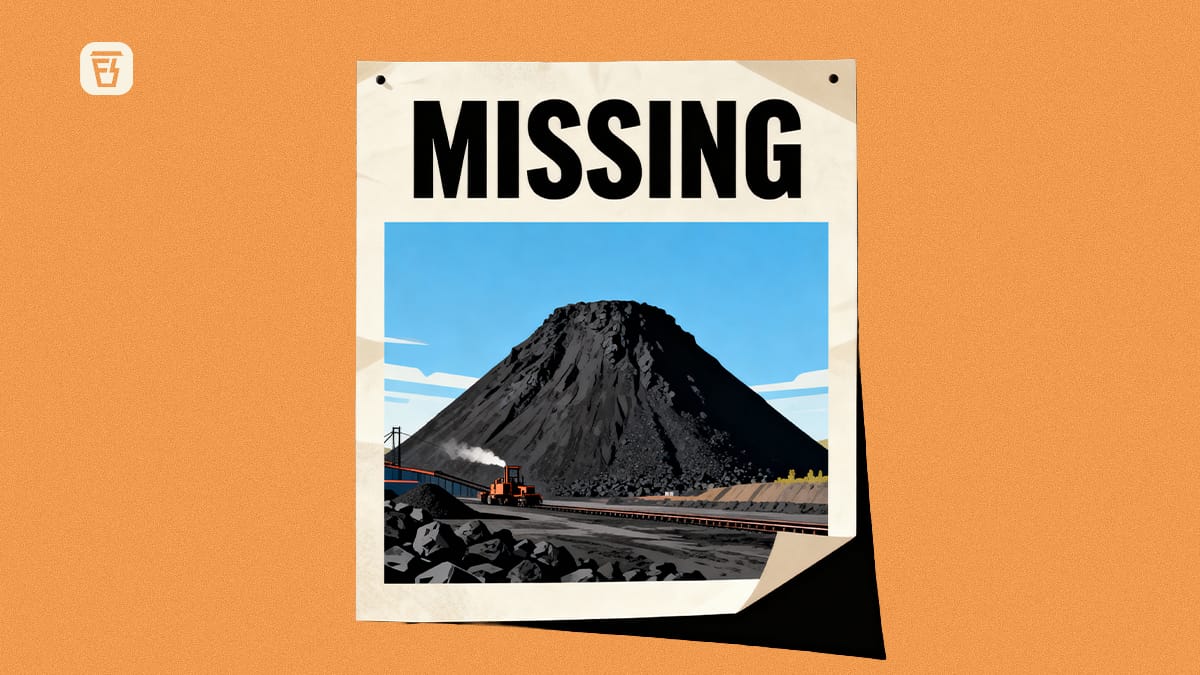
In today’s Finshots, we try to reason through how 40 lakh tonnes of coal stocks have gone missing from SCCL (Singareni Collieries Company Ltd.).
But here’s a quick sidenote before we begin. We’re looking for a business writer to join Finshots’ newsletter team. If you’re someone who can tell compelling stories and explain financial concepts in plain English without drowning readers in jargon, do consider applying through the link here. Or share this with someone who might be a good fit for the role.
Now onto today’s story.
The Story
Coal might not win any awards for being the most glamorous commodity out there. But it is undeniably the backbone of India’s energy system. With roughly 74% of the country’s electricity still generated by coal-fired power plants, every single tonne pulled from the earth carries massive economic weight.
That makes the recent controversy surrounding Singareni Collieries Company Limited (SCCL), South India’s primary coal supplier, particularly alarming. Union Coal Minister G. Kishan Reddy recently wrote to Telangana Chief Minister Revanth Reddy, seeking a formal inquiry into a rather baffling discrepancy after nearly 40 lakh tonnes of coal appeared to have vanished from SCCL’s records.
To grasp the sheer scale of that number, 40 lakh tonnes of fuel is enough to keep the lights on in millions of households. And if you were to sell that pile in the domestic market right now, it would fetch around ₹1,600 crore, and probably a lot more if shipped overseas.
Naturally, this sparks a very simple yet startling question: How does Coal, something that is heavy and bulky, just disappear like that?
Well, commodities rarely disappear in the literal sense, like a magician’s coin. Coal leaves a massive physical footprint. So, when murmurs of “missing coal” start making the rounds, it almost always points to a mismatch between what the accounting books say should be there and what is actually sitting in the physical inventory.
And while an official inquiry will likely uncover the facts and no official explanation has emerged yet, still, there are a few practical ways to explain this gap.
Because here’s the thing. Coal inventories are never perfectly stable.
Unlike a pile of steel rods or shipping containers, coal is a living inventory. It loses moisture and sheds dust that can be blown away by windstorms. Sometimes it even catches fire on its own.
Mining companies around the world account for what they call “system losses”. They’re small reductions in stock that occur naturally during storage and transportation.
Individually, these losses are tiny. But when you’re managing tens of millions of tonnes, even a 1% discrepancy can translate into hundreds of thousands of tonnes on paper.
The most innocent explanation is a simple measurement error. You do not weigh millions of tonnes of coal on a kitchen scale. Inventories are estimated using complex surveys, density assumptions, and daily production records. Across sprawling mines and colossal stockyards, even a tiny miscalculation can snowball into a massive discrepancy over a few years.
Then, there is the quality factor. Coal is not a uniform, static product. Its weight, moisture content, ash content, and calorific value (the amount of energy released when a unit of coal is burned) fluctuate depending on the type of coal and environmental conditions.
So, if a company’s inventory system fails to properly adjust for a pile of coal drying out under the hot sun, the recorded stock levels will slowly drift away from physical reality.
But we also have to look at the darker possibilities.
Historically, coal supply chains have always been leaky. Moving this rock involves a tangled web of contractors, transport operators, etc. This creates multiple touchpoints where diversion can occur.
Add to that the complexities of public sector governance.
State-owned enterprises are often subject to multiple layers of administration, which can make accountability diffuse and decision-making slower. In a system like that, a bookkeeping discrepancy can quietly grow for years before anyone notices.
And this is a big deal because coal is a strategic national resource. When global crude oil prices go up and down like a roller coaster, a country needs absolute certainty about its domestic fuel reserves.
If inventory records are effectively a guessing game, national planning takes a hit. Power plants might also overestimate their fuel security, the government might misjudge supply conditions, and investor confidence might start to crack.
But of course, a discrepancy on paper is not automatic proof of a grand heist. That is exactly why an independent inquiry is necessary to clear the air.
But looking at the bigger picture, this entire episode shines a harsh spotlight on accountability and modern inventory management.
If we look closely at countries like China and Indonesia, they have spent the last decade building robust systems to ensure their fossil fuels stay exactly where they are supposed to be.
China’s large state-owned miners barely rely on manual estimates anymore. They deploy GPS-enabled truck tracking, RFID (Radio Frequency Identification) tags, automated weighbridges, and centralised digital dashboards.
Every truckload is monitored from extraction to delivery. Instead of sending people with measuring tapes, they use drones and LiDAR (Light Detection and Ranging, the technology used in robot vacuum cleaners to map your home) to map stockyards, and mine managers can watch their inventory move in real time.
Indonesia took a slightly different path to combat illegal mining. Regulators built sweeping digital platforms that integrate the entire supply chain. Export permits, transport logs, and daily production data are interlinked, creating a digital fence that makes it incredibly difficult for a shipment to fall off the back of a truck.
In fact, Indonesia’s biggest lesson isn’t technological at all. It is procedural. Production records, transport permits, stockyard inventories, and export documentation increasingly flow through the same digital systems.
That means a mismatch cannot hide in one corner of the supply chain for very long. Every tonne produced is expected to show up somewhere else in the system. And when it doesn’t, investigators know exactly where to start looking.
The ultimate irony here is that none of this technology is out of reach for India. We have an extensive satellite network, including specialised satellites with both SAR & optical imaging capabilities together. This essentially gets us an accurate picture of the Earth even in darkness or under cloud cover, which means that it could also be used to remotely monitor large open-air coal stockpiles without deploying personnel on the ground.
In fact, many of these technologies are already being deployed across parts of India’s mining sector. The problem is that they haven’t become the norm. Industry estimates suggest that nearly 70% of mining dispatch records are still maintained manually, which means critical information often sits in disconnected systems rather than flowing seamlessly across the supply chain.
A company mining 7 crore tonnes of a vital natural resource should not have to rely on manual, paper-based documentation.
Either way, whether these 40 lakh tonnes were stolen, miscalculated, or simply lost in a spreadsheet, the lingering uncertainty points to a glaring flaw. India is managing one of its most critical economic engines with surprisingly limited visibility.
So yeah, the mystery may not be just about how 40 lakh tonnes of coal disappeared into thin air, but also about how the system only realised it was gone well after the fact.
Until then…
Liked this story? Share it with a friend, family member or even strangers on WhatsApp, LinkedIn and X.
🚨 ATTENTION: FINSHOTS FAMILY
This week we’re hosting a free 2-day Insurance Masterclass that helps you build real financial security by understanding health and life insurance the right way.

📅 Friday (tomorrow), 19th June at 6:30 PM: Life Insurance
How to protect your family, choose the right cover amount, and understand what truly matters during a claim.
📅 Saturday, 20th June at 10:00 AM: Health Insurance
How hospitals process claims, common deductions, the mistakes buyers usually make, and how to choose a policy that won’t disappoint you when you need it most.