
Can Coforge build an AI giant through acquisitions?
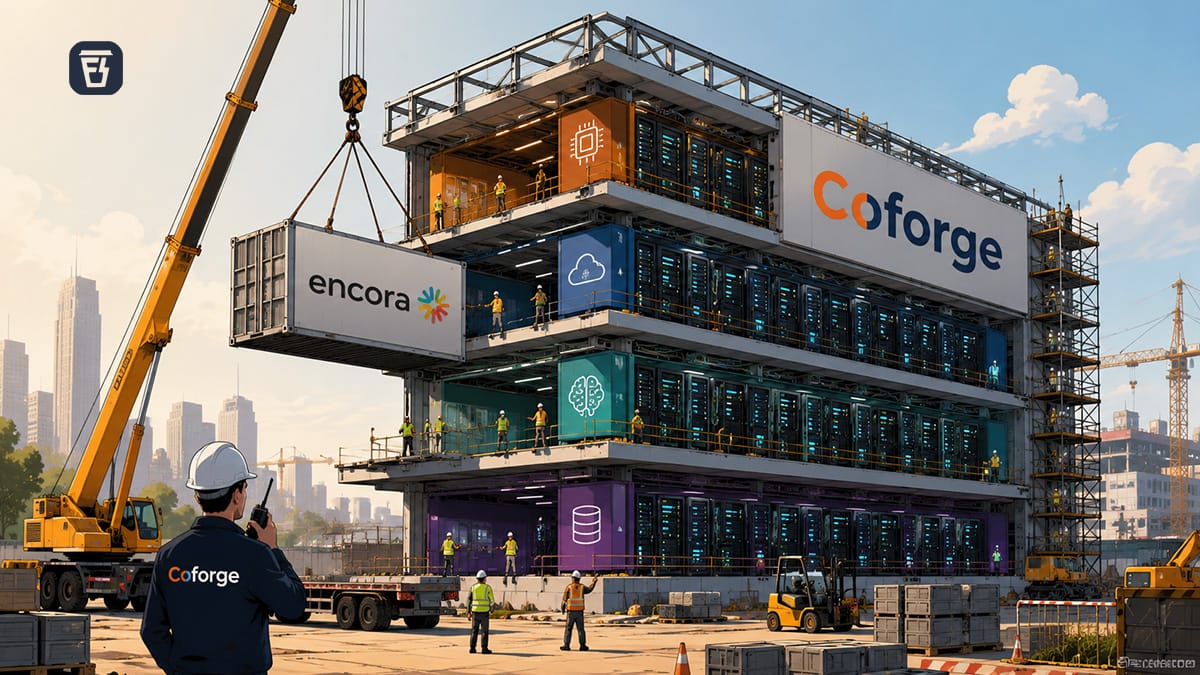
In today’s Finshots, we explain why Coforge is spending billions of dollars on acquisitions, and whether buying up client relationships can replace the traditional Indian IT playbook.
But here’s a quick sidenote before we begin. If you’re someone who loves to keep tabs on what’s happening in the world of business and finance, then hit subscribe if you haven’t already. We strip stories off the jargon and deliver crisp financial insights straight to your inbox. Just one mail every morning. Promise!
If you’re already a subscriber or you’re reading this on the app, you can just go ahead and read the story.
I was reading an Andreessen Horowitz (a16z) newsletter earlier this week about how AI companies win customers. It argued that there are broadly two playbooks:
- Lighthouse: The first is the "Lighthouse" strategy, where startups chase a handful of marquee customers whose logos signal credibility to the rest of the market.
- Landgrab: The second is the "Landgrab" strategy, where companies ignore prestige and instead sign as many customers as possible, betting that scale and economics will matter more than famous names.
The right strategy for your company depends on one simple question:
Are you trying to earn trust, or are you trying to capture the market?
That framework stayed with me because the more I thought about it, the more it felt like it described what was happening in India's IT industry, especially with companies like Coforge.
Well, to be clear, Coforge doesn't quite fit either bucket. But it seems to be carving out a middle path. Instead of winning customers one account at a time or having a few marquee customers, it buys companies that already have long-standing customer relationships and then finds ways to sell those clients a lot more than they were buying before.
But to understand why this strategy even makes sense, we need to zoom out and look at what's happening to the IT industry itself.
You see, for nearly three decades, Indian IT services relied on a remarkably simple formula known as labour arbitrage. Companies hired thousands of software engineers domestically, where talent costs were significantly lower than in Western markets, and billed their time out to international clients at hourly rates.
The model was remarkably simple because more engineers meant more billable hours. More billable hours meant more revenue. And this exact framework transformed companies like TCS, Infosys, Wipro, and HCLTech into global powerhouses.
AI, however, is beginning to break that equation. If an AI assistant allows a single engineer to complete a software development project in half the time, enterprise clients will inevitably question why they should continue paying for the original number of billable hours.
While AI implementation creates new demand for cloud migrations, data structuring, and system integration, it simultaneously reduces the overall volume of human labour required for routine maintenance and coding.
And that's precisely why Coforge made the biggest bet in its history by acquiring engineering specialist Encora for $2.35 billion. The sheer scale of the deal helped transform Coforge into an enterprise generating nearly $2.5 billion in annual revenue.
To fund the transaction, Coforge issued nearly 94 million new shares to private equity sellers Advent International and Warburg Pincus, while securing a three-year bridge loan of $550 million. In simple terms, Coforge asked existing shareholders to share ownership with new investors and also took on a sizeable amount of debt to fund the acquisition.
On paper, the immediate financial results look exceptional. Coforge reported a 49% surge in year-on-year revenue, alongside expanding operating margins, despite absorbing a global workforce of over 9,000 Encora employees.
But those headline numbers reflect the fact that Encora's financials were consolidated into the company's reporting for part of the quarter.
And that's hardly surprising. Because if you buy a large company, your reported revenue will almost always jump overnight. The real question, however, is whether Coforge has found a repeatable way to make those businesses worth much more than they ever were on their own.
And it appears that they just may have. You see, Coforge is purchasing niche domain specialists that hold decades-long client relationships and nearshore delivery centres in critical markets. Once an acquisition closes, the management moves swiftly to integrate the target firm into a single operating platform, eliminate duplicate corporate overhead, and, more importantly, start pitching a wider range of services to the customers it has just acquired.
Its earlier acquisition of software testing firm Cigniti offers a clear blueprint of how the strategy operates in practice. Before joining Coforge, Cigniti had spent twenty-five years building deep technical expertise, but it had never managed to land a truly massive enterprise contract. Its two largest customer accounts combined generated around $25 million in annual revenue. Within months of being integrated into Coforge, those same two client accounts expanded to nearly $75 million through broader project proposals, while EBITDA margins rose from 11% to roughly 19%.
Encora is simply Coforge trying to repeat the same trick, only this time on a much bigger stage. The company brings eleven major client accounts that each generate over $10 million annually, with many of those corporate relationships spanning more than a decade. Coforge plans to cross-sell its own cloud, insurance, and automation services into those accounts, while simultaneously pitching Encora's specialised engineering capabilities to its existing client base.
But Encora brings something else to the table too: over 3,100 engineers based across Latin America. This gives Coforge a powerful nearshore presence to serve clients in the US within their own time zones. Combined with Encora's portfolio, Coforge now manages forty-five client relationships that generate over 10 million each. That's becoming increasingly important because AI projects often require engineers to work closely with clients in real time. Being in a similar time zone is suddenly becoming a competitive advantage.
But every bold strategy comes with an equally bold set of risks. Encora was not a distressed asset purchased at a discount; Coforge paid an enterprise value of $2.35 billion, which translates to roughly 3.9x revenue and 20x EBITDA. At that price, there isn't much room for things to go wrong.
And investors seem to share that optimism. Despite being much smaller than India's IT giants, Coforge trades at valuation multiples that rival or even exceed many of its larger peers. In other words, the market isn't paying for what Coforge is today. It's paying for what it believes Coforge could become if this acquisition-led strategy works.
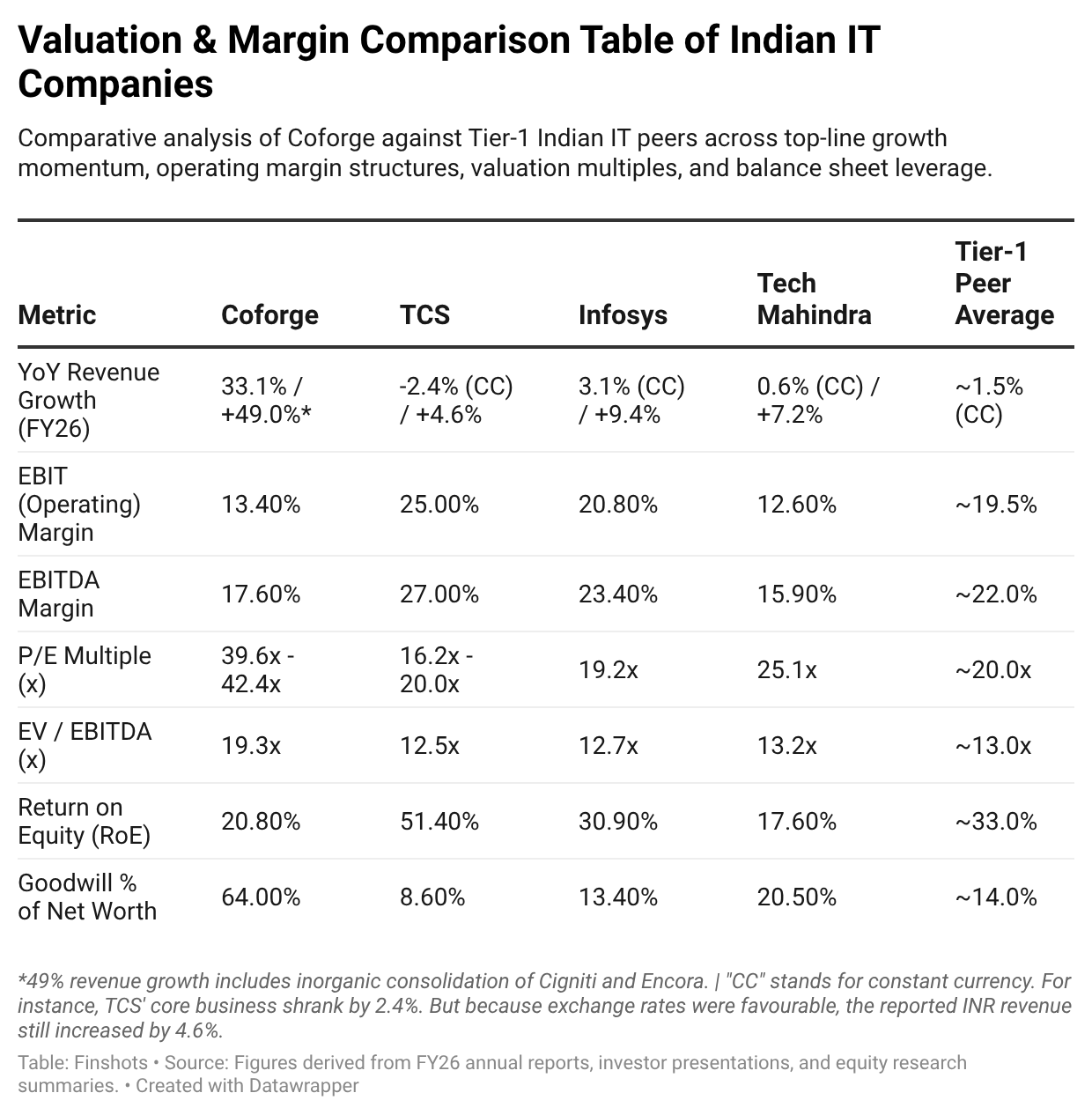
You can already see the cost of that ambition on Coforge's balance sheet. Following recent transactions, goodwill rose sharply to 64% of the company's net worth, compared with historical levels of 34 to 40%.
And goodwill isn’t necessarily a bad thing. It simply reflects the premium a company pays over the fair value of an acquired business because it expects to benefit from intangible assets like customer relationships, brand value, and future earnings. But when goodwill becomes a very large part of a company's net worth, it also raises the stakes. If those acquisitions fail to deliver the promised growth, the company may eventually have to write down that goodwill, hurting both profits and investor confidence.
Contract acquisition costs have also escalated as the firm pursues massive multi-year deals, driving higher upfront cash outflows. Management says the underlying business continues to generate healthy cash flows. But that's also the reality of acquisition-led growth. The financial burden arrives immediately, while the benefits usually take years to show up.
Ultimately, acquisitions don't create value because they add revenue overnight. They create value only when the combined business becomes worth more than the two companies ever could have been separately. That's now the standard Encora will be judged against.
Coforge's ambitious transformation is less about AI buzzwords and more about the changing structural economics of the IT services industry. Because for decades, the primary competitive advantage for Indian tech firms was maintaining access to a massive pool of affordable engineering talent. As artificial intelligence automates routine tasks, that historic advantage naturally loses its potency. Tomorrow's winners may not be the companies with the largest workforce. They may simply be the ones with the strongest customer relationships.
So yeah, the Lighthouse and Landgrab strategies may explain how some AI companies acquire customers. But Coforge builds on a different premise. Rather than winning relationships from scratch, it acquires companies that already possess them and then uses its own operating model to unlock more value from those accounts.
Coforge has clearly recognised the structural shift in Indian IT, and is placing a massive bet on “relationship arbitrage” as the true successor to labour arbitrage. And early results from smaller acquisitions show that the integration playbook can work under the right conditions.
If Encora delivers the same results that Cigniti did, Coforge may prove that this is another viable way to grow in the AI era.
However, integrating an entity as massive as Encora represents an entirely different order of magnitude. The coming quarters will reveal whether Coforge can successfully scale this model to build a true technology giant, or whether it has simply paid a premium price for a very complex growth story.
Until then…
If you liked this story, feel free to share it with your friends, family, or even strangers on WhatsApp, LinkedIn, and X.
How strong is your financial plan?
You've likely ticked off mutual funds, savings, and maybe even a side hustle. But if Life Insurance isn't a part of it, your financial pyramid isn't as secure as you think.
Life insurance is the crucial base that holds all your wealth together. It ensures that your family stays financially protected when something unpredictable happens.
If you’re unsure where to begin, Ditto's IRDAI-Certified insurance advisors can help. Book a FREE 30-minute consultation and get honest, unbiased advice. No spam, no pressure.