
How close are we to Universal Basic Income?

In today’s Finshots, we explore whether the AI revolution will finally turn Universal Basic Income (UBI) from a utopian dream into an economic reality.
But here’s a quick sidenote before we begin. We’re looking for a business writer to join Finshots’ newsletter team. If you’re someone who can tell compelling stories and explain financial concepts in plain English without drowning readers in jargon, do consider applying through the link here. Or share this with someone who might be a good fit for the role.
With that out of the way, let’s dive into today’s story.
The Story
Back in 1516, English philosopher Thomas More wrote a book called Utopia. In it, he posed a simple question: what if people steal not because they're criminals, but because they're desperate?
If hunger and poverty are pushing people toward crime, he argued, wouldn't it make more sense to ensure everyone had the means to survive in the first place? As he famously put it, it made little sense to turn someone into "first a thief, and then a corpse."
And for centuries that followed, the idea of giving everyone free money remained nothing more than a philosophical debate. Governments simply lacked the administrative machinery to send cash directly to millions of people. But fast forward to today, and a massive technological shift is dusting off this 500-year-old idea.
Look at what is happening in South Korea right now. Semiconductor giants like Samsung Electronics and SK Hynix are minting money from the AI boom, heavily driven by the explosive demand for high-bandwidth memory chips. The profits are so staggering that a South Korean policymaker recently proposed giving citizens “dividends” using excess revenues that came from taxing AI profits. He publicly pushed tech companies to share their AI-driven windfalls with workers and suppliers, too.
Why, you ask?
Because there is a growing anxiety that the vast benefits of AI will be hoarded by a tiny circle of companies, investors, and highly skilled workers, thereby increasing income inequality.
This echoes exactly what Elon Musk has been talking about. Musk believes advanced AI will eventually become so hyper-productive that human labour might take a backseat, forcing society to adopt some form of Universal Basic Income (UBI), or Universal High Income, as Musk calls it. In his view, the problem of the future won't be creating wealth; it will be ensuring that enough people get a share of it when machines do most of the heavy lifting.
Which brings us to the multi-trillion-dollar question: If AI creates unprecedented prosperity, is it time for UBI to step off the whiteboard and into public policy?
Well, UBI’s appeal is incredibly simple. Instead of untangling a messy web of dozens of welfare programs with strict eligibility rules, the government just gives every citizen a guaranteed income floor.
The premise is that nobody goes to bed hungry or will have to worry about a roof over their head. As a result, financial anxiety drops, people get the breathing room to pursue education, care for loved ones, or start a business without the constant dread of survival hanging over their heads.
And real-world trials show the idea isn't as radical as it sounds.
When Finland ran a widely discussed basic income experiment, recipients reported lower stress, better mental health, and higher life satisfaction. In Kenya, cash transfers boosted household nutrition, consumption, and even local economic activity. Alaska has its Permanent Fund, which pays residents a yearly dividend from state oil revenues. It has operated for decades without causing the mass labour dropout that many people swore would happen.
Contrary to popular belief, across these experiments, researchers found a common thread that most people just kept working. The assumption that free money automatically breeds laziness has found surprisingly little support in the data.
But here is where reality bites.
Most of these pilot programs were small, temporary, and tightly controlled. Running a two-year experiment for a few thousand people is a completely different beast than guaranteeing a permanent income for an entire nation indefinitely.
And this is where we must talk about the elephant in the room.
A meaningful UBI requires astronomical sums of money every single year. Even the wealthiest nations on earth would sweat trying to fund it. Proposals often rely on wealth taxes, automation taxes, or taxes specifically on AI-generated profits. Yet, every single one of these funding sources comes with severe political and economic trade-offs.
One interesting proposal that's gaining traction is something called an AI Sovereign Wealth Fund.
The idea is borrowed from countries like Norway and Alaska. Instead of imposing heavy new taxes on AI companies or handing out corporate profits directly to citizens, governments would funnel a portion of the excess tax revenues generated during AI and semiconductor booms into a professionally managed investment fund.
Think of it this way. Suppose an AI supercycle causes semiconductor companies to generate record profits and pay unusually large amounts in corporate taxes, rather than spending that windfall immediately, the government invests it across a diversified portfolio of global assets. Over time, those investments generate their own returns, creating a permanent pool of capital that can fund citizen dividends, worker retraining programs, pensions, or support for people displaced by automation.
The logic is simple. Imagine if the government funded UBI directly using taxes collected from AI companies. During an AI boom, tax collections would explode, and citizens could receive generous payouts. But what happens when the boom ends? Semiconductor profits fall, AI spending slows, tax revenues dry up, and suddenly the government either has to slash payments or borrow heavily to keep them going.
This is where a sovereign wealth fund can solve the problem. Instead of distributing every rupee of tax revenue immediately, the government invests a portion of those windfall gains into a diversified portfolio of assets. Over time, the fund generates its own investment returns, allowing future payouts to be based on a much more stable income stream rather than the unpredictable fortunes of a single industry.
Then there is the philosophical divide. While giving cash directly is an efficient poverty-killer, money alone doesn’t fix broken healthcare, crumbling schools, or a lack of affordable housing. If a government replaces public services with a monthly cheque, it might just be treating the symptoms rather than curing the disease.
The AI angle makes this debate incredibly complicated. If automation ultimately creates more jobs than it destroys, just as previous technological revolutions did, we might never need UBI. But if AI is fundamentally different, allowing mega-corporations to rake in billions with a skeleton crew, the pressure for aggressive wealth redistribution will become difficult to ignore.
However, a full-scale UBI still appears distant.
This is especially true in developing countries like India. Here, the government must simultaneously juggle the massive costs of healthcare, infrastructure, defence, and education, as well as a web of existing welfare schemes. Finding the capital for a nationwide, unconditional UBI in that environment is a near-impossible math problem today.
Instead of jumping straight to a pure UBI, governments will likely test the waters with stepping stones. We might see more targeted cash transfers or subsidies (oh wait).
Ultimately, real-world trials show that UBI is neither a guaranteed economic miracle nor a societal disaster. Recipients generally spend the money responsibly, and overall well-being improves based on limited studies. But the challenge of financing it at scale remains unsolved.
So yeah, while AI is making the conversation more relevant than it has been in centuries, the world is still far from embracing UBI as a catch-all solution. What AI is really doing is holding a mirror up to society and forcing us to confront a question that Thomas More and Juan Luis Vives asked over 500 years ago: If society becomes dramatically wealthier, how should we share the spoils?
UBI is just one possible answer. Whether it is the right one remains very much an open question.
Until then…
Liked this story? Share it with a friend, family member or even strangers on WhatsApp, LinkedIn and X.
Also, if you’re someone who loves keeping tabs on the world of business and finance, hit subscribe if you haven’t already. And if you’re already a subscriber, thank you! Maybe forward this to someone who’d enjoy our stories but hasn’t discovered us yet.
🚨 ATTENTION: FINSHOTS FAMILY
This week we’re hosting a free 2-day Insurance Masterclass that helps you build real financial security by understanding health and life insurance the right way.
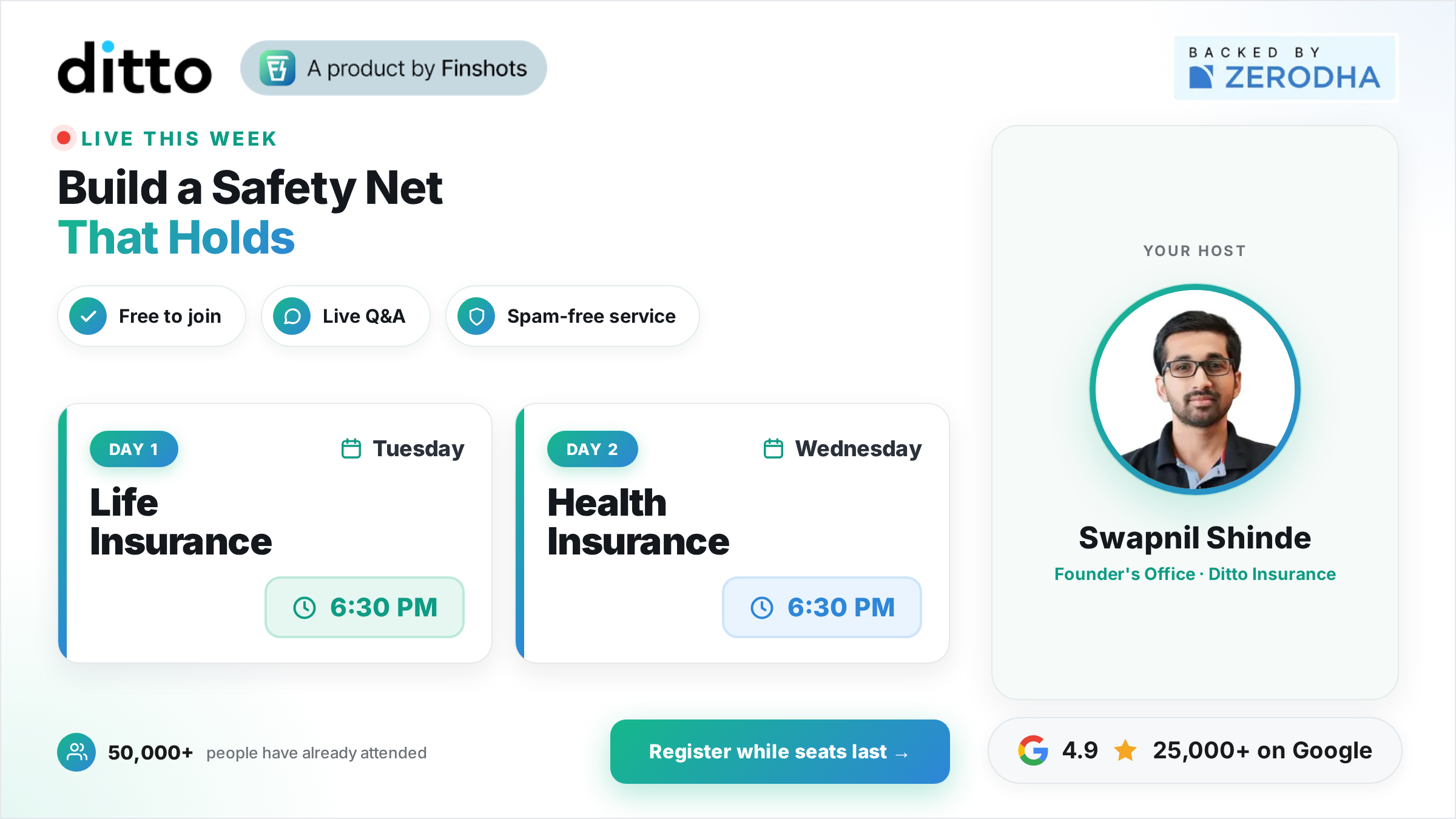
📅 Tuesday (tomorrow), 16th June at 6:30 PM: Life Insurance
How to protect your family, choose the right cover amount, and understand what truly matters during a claim.
📅 Wednesday, 17th June at 6:30 PM: Health Insurance
How hospitals process claims, common deductions, the mistakes buyers usually make, and how to choose a policy that won’t disappoint you when you need it most.