
Carlsberg's impressive margins, Binance's $6 billion heist, & more...

In this week’s wrapup, we discuss China’s AI bubble, Binance’s $6 billion crypto heist, India’s booming astrotech industry, the challenges of expanding the country’s strategic petroleum reserves, and the Indian beer industry through the lens of Carlsberg’s UDRHP.
Also, here’s a quick note before we dive in. We’ll be taking a publishing holiday tomorrow, November 8th, for Diwali. We’ll be back with a new story on November 9th. Have a safe and happy Diwali!
Has China’s AI bubble already burst?
In just four months, the STAR 50, China’s main index of AI stocks, has fallen about 40%. That wiped out nearly $480 billion of investor wealth. Over the same period, the Nasdaq in the US barely moved.
Part of the reason lies in how the rally started. Beijing wanted to depend less on US tech, so state-backed funds poured money into chipmakers, robotics firms and AI labs. Retail investors saw that backing as a signal to buy.
At the peak, AI stocks made up 42% of China’s stock market value and 57% of its trading volume. Even the robot maker Unitree’s IPO was oversubscribed 8,000 times. But then, its first earnings showed 17% lower profits, and its stock has since halved.
So is this only China’s problem, or an early warning for AI stocks everywhere? Read the full story here.
The problem with cryptocurrency
Binance, the world’s largest cryptocurrency exchange, was hacked last week, with hackers stealing over $6 billion worth of crypto in just 20 minutes.
And Binance is far from alone. Bybit lost roughly $1.5 billion in 2025, WazirX lost over $230 million in 2024, and more than $1.31 billion was lost across 344 incidents in just the first half of 2026.
This naturally raises a more practical question for retail investors as to how safe the crypto sitting in our own accounts is.
If even the world’s largest exchange can be drained in 20 minutes, should we take security into our own hands? Or can the crypto industry learn from these failures and become, in a way, antifragile?
Read our full story to find out.
How astrology became a big bucks business in India
Astrology has been around in India for centuries. But who would have thought that something people once turned to neighbourhood astrologers for would one day become a billion-dollar tech business?
Startups found a way to do exactly that by bringing astrologers and customers together through apps. And the pandemic gave the industry a massive push. Today, young Indians are spending money to get answers about everything from relationships to careers. There’s also a growing market for gemstones and even financial astrology. But what’s really driving this unusual business boom?
That’s what we explored in Wednesday’s newsletter. You can read it here.
Why can’t India simply build bigger strategic oil reserves?
India imports nearly 90% of its crude oil needs. So, when war or geopolitical tensions disrupt oil supplies, the shock can travel thousands of miles and hit our wallets. That’s where strategic oil reserves come in. They’re essentially emergency stockpiles that countries can tap when imports dry up.
Yet, India’s reserves offer barely a week of cover, while countries like Japan and South Korea have enough stocks to last over 200 days.
So why hasn’t India built a bigger safety net? The answer involves some expensive trade-offs, from the cost of building underground storage and filling it with oil to bureaucratic delays and competing budget priorities. But there are smart ways to address these issues.
Find out how India can strengthen its energy security in our Thursday’s newsletter.
Carlsberg’s profit margins look great. But…
When you think of beer in India, United Breweries’ Kingfisher is probably the first name that comes to mind. After all, it commands nearly half the market. Carlsberg, on the other hand, sells only about one in every five beers. And yet, it makes more than twice the operating profit margin of its bigger rival.
A big reason for this is that Carlsberg understood its customers’ preferences early on and built much of its business around strong beer, which accounts for most of its sales. It also benefitted from falling raw material prices over the last few years and a few other cost advantages. All of this helped keep its expenses low compared to the revenue it earned from selling beer.
But that advantage is now beginning to fade.
For context, in Q1FY27, Carlsberg’s operating profit margin fell sharply compared to the same quarter last year, even as its revenue jumped. So, what’s eating into its margins, and can the company protect the healthy profits it has built over the years?
Find out in yesterday’s Markets edition here.
Finshots Weekly Quiz v2.0 🧠
As you probably already know, the Finshots Weekly Quiz has a new avatar. If you missed out on it in the last few months, don’t worry. Click here to check out the rules and set a reminder to participate consistently starting next month!
But for now, it’s time to announce the winners. First up, the winner of Finshots Weekly Quiz v2.0 for October 2026. Drumroll, please… 🥁 Bimla Devi! Congratulations.
Next, let’s move on to the top scorers from our previous weekly quiz. There were a whole bunch of you who participated, and many of you ended up with the same scores. So we’re calling you Bulls, Bears, Unicorns, Blue Chips, and Rising Stars. Here’s how the leaderboard looks right now:
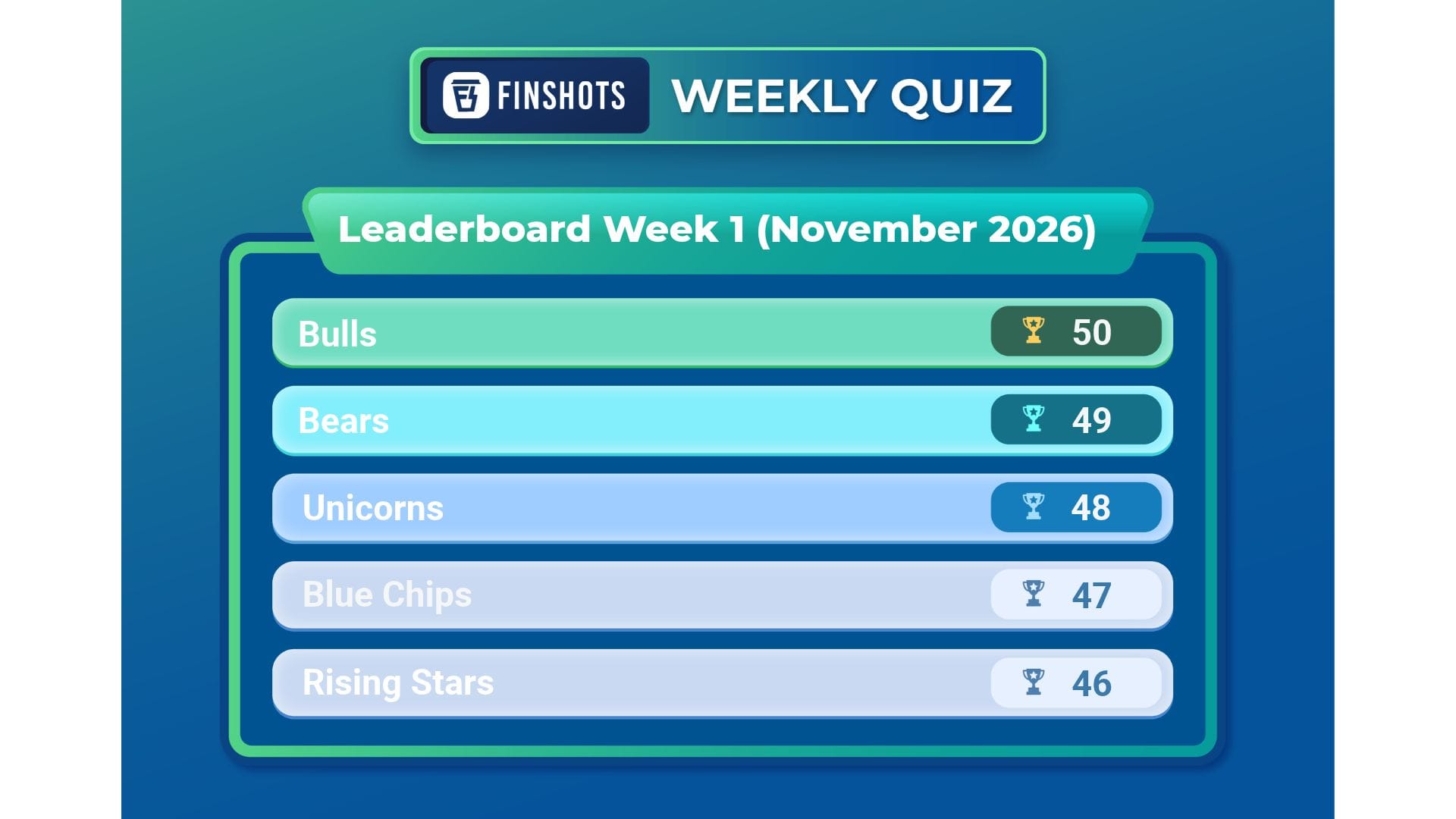
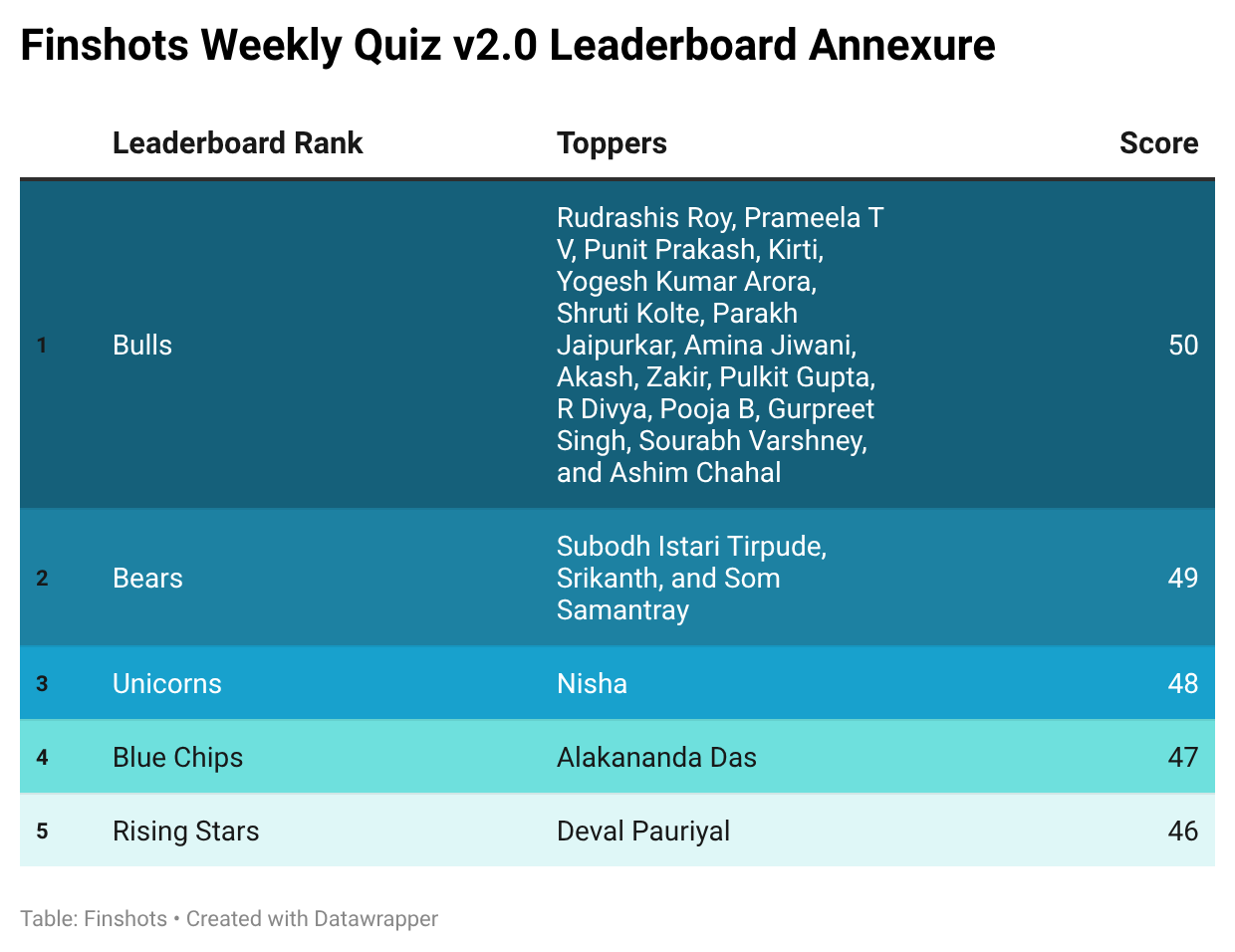
If your name has been featured on the leaderboard, then congratulations! If not, don’t lose hope. If you attempted last week’s quiz, keep at it and answer all the weekly quizzes this month. You never know when the turntables! Click on this link to take this week’s quiz, which is open till 12 noon, Friday, 13th of November, 2026. The more answers you get right, the better your chances of appearing on the Finshots Weekly Quiz leaderboard. We’ll publish it every Saturday in the Weekly Wrapup. And the winner will be announced in the first week of December.
Liked this week’s wrapup?
Don’t forget to share it with your friends, family, or even strangers on WhatsApp, LinkedIn, and X. And subscribe to Finshots, if you haven’t already. Plis!