
Has China's AI bubble already burst?
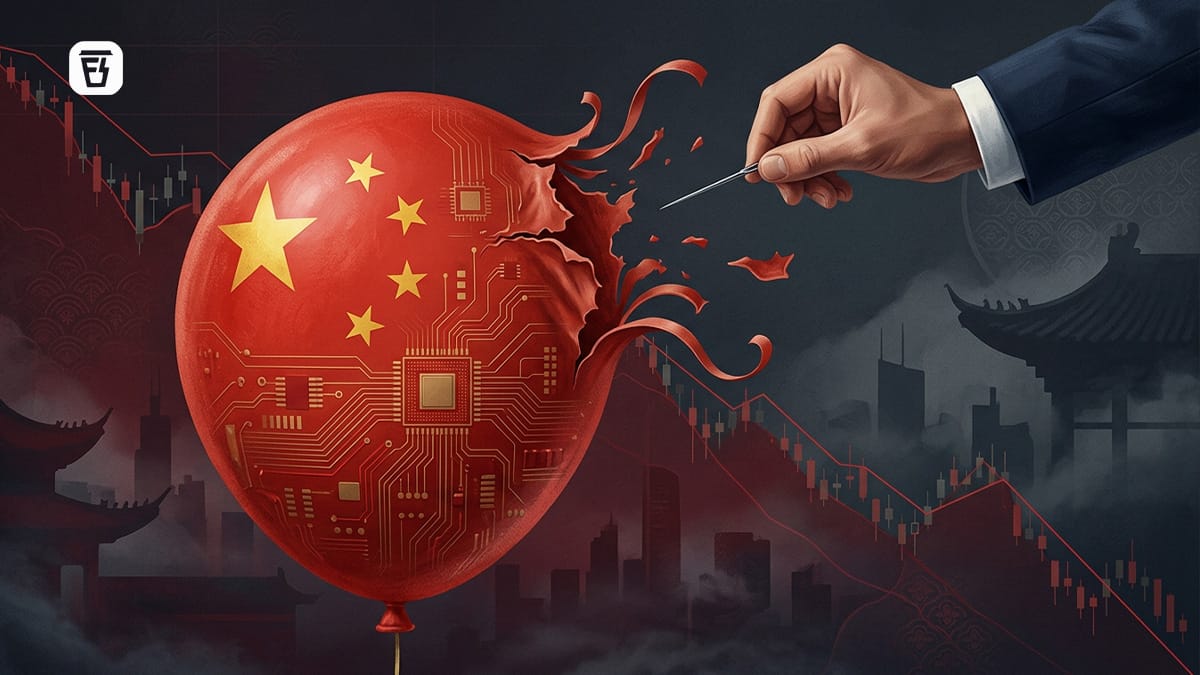
In today’s Finshots, we look at how the global AI boom turned into a debt-fuelled bubble and why that bubble may have already popped in China.
But before we begin, if you’re someone who loves to keep tabs on what’s happening in the world of business and finance, then hit subscribe if you haven’t already. We strip stories off the jargon and deliver crisp financial insights straight to your inbox. Just one mail every morning. Promise!
If you’re already a subscriber or you’re reading this on the app, you can just go ahead and read the story.
The Story
For the last few years, Wall Street has been debating a simple question. Is artificial intelligence the biggest bubble of our lifetimes, or the greatest technological leap since the internet?
In the US, investors are still giving AI the benefit of the doubt. That’s why the tech-heavy Nasdaq has barely flinched.
But if you look across the Pacific, you’ll find that China’s AI rally has already come crashing down.
Over the past four months, China’s STAR 50 index, which is the country’s main index of AI stocks, has crashed by 40%, wiping out nearly $480 billion in investor wealth.
And because China pushed its AI ambitions particularly aggressively, the meltdown offers a glimpse of what could happen when AI hype collides with cold financial math.
To understand why, we first need to look at how the global AI boom took shape. When OpenAI launched ChatGPT in late 2022, America’s tech giants panicked. Afraid of missing out on the next big technological shift, hyperscalers (companies that run the world’s biggest cloud networks) like Amazon, Google, Meta and Microsoft went on a spending spree. They poured billions into building data centres packed with specialised AI chips. In Silicon Valley, tech leaders openly admitted that they’d rather build too much capacity than risk falling behind.
And those data centres needed plenty of computing power. Training AI models involves processing enormous amounts of data, which requires specialised processors capable of running thousands of calculations simultaneously. Most of those chips came from one company: Nvidia.
So when Big Tech went shopping, a large chunk of that money flowed straight to Nvidia. With over 70% of the AI chip market, the company saw its annual sales explode nearly fivefold in two years, briefly pushing its valuation up from $400 billion to $2.8 trillion.
Meanwhile, hyperscalers and chipmakers have piled up $3.7 trillion in combined debt and off-balance-sheet lease commitments to build data centres, almost the size of Manhattan.
But there’s a problem with that math. Building and running AI infrastructure costs an enormous amount of money. But to make these investments worthwhile, the AI industry needs to generate enough revenue to justify the spending. One estimate suggests it needs around $600 billion in annual revenue just to generate adequate returns on its hardware investments.
Yet actual customer spending on generative AI is expected to reach just $64 billion this year.
What’s worse is that some of the revenue reported across the AI ecosystem may be supported by what’s called circular financing. For instance, a tech giant invests billions in an AI startup like OpenAI or Anthropic. The startup then uses some of that money to buy cloud computing services from the same tech giant. Even though that revenue is real, the concern is that demand may be partly dependent on investment money circulating within the same ecosystem rather than independent customers paying for AI services.
And that’s not the only reason investors are apprehensive about whether all this spending will pay off. The first major crack showed up on what Wall Street called AI’s “Black Monday”. When a little-known Chinese lab named DeepSeek released its open source reasoning model, it proved you could train a world-class AI model at a fraction of OpenAI’s cost using older chips. Nvidia shed $600 billion in market value in a single day as investors realised companies might not need enormous computing investments after all.
Now, Wall Street is asking Big Tech to show that the returns justify the spending. Just this week, Alphabet lost nearly $500 billion in market value after its heavy AI investments raised concerns about cash flows.
But while Wall Street is only beginning to feel the tremors, China’s AI market has already lived through the earthquake. So why did China’s bubble burst first?
It comes down to how Beijing fuelled its AI rally. Over the past two years, China wanted to revive its sluggish economy and reduce its dependence on American technology. So state-backed funds began pouring money into domestic chipmakers, robotics companies and AI labs.
And in a market where individual investors play a major role in trading, government backing acts like an official stamp of approval. Millions of retail traders rushed to buy AI stocks, turning what was supposed to be a gradual market recovery into a speculative frenzy.
Soon, AI stocks accounted for 42% of China’s entire stock market value and 57% of all trading volume. In fact, at the peak of the rally, companies on China’s STAR 50 index were trading at nearly 250 times their annual profits. And at such steep valuations, even a small disappointment can send investors rushing for the exits.
Take Unitree, a Chinese humanoid robot maker backed by state funds, for example. When it listed in August, retail investors were so eager to buy its shares that its IPO was oversubscribed 8,000 times. But its first post-IPO earnings report showed net profits falling 17% as research and development costs doubled. Its stock has since halved.
Several other domestic chipmakers have also lost half their value since July. Meanwhile, optical hardware makers Zhongji Innolight and Eoptolink plunged 60% amid fears that Washington could restrict Chinese components in US data centres. Even emergency stock purchases by a state-owned firm couldn’t stop the decline.
But the bigger problem facing Chinese AI companies is a familiar one: price wars.
Just like China’s solar and electric vehicle industries, government subsidies encouraged too many companies to build similar AI models and hardware. Now, with competition intensifying, companies may have to slash prices to survive. That could leave everyone fighting for market share while making very little money.
And there’s another reason investors should be worried. Even if AI eventually transforms the global economy, that doesn’t mean everyone building its infrastructure will make money.
We’ve seen this happen before. Back in 1996, a breakthrough called Wavelength Division Multiplexing allowed a single fibre-optic cable to carry 16 streams of internet data instead of one. Convinced that internet traffic would triple every year, telecom companies borrowed around $500 billion to lay millions of miles of cable across oceans and continents.
The internet was very real, of course, and it eventually changed the world. But telecom companies built far more capacity than customers needed at the time. So when the dot-com bubble burst, roughly 85–95% of those buried cables remained unused. They became known as “dark fibre”, while stocks plunged and dozens of telecom companies went bankrupt.
There’s an important difference between those cables and today’s AI infrastructure, though. Fibre-optic cables can sit underground for decades, waiting for demand to catch up. AI chips, on the other hand, can lose economic value much faster as newer, more efficient processors arrive. If computing capacity grows faster than customer demand, the prices companies can charge for renting out that capacity could fall sharply.
China’s $480 billion wipeout could well be the first casualty of a global AI reset.
That said, it doesn’t necessarily mean that AI is a fad or that the technology won’t transform the world.
Just like how the internet eventually changed almost everything about how we live and work, and yet that didn’t save the telecom companies that spent billions laying cables nobody needed at the time, AI could follow a similar path.
The technology might be here to stay. But the companies betting trillions on it still need to figure out how to make those investments pay off. And that’s a much harder problem than building the next big AI model.
Until then…
Don’t forget to share this story on WhatsApp, LinkedIn, and X.
🚨 ATTENTION: FINSHOTS FAMILY
This week, we’re hosting a free 2-day Insurance Masterclass that helps you build real financial security by understanding health and life insurance the right way.
📅 Tuesday, 3rd November at 7:30 PM: Life Insurance: How to protect your family, choose the right cover amount, and understand what truly matters during a claim.
📅 Wednesday, 4th November at 7:30 PM: Health Insurance: How hospitals process claims, common deductions, the mistakes buyers usually make, and how to choose a policy that won’t disappoint you when you need it most.