
The problem with cryptocurrency
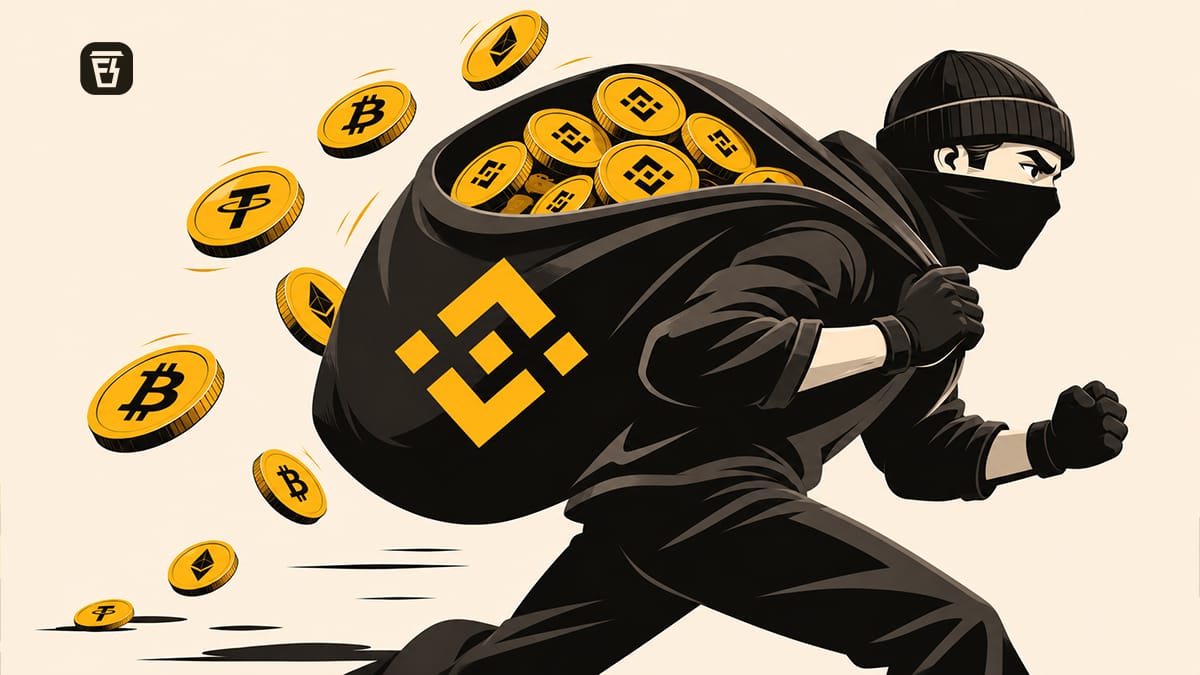
In today's Finshots, we look at the Binance attack and what it reveals about risk across the crypto market.
But before we begin, if you’re someone who loves to keep tabs on what’s happening in the world of business and finance, then hit subscribe if you haven’t already. We strip stories off the jargon and deliver crisp financial insights straight to your inbox. Just one mail every morning. Promise!
If you’re already a subscriber or you’re reading this on the app, you can just go ahead and read the story.
 Love our insights? Add Finshots as a Preferred Source on Google ⭐
The Story
20 minutes.
That’s how long it took hackers to drain over $6.3 billion from Binance, the world's largest cryptocurrency exchange. The attack hit wallets across multiple blockchains, leaving the exchange scrambling to contain the damage.
But how did hackers manage to pull this off without stealing private keys or breaking the cryptography that protects its wallets?
To understand that, we need to look at how cryptocurrency exchanges process transactions. When you buy crypto on an exchange, you don't necessarily hold the private keys to those assets. The exchange typically holds them for you (this is the premise behind the infamous phrase ‘not your keys, not your coins’).
And to process withdrawals quickly, it keeps some funds in hot wallets, which are essentially crypto wallets connected to the internet.
Whenever the exchange needs to transfer those funds, a transaction has to be authorised. This usually involves a signing system that uses the wallet's private keys to create a cryptographic signature and approve it.
Binance's investigation suggests that a DevOps engineer's laptop may have been compromised, and the attackers allegedly used this to exploit the exchange's signing infrastructure. So, to an unsuspecting person, this may have looked like legitimate transactions, but the transfers were far from it.
Binance has said it found no evidence that wallet private keys were leaked, although its investigation is still ongoing. And it also promised to cover the losses through its emergency insurance reserve called the Secure Asset Fund for Users (SAFU) and its own treasury.
At the end of the day, this incident reminds us how quickly a single security failure can become an industry-wide event. But the Binance heist is far from isolated.
You see, crypto platforms have been hit by a series of costly security breaches in recent years. Just to recap, in 2025, attackers stole roughly $1.5 billion in cryptocurrency from the Bybit exchange, which was considered the largest crypto theft in history, until the Binance hack came along. And then there was the 2024 cyberattack on WazirX, which left the exchange short of over $230 million worth of crypto assets. Besides, CertiK, a Web3 security firm, suggests that more than $1.31 billion was lost across 344 incidents in the first half of 2026 alone.
So why have the last few years been particularly bad for crypto security?
For starters, there's simply a lot more money sitting inside centralised exchanges. These platforms have become the gateways through which millions of people buy, sell and hold digital assets. And as crypto adoption has grown, so has the value of cryptocurrencies concentrated in a relatively small number of exchanges and custodians.
Take Binance itself, for instance. In November 2022, it held around 582,486 BTC, worth approximately $9.43 billion at the time. By February 2026, it had increased further to roughly 639,588 BTC, worth around over $50 billion.
In other words, Binance alone was holding tens of billions of dollars' worth of Bitcoin on behalf of its users. This creates an obvious incentive for attackers. Rather than targeting thousands of individual investors, compromising one exchange can give them access to billions of dollars.
The second factor could be the rapid advancement of AI (artificial intelligence). AI is making it easier for attackers to automate parts of their operations, gather information about their targets and create convincing phishing attempts.
In fact, Google has documented threat actors using AI to gather information, create realistic phishing campaigns and develop malware. TRM Labs has also found that AI adoption in crypto crime has grown substantially, particularly in scams and social engineering.
Now, that doesn't mean AI was responsible for the Binance breach. There is no established evidence of that. At least not yet. But it does mean that attackers have a more powerful and scalable toolkit than they did just a few years ago.
And when you combine larger pools of money with more sophisticated tools, hacking becomes an increasingly attractive business. The people behind these attacks are no longer necessarily lone hackers looking to make a quick buck. Organised criminal networks and state-sponsored groups have become major players in the crypto theft business.
In fact, North Korea-linked actors were responsible for around 63% of the value stolen in crypto hacks in 2025, and they stole approximately $12.8 billion in crypto since 2017.
The industry's own preparedness is another concern. Cybersecurity company, Sygnia's 2026 survey found that 83% of respondents in the crypto and decentralised finance sectors had experienced a cyberattack in the preceding 12 months.
Sidebar: I lost some crypto due to a hack, too :(
Across the entire survey, 73% of security leaders said their organisations would not be fully prepared to respond to a major cyberattack. The findings suggest the problem isn't simply that attackers are getting better, but that many organisations still struggle to prepare for the attacks they know are coming.
But these attacks have another consequence.
Every time a major exchange is hacked, investors are reminded of a basic distinction in crypto: owning a cryptocurrency and controlling the keys to it are two different things.
When you keep your crypto on an exchange, you're trusting that platform to safeguard your assets and give you access whenever you need them. This is convenient, especially if you trade frequently. But it also means your security depends mostly on the exchange's systems, employees and internal controls. One way to reduce that dependence is to move long-term holdings into a wallet you control, ideally a cold hardware wallet (a physical device that is not connected to the internet). This keeps your private keys offline, making it less susceptible to hacks. You can then transfer only the amount you need to an exchange when you want to trade or sell. This makes your crypto somewhat antifragile.
And I feel security across the whole industry could evolve in a similar way. This is because every major hack exposes weaknesses in how exchanges store assets, approve transactions and manage access. Those failures can then push platforms to introduce stronger safeguards, investors to take greater control of their private keys, and the industry to develop better monitoring and recovery mechanisms.
Over time, this could make the ecosystem less dependent on a handful of centralised platforms and more conscious of security risks.
So the crypto ecosystem may be learning from its security failures, but it is also revealing how fragile its interconnected structure can be. For the system to become antifragile, it has to manage risk better without creating new vulnerabilities elsewhere.
That said, at the end of the day, for retail investors like you and me, the first step is to understand where our crypto is actually stored and who controls the private keys. If you hold a significant amount of cryptocurrency long term, keeping everything on a centralised exchange isn't wise. Don’t make the mistake I did.
A good hardwallet may cost a little upfront, but it can help by keeping your private keys offline.
Of course, none of these measures can eliminate risk entirely. Even someone using a hardwallet can unknowingly approve a malicious transaction. And even a smart contract that has passed a security audit can still interact with hacked systems. But the objective is to ensure that one malicious link or one mistaken approval cannot bring down an entire system.
Until then...
If you liked this story about the Binance hack and crypto security, feel free to share this with your friends, family, or even strangers on WhatsApp, LinkedIn, or X.
How Strong Is Your Financial Plan?
You've likely ticked off mutual funds, savings, and maybe even a side hustle. But if Life Insurance isn't a part of it, your financial pyramid isn't as secure as you think.
Life insurance is the crucial base that holds all your wealth together. It ensures that your family stays financially protected when something unpredictable happens.
If you’re unsure where to begin, Ditto's IRDAI-Certified insurance advisors can help. Book a FREE 30-minute consultation and get honest, unbiased advice. No spam, no pressure.