
Why can't India simply build bigger strategic oil reserves?
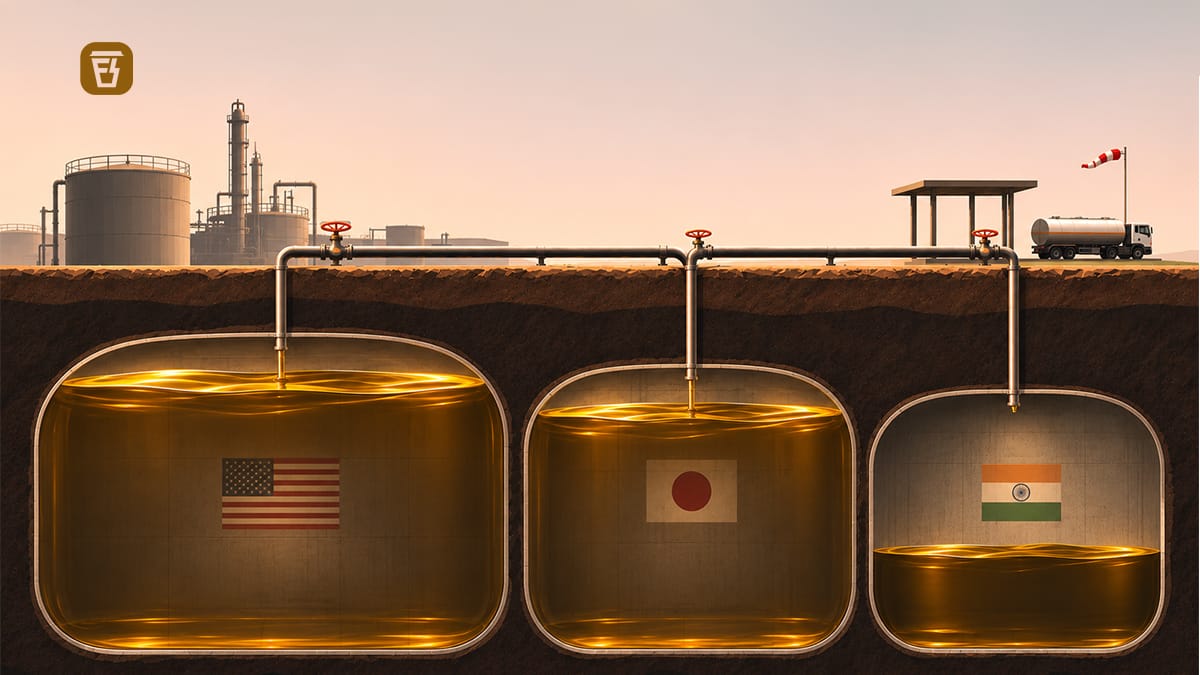
In today’s Finshots, we look at why India hasn’t built bigger emergency oil reserves to protect itself from oil supply disruptions.
But before we begin, if you’re someone who loves to keep tabs on what’s happening in the world of business and finance, then hit subscribe if you haven’t already. We strip stories off the jargon and deliver crisp financial insights straight to your inbox. Just one mail every morning. Promise!
If you’re already a subscriber or you’re reading this on the app, you can just go ahead and read the story.
The Story
When an oil crisis pops up anywhere in the world, it’s usually India that becomes the victim thousands of miles away. That’s because we import nearly 90% of our crude oil.
But then there’s something called strategic oil reserves, where countries maintain emergency stockpiles of crude oil for safety. They can help during wars, geopolitical tensions, or other crises.
India’s existing strategic reserves are managed by a government entity called ISPRL (Indian Strategic Petroleum Reserves Limited) and can hold 5.33 million tonnes of crude oil. That can get us through roughly 10 days of crude requirement if imports get disrupted. But the actual inventory is around 64% of capacity, which means our emergency cushion is even thinner, barely a week. But if we add broader national oil stocks, including those held by oil companies, we can get through 74 days.
By comparison, Japan and South Korea maintain oil stocks equivalent to well over 200 days of imports. And they’re both countries that import between 97% and 99% of the crude that they use.
That naturally makes it look like India is in a very scary spot. And lately, that has sparked conversations around the need to expand the country’s oil reserves, with notable voices such as former RBI governor C. Rangarajan also calling for the country to stockpile more crude oil.
But that begs the question: why exactly hasn’t India built bigger reserves yet?
Well, the first problem is money. Digging underground oil caverns and then filling them with crude is an expensive exercise. These facilities require specialised underground caverns, pipelines, and supporting infrastructure.
India’s Strategic Petroleum Reserve (SPR) programme dates back to the 1990s, although its first phase facilities became operational only in 2019. As national oil needs rose, India planned Phase II of the reserve expansion in 2021, with an estimated cost of around ₹15,000 crore.
And that’s only the cost of building the storage facilities. Filling them with crude oil would cost even more. At $70 a barrel, the lower end of the crude oil price range considered comfortable for India’s economy, buying enough oil to fill the planned reserves could cost well over ₹25,000 crore.
So in total, spending ₹40,000 crore or more is a pretty difficult call to make for a big developing country that imports most of its crude. Because every rupee spent buying oil for emergency storage is money that can’t be spent on other priorities, such as roads, healthcare, or education. To put that in perspective, ₹40,000 crore is nearly 40% of the budget allocated to the Union Health Ministry for FY27.
This investment doesn’t generate a direct financial return either. Oil sitting in an underground cavern only proves its worth when a crisis strikes. And supply shocks aren’t as frequent as they used to be. For context, in any given year, there’s only a 24% chance of an oil supply shock. Of course, the current West Asia crisis feels like evidence against that.
So it doesn’t mean strategic reserves are a waste of money. If anything, they’re insurance against supply shocks that could otherwise send fuel prices soaring. The tricky part is deciding how much insurance the country can afford.
That’s why India is now increasingly using the PPP (public-private partnership) model to expand storage capacity in Phase II. Here, private companies are responsible for building and operating storage facilities with some government support. In normal times, they can lease some of the capacity for commercial use. But in a crisis, the government typically gets the first right to access the crude stored in these facilities.
But even if India manages to finance more reserves, there’s another problem: getting them built on time.
Phase II, for instance, has faced bidding delays and land acquisition hurdles. The government has also repeatedly reduced budget allocations, with actual spending falling well short of original estimates. Although the expansion was announced in 2021, progress has only recently picked up.
In other words, announcing a project is one thing. Actually getting it off the ground is quite another.
India’s planned expansion would double its strategic storage capacity (though even 20 days of cover doesn’t sound particularly impressive). But these projects take years to complete, and every delay leaves the country with a smaller safety net than it needs.
So, what can India do?
For starters, it needs a more predictable, long-term approach to building its strategic reserves. One way to do that is to buy crude oil when prices are low.
Right now, the government sets aside a specific budget every year for ISPRL to buy crude oil and fill these reserves. But in the Union Budget for FY27, the allocation for buying crude was heavily cut down. Even last year’s money largely went unused. Spending on strategic reserves in total was budgeted at ₹5,876 crore but revised down to ₹870 crore.
The problem with this approach is that oil prices don’t always cooperate with the government’s budget cycle. For instance, if prices are above $100 a barrel today but crash tomorrow, India may not have enough money set aside to take advantage of the fall. It would then have to seek additional funds through a supplementary budget allocation.
A better approach could be to create a revolving fund that the government can dip into whenever oil prices fall. This would give us the flexibility to buy crude when it’s cheap, rather than wait for the next budget allocation. Sure, for this to work, the caverns must have empty space, there must be a clear price trigger for buying, and the government should be able to sell oil when prices are high to free up space and refill the fund.
India has already seen the benefits of this approach. In April 2020, after the pandemic crashed prices, it bought crude oil at around $19 a barrel, saving over ₹5,000 crore, according to the petroleum ministry. Such gains can help offset the cost of maintaining the reserves, though they depend on how prices move later.
Another thing that can help, and which India is already doing, is joint stockpiling. Here, an oil-producing country, such as the UAE’s ADNOC (Abu Dhabi National Oil Company), rents space in India’s warehouse and stores its own oil there. Although the oil still belongs to ADNOC, if there is a crisis, India has the first right to take that nearby-sitting oil. In normal times, ADNOC can sell the oil to Indian buyers or other countries.
And finally, legal obligations to maintain government and industry stocks have helped East Asian countries strengthen their energy security. India could adopt a similar approach by setting a legally backed target for 90 days of oil stocks, with interim milestones of 45 or 60 days.
Ultimately, it’s not about the number of days but the will and certainty of action. India should certainly build a larger, reliable buffer that reflects its supply risks and financial capacity, while ensuring that announced projects are actually completed.
Because when the next oil shock arrives, having a plan to build reserves won’t help nearly as much as having the oil already stored underground.
Until then…
If you liked this story, feel free to share it with your friends, family, or even strangers on WhatsApp, LinkedIn, or X.
Trust Finshots for Finance? You'll love Ditto for insurance.
Built by the same four friends behind Finshots, Ditto is here to make insurance simple. No spam, only honest advice to help people make smart insurance decisions.
✅Backed by Zerodha
✅Rated 4.9 on Google (36,000+ reviews)
✅Over 7 lakh customers advised