
Is Vodafone Idea finally making a comeback?
In today's Finshots, we explore whether Vodafone Idea has finally done enough to reverse its long-standing cycle of decline.
But here's a quick sidenote before we begin. We’ll be taking a publishing off tomorrow on account of Independence Day. But don’t worry, we’ll send you a quick wrapup in our Sunday newsletter, along with the weekly quiz and quiz toppers. See you in the Sunny Side Up, and happy Independence Day, folks!
Now, on to today’s story.
The Story
When I interviewed for Finshots with our co-founder, Shrehith, we had an extensive conversation about all sorts of things, from the stock market and interest rates to government policy and the broader economy. But one conversation has stayed with me. We spent quite a bit of time talking about Vodafone Idea and whether the company could ever make a comeback.
You see, at the time, the answer seemed far from obvious. The company had been losing customers, its network was falling behind Jio and Airtel, and its balance sheet was under enormous pressure.
But if you stepped back and looked at the business, the problems were actually quite clear.
Vodafone Idea needed capital to upgrade its network, a solution to its enormous debt and AGR liabilities, a faster migration of customers from 2G to 4G and 5G, and a greater focus on retaining active, high-value subscribers.
These problems fed into one another. Vodafone Idea could not invest because it was losing money, but it was losing money because it could not invest. The longer that continued, the harder recovery became.
And now, almost eight years after the Vodafone-Idea merger, something interesting is happening. The company has started addressing almost every one of those problems.
In the quarter ended June 30, 2026, Vodafone Idea's revenue increased 6% year-on-year to ₹11,689 crore, while its net loss fell significantly to ₹3,754 crore from ₹6,608 crore a year earlier. Its Average Revenue Per User (ARPU) has successfully climbed to ₹177, and, perhaps most importantly, its overall subscriber base increased for the very first time since the 2018 merger. The company is also currently investing heavily in its 4G and 5G network again. Its recent inclusion in the Nifty Next 50 index adds another interesting market signal that investors are beginning to treat Vodafone Idea as a company with a viable future rather than simply a distressed company trying to survive.
So, did Vodafone Idea finally figure out how to revive itself?
Well, the answer to this question is a lot more nuanced than a simple ‘Yes’ or ‘No’.
The company is still losing money, but revenue is now growing faster than operating costs. That matters because telecom is a scale business. Once the network is built, serving another customer does not require another entire network, so higher revenue can eventually translate into a disproportionately larger improvement in profits.
But the income statement only makes sense when we look at the balance sheet. Vodafone Idea's biggest problem was that it had very little financial flexibility. It could not raise money easily, had massive bank obligations and faced the risk that statutory payments would consume the cash needed to keep the business running. That has now changed. Its outstanding bank debt fell to about ₹211 crore as of June 30, 2026, from ₹1,926 crore a year earlier, leaving operational net debt at around ₹3,489 crore. The improvement has also restored lender confidence, with CRISIL assigning the company an A- Stable rating in May.
Following this, Vodafone Idea is actively negotiating a ₹25,000 crore funded facility with a banking consortium led by the State Bank of India, alongside an additional ₹10,000 crore non-funded facility. The company has also maintained its ambitious target of spending roughly ₹45,000 crore on network capital expenditure over the next three years.
But there was another problem that had been hanging over Vodafone Idea for years: AGR dues. Telecom companies pay the government licence fees and spectrum charges based on their Adjusted Gross Revenue, or AGR. The dispute was over what should actually count as AGR. Telecom companies argued that only revenue from telecom services should be included, while the government argued that AGR should also include non-telecom income, such as revenue from investments, interest and other sources of income. In 2019, the Supreme Court sided with the government, leaving Vodafone Idea with a liability that threatened to consume the cash it needed to keep investing in its network.
The second part of the turnaround is its statutory liabilities. AGR (Adjusted Gross Revenue) was one of the biggest reasons investors doubted Vodafone Idea could recover. Even if the operating business improved, a large statutory payment could still drain the cash needed to fund that recovery. The Department of Telecommunications has now reassessed its AGR dues at ₹64,046 crore as of December 31, 2025, down from ₹87,695 crore. More importantly, the payment schedule has been pushed into the future. Vodafone Idea only has to pay a minimum of ₹100 crore annually between FY32 and FY35, with the remaining amount spread across six equal instalments from FY36 to FY41. The liability has not disappeared, but the longer schedule gives Vodafone Idea more room to use its operating cash flows to rebuild its network.
Vodafone Idea has also received relief in a separate legal dispute last week. The Bombay High Court quashed the government's retrospective ₹2,113 crore One-Time Spectrum Charge demand, so the disputed amount is not an immediate cash burden.
Now, with its balance sheet under less pressure, Vodafone Idea can finally address the operational problem that triggered its decline: its network. It spent ₹8,742 crore on capital expenditure in FY26, expanded 4G coverage to more than 87% of the population and launched 5G in more than 200 cities. It has also signed a roughly ₹30,000 crore network equipment deal with Nokia, Ericsson and Samsung as part of its larger three-year investment plan.
However, investing in the network is only half the solution. The bigger opportunity lies in getting back at least some of its customers lost to Jio and Airtel.
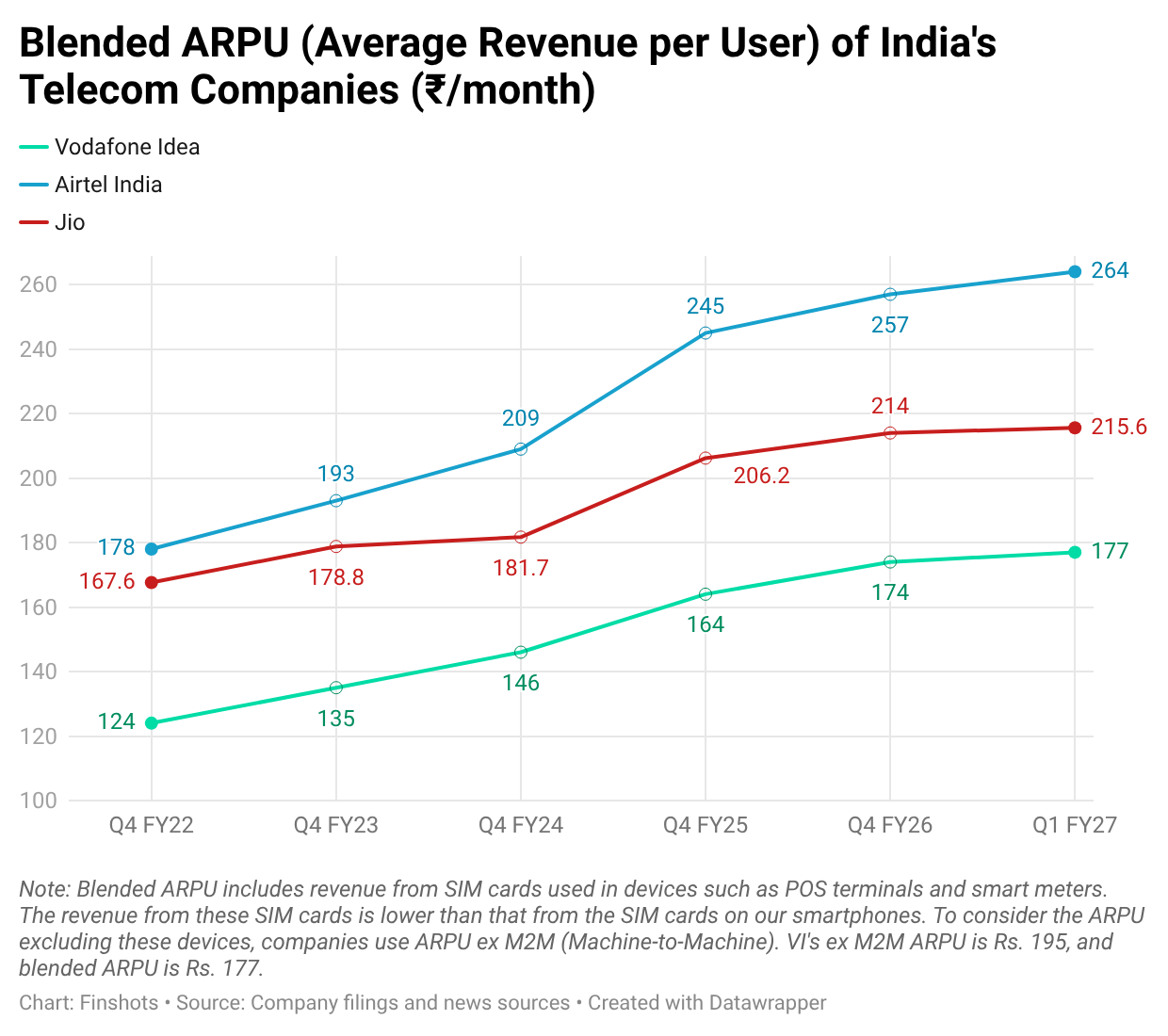
Moreover, it needs to make its existing customers more valuable. A significant portion of its subscriber base remains on legacy 2G services, so moving these users to smartphones and 4G or 5G can increase data usage and ARPU without relying entirely on tariff hikes. The strategy is already showing results. Blended ARPU has risen to ₹177 now from ₹164 in March 2025, while the subscriber base has finally stopped declining.
Vodafone Idea also does not need to spread network investment evenly across the country. Management says targeted investments in circles such as Maharashtra, Gujarat, Kerala and Uttar Pradesh East have produced better customer acquisition and retention. This helps explain why the latest subscriber number matters. Vodafone Idea added customers for the first time since the 2018 merger. The increase was only around 3 lakh users, nowhere near enough to declare a turnaround, but it changes the direction of the business after years of decline.
But the headline subscriber number hides another problem. Only 85.3% of Vodafone Idea's subscribers are active, compared with 99.24% for Airtel and 98.62% for Jio. In other words, roughly 15% of Vi's reported customers are dormant, which helps explain why its ₹195 ARPU still trails its rivals. So the next challenge is not just adding subscribers, but converting more of them into active, higher-value users.
This is where we need to be realistic, though. Vodafone Idea has improved. It has not been fixed. An ARPU of ₹195 is still below Jio and Airtel, and adding roughly 3 lakh subscribers is hardly enough to declare victory. The company still needs to spend heavily on its network, while Jio and Airtel have much stronger balance sheets with which to keep investing. Its three-year network plan is ambitious, and the company needs to increase EBITDA while funding that expansion. The turnaround therefore depends on network investment generating better customers and higher revenue, while that revenue eventually generates enough cash to fund the next round of investment.
This delicate operational requirement is exactly what makes the current recovery wildly different from the temporary financial reprieves Vodafone Idea has historically received.
The income statement is beginning to reflect those changes, with revenue rising and losses falling by more than 40%.
That does not mean the turnaround is complete. Vodafone Idea still needs to close the gap with Jio and Airtel, invest heavily without exhausting its cash and eventually generate enough free cash flow to deal with its long-term liabilities. But the company is no longer trapped in the same death spiral that brought it to the brink of insolvency. It now has the breathing room to invest, and the early signs suggest that investment is improving the network, customer quality and revenue.
So perhaps Vodafone has all the ingredients for a comeback. But the next few quarters will determine whether this is a genuine turnaround or simply Vodafone Idea's most successful reprieve yet.
Until then...
If you liked this story about Vodafone Idea's potential turnaround, feel free to share this with your friends and family who still use VI, or even strangers on WhatsApp, LinkedIn, or X.
🚨 ATTENTION: FINSHOTS FAMILY
The moment you became a parent, insurance stopped being optional.
It's the one thing you keep meaning to sort out but never quite get to. And the longer you wait, the more expensive and complicated it gets.
Our 2-day Insurance Masterclass will help you figure out what to buy, how much cover you need, and how to avoid common mistakes.
📅 Monday, 17th August at 6:30 PM: Life Insurance
📅 Tuesday, 18th August at 6:30 PM: Health Insurance
Only 300 seats remaining. 👉🏽 Click here to reserve your spot today.