
Why the Nobel Prize in Economics went to Robert Hall and Michael Woodford
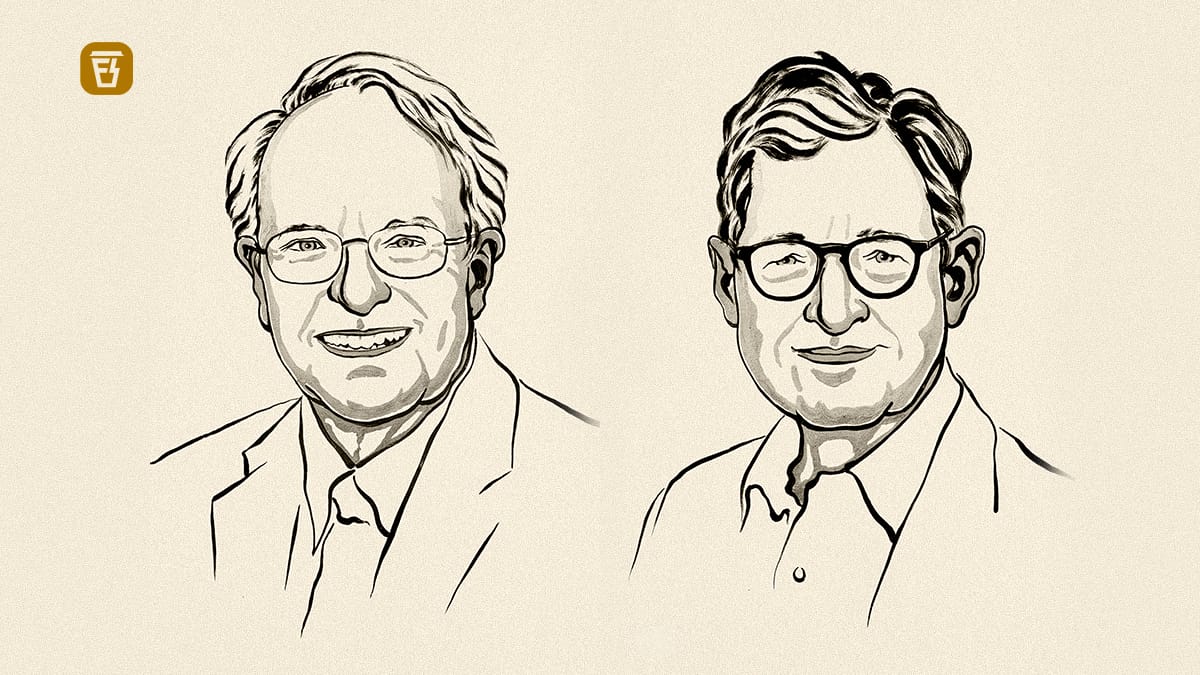
In today’s Finshots, we explain the ideas and research that earned Robert Hall and Michael Woodford this year’s Nobel Prize in Economics.
Before we get into today’s story, a quick note from the Finshots team!
Ditto is hiring a Performance Marketing Executive. If you have hands-on experience running campaigns on Meta Ads and Google Ads, and enjoy working on campaigns that drive measurable results, we’d love to hear from you.
Think this sounds like you? Click here to apply.
Now, on to today’s story.
The Story
Recently, the RBI raised the repo rate by 0.25 percentage points to 5.5%. Thanks to rising inflation, driven partly by higher oil prices. When oil gets expensive, costs can rise across the economy. Businesses feel the pinch, and people may start worrying about their jobs.
But have you ever wondered how the RBI decides what to do in a situation like this?
General logic might tell you that when inflation rises, the RBI can increase interest rates, making loans more expensive. People and businesses may then borrow and spend less. That could cool demand and eventually ease inflation. But how much should the RBI raise rates?
Because if it raises them too much, it could slow the economy. Or if it does the opposite, inflation could flare up again.
That’s the problem this year’s Economics Nobel laureates, Robert Hall and Michael Woodford, spent much of their careers trying to solve.
Before we tell you how, here’s one quick thing you need to know. Economics has two broad branches: microeconomics and macroeconomics. Microeconomics looks at how people, households and businesses make decisions. While macroeconomics takes a bird’s eye view, examining how the economy as a whole behaves.
With that out of the way, let’s get back to Hall and Woodford’s work.
Eons ago economists relied heavily on the idea that certain economic variables moved in predictable ways. For instance, the Phillips curve suggested that inflation tended to fall when unemployment rose. Or when people had more money to spend, consumption usually increased. These ideas drew heavily on Keynesian economics or theories developed by John Maynard Keynes in response to the Great Depression of the 1930s.
Economists used these patterns to predict how the economy might respond to policy changes. Like when demand weakened, governments could spend more and central banks could cut interest rates to encourage borrowing and spending. Or vice versa. These steps taken to smooth out economic ups and downs are called stabilisation policy.
But things got complicated in the 1970s. Oil prices shot up after oil producing Middle Eastern countries cut output amid political tensions with the West. And Western economies found themselves facing two problems at once: high inflation and high unemployment. This was the opposite of what economists had come to expect.
They didn’t have a clear explanation for why this was happening. And without understanding what was driving the economy, it became harder for governments and central banks to predict whether their policy decisions would actually work.
Economists realised they needed a better way to understand what was happening beneath the surface.
So, one economist, Robert Lucas Jr., argued that they were relying too heavily on the assumption that relationships between economic variables would remain stable. Instead, they needed to look at the decisions that drove those numbers in the first place. Inflation, for instance, depends partly on how businesses set prices, while overall consumption depends on how millions of households decide to spend.
This approach, known as microfoundations, meant building economic models from the ground up, starting with individual decisions. But putting it into practice wasn’t easy. One particularly tricky question was how people decided to spend.
And that’s where Robert Hall came in. He essentially said, “Hey, maybe we’re asking the wrong question. Instead of trying to figure out what helps us predict changes in spending, why don’t we first ask if those changes can be predicted at all?”
So he started with something we all do every month: deciding how much of our income to spend. Say you earn ₹50,000 a month. You might spend ₹35,000 and save the rest. But that decision doesn’t depend only on your current salary. You might spend more if you expect an increment or promotion soon or save more if you’re worried about losing your job.
Hall reasoned that if people planned their spending based on what they expected to earn, their decisions would change when they received new information. Meaning, if you already knew you’d get a salary hike next month, you’d probably factor it into your plans. But an unexpectedly large hike might encourage you to spend more. While a smaller than expected one could make you cut back on spending.
This led to a rather surprising conclusion. That if people already make spending decisions based on what they know, economists shouldn’t be able to predict how their spending will change using that same information. Spending should change mainly when people learn something new that they couldn’t have seen coming.
Hall tested this idea in a landmark paper in 1978 and found evidence to support it. Later, research he conducted with Frederic Mishkin found that roughly 80% of the households they studied made spending decisions that broadly followed this pattern. The rest tended to spend based on how much money they currently had, often because they had little savings or couldn’t borrow easily.
This helped economists understand why different households might respond differently to the same government policy.
Okay, that explains how households make spending decisions. But remember, our original problem was figuring out how to make stabilisation policy work better. Hall’s research helped economists understand household spending, but policymakers still needed a broader framework connecting those decisions to inflation, production and interest rates.
Enter Michael Woodford. In his 2003 book, he brought these ideas together into a model that helped explain how these different pieces of the economy interact:
- How households spend
- How businesses set prices, and
- How central banks use interest rates to influence the economy.
For instance, when central banks cut interest rates, borrowing becomes cheaper. People and businesses may then spend more, boosting demand, production and employment. But if demand grows too much, businesses may raise prices, pushing inflation higher.
But there’s also the question of how businesses react when their costs or demand change. Imagine you sell biscuits and the price of flour suddenly rises. You may not increase the price immediately because that would mean changing the MRP and printing new packaging. You might also worry that your competitors won’t raise their prices just yet. In an economist’s world this is called price stickiness.
Now imagine more customers start buying your biscuits. Since your prices haven’t changed, you might find it easier to increase production instead. You could bake more biscuits and hire another worker to meet the extra demand. In other words, changes in demand can affect production and employment even before prices change.
So you could say that Woodford’s big contribution was to connect all these dots by building on top of Hall’s earlier work. He showed how households’ spending decisions, businesses’ pricing decisions and central banks’ interest rate decisions are linked.
For instance, people’s expectations about future income influence how much they spend today. That spending affects demand, which influences how much businesses produce and whether they raise prices. Central banks, in turn, can adjust interest rates to influence spending and bring demand and inflation under control.
This gave policymakers a more systematic way to understand how decisions in one part of the economy could affect everything else. They’re also known as New Keynesian models and are used by central banks around the world today.
In fact, these same principles help explain the RBI’s recent decision to raise rates. Sure, a rate hike won’t magically bring inflation down, especially when rising oil prices are driving it. But by raising rates, the RBI can try to rein in demand and prevent the initial price shock from fuelling more persistent inflation.
That said, no model can predict the future perfectly or guarantee that a policy decision will work as intended. It’s just that these ones by Hall and Woodford simply help policymakers weigh their options and decide how best to respond to different economic situations.
Until next time…
If this story helped you understand the ideas behind Robert Hall and Michael Woodford’s work, and how they help central banks make better decisions, spread the knowledge by sharing it on WhatsApp, LinkedIn and X.
And if you’re someone who loves keeping tabs on the world of business and finance, hit subscribe if you haven’t already. And if you’re already a subscriber, thank you! Maybe forward this to someone who’d enjoy our stories but hasn’t discovered us yet.
A Note from Our Co-Founder
“When we started Finshots, our aim was to make finance simple and accessible for everyone. Soon, we realised that understanding finance is just one of the challenges. Making smart decisions, especially with insurance, is a whole different ball game. That’s why we built Ditto, a platform that makes insurance simple. No jargon, no spam, just honest advice from advisors who are only here to help you find the right plan.”
— Shrehith Karkera, Co-founder, Finshots & Ditto Insurance