
How China is building its global EV battery empire
In today’s Finshots, we look at how China came to dominate the EV battery market, why India is struggling to catch up, and what that means for the future.
But before we get into today’s story, a quick note from the Finshots team!
Ditto is hiring a Copywriter. We’re specifically looking for people with hands-on experience writing copy for Meta Ads (Facebook and Instagram). If you’ve worked on ad hooks, headlines, primary text, and on-creative copy designed to drive performance marketing ads, we’d love to hear from you.
Think this sounds like you? Click here to apply.
Now, on to today’s story.
The Story
In 2005, China’s EV battery industry had just two companies. Twenty years later, it makes over 75% of the batteries sold worldwide.
That kind of dominance doesn’t happen overnight. China spent years building its battery industry, partly because it wanted to tackle urban pollution, reduce its dependence on imported oil and protect itself from global oil price shocks. It also wanted to become a major player in the global car industry.
So when China won the bid to host the 2008 Olympics, it used the Games as an opportunity to test its battery technology. Around 50 electric buses powered by lithium batteries ferried officials and athletes around. And that was just the beginning.
Throughout the 2010s, the Chinese government offered subsidies to encourage electric vehicles, first for public transport and then for ordinary car buyers. But the real turning point came in 2015.
That year, China introduced a rule that made it much harder for foreign battery makers to compete. EV companies could access government subsidies only if they used batteries made by suppliers on an approved list. And every company on that list was Chinese.
In effect, China gave its homegrown battery makers a protected market. Even South Korean companies that had already set up factories in China suddenly found themselves shut out.
With foreign rivals pushed aside, Chinese battery makers CATL and BYD could focus on competing with each other. That competition helped them make batteries cheaper and better. They also built much of their supply chains in-house and developed a deep pool of skilled battery engineers. Together, these advantages put them far ahead of competitors elsewhere.
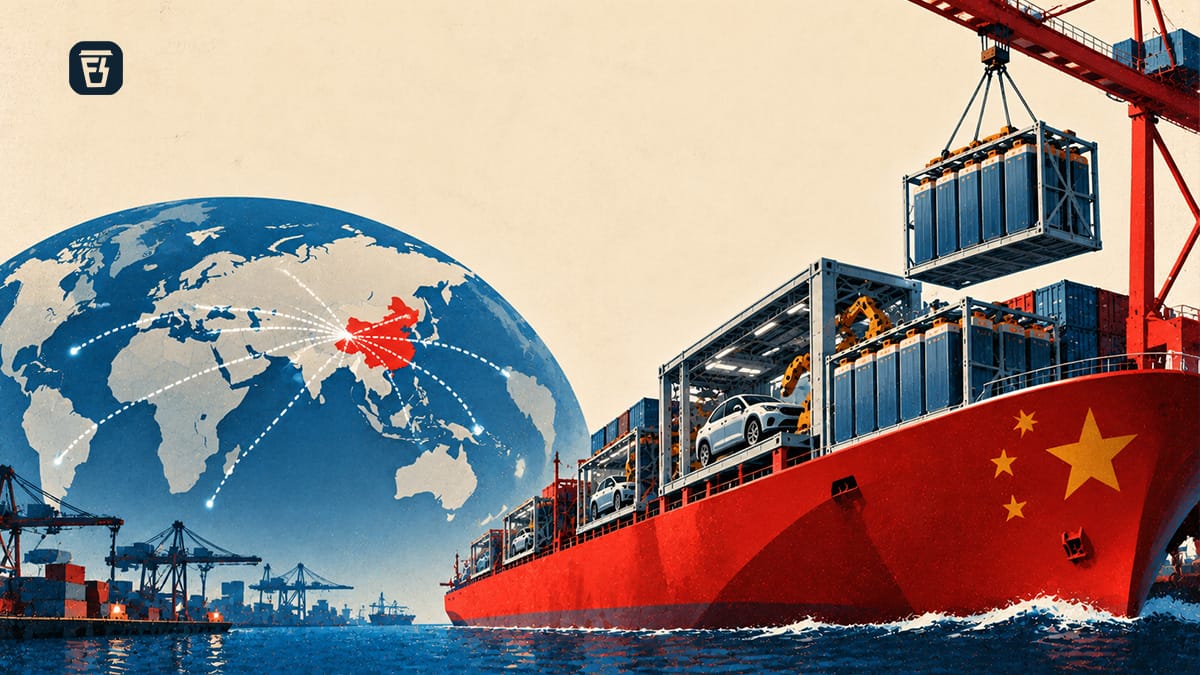
And China isn’t keeping that advantage to itself. It’s now taking its entire battery-making ecosystem overseas.
They’re not just exporting batteries but building factories abroad too. Research firm Rhodium Group counted at least 68 battery plants built overseas by Chinese companies over the last decade. In 2024, Chinese EV firms spent more money building supply chains abroad than at home. Hungary and Indonesia alone attracted a combined $40 billion in investment.
There’s a business advantage to this strategy as well. Building factories overseas helps Chinese companies avoid import tariffs and can earn them better margins than manufacturing at home. To put that in perspective, according to Wired, batteries made abroad earn them a 29% profit margin, compared to 23% for batteries made domestically. It also gives them a stronger foothold in markets such as Europe, where the future of electric cars remains a major battleground.
But there’s another reason countries welcome these investments. They hope Chinese companies will bring their technology and train local engineers, helping them eventually build advanced batteries themselves. It’s almost the reverse of what happened decades ago, when Western and Japanese carmakers shared technology with China in exchange for access to its market.
India, however, missed out on this opportunity.
In 2023, India rejected a $1 billion factory proposal from BYD in partnership with Megha Engineering. The concerns were linked to national security. Since the 2020 Galwan border clash, investments from countries sharing a land border with India have required prior government approval.
And that decision had consequences. In other countries, Chinese investments brought factories, equipment, technology and trained engineers together. India on the other hand, lost access to that combination by restricting such investments. Which means that its domestic battery makers were left to work out some of the hardest parts of manufacturing on their own.
The dependence shows up in the trade numbers. In FY26, nearly 84% of India’s lithium-ion battery imports came from China. The import bill had also grown ninefold since 2018, reaching $4.7 billion.
Yet, there was an upside to all this dependence: batteries became much cheaper.
Battery makers around the world built so many factories that, by 2024, manufacturing capacity was roughly 2.5 times actual demand. Add intense competition and a shift towards cheaper lithium iron phosphate (LFP) batteries, and global battery pack prices fell from $827 per kilowatt-hour in 2013 to a record low of $108 in 2025.
Indian buyers benefitted too. In 2024, Tata Motors cut the price of its Nexon EV by up to ₹1.2 lakh and its Tiago EV by up to ₹70,000, citing falling battery costs.
So, cheaper Chinese supply chains helped make Indian EVs more affordable. But they also made it harder for India to break free from Chinese batteries.
That’s because India’s biggest problem isn’t simply building factories or finding money to invest. It’s learning how to make batteries well. That kind of expertise takes years of hands-on experience on the factory floor, and Chinese companies have been reluctant to share it.
Lately, getting access to that knowledge has become even harder. China has tightened restrictions on exporting certain battery technologies and manufacturing know-how. Tata’s battery arm, Agratas, reportedly couldn’t finalise a technology licensing deal with a Chinese partner because of these restrictions. It’s now developing its own lithium-cell technology at Sanand in Gujarat, with commercial production not expected before 2027. Reliance and JSW have reportedly also faced similar hurdles.
Meanwhile, China is already looking ahead. Its industry ministry has set 2030 as the target for the first large-scale (read global) production of solid-state batteries, which could offer greater safety and longer driving ranges than today’s lithium-ion batteries.
China’s weakness though, lies more in cutting-edge research than in manufacturing. That could give other countries an opening to catch up.
So, what is India actually doing about all this, you ask?
First, securing their own supply. State-run KABIL (Khanij Bidesh India) has moved to acquire five lithium-rich blocks in Argentina. But extracting lithium from underground brine takes years, so this is a long-term bet, not a quick fix.
Second, using minerals by recycling instead of actually mining. The government’s ₹34,300 crore National Critical Mineral Mission includes a scheme to recover 4 lakh tonnes of minerals annually from old batteries and electronic waste. The only problem is while that sounds promising on paper, India’s recycling industry is still in its early stages.
Third, skipping lithium altogether. In 2022 Reliance bought UK-based Faradion to develop sodium-ion batteries in India. Sodium is roughly 1,000 times more abundant than lithium, and China doesn’t control its supply in the same way. The catch is that sodium-ion batteries store less energy for their size, making them better suited to stationary energy storage than electric vehicles, at least for now.
India has also tried to build its own battery manufacturing capacity. The government’s production-linked incentive scheme aimed to create 50 GWh (gigawatt-hours) of capacity by 2025. But only 1.4 gigawatt-hours is operational, almost all of it at Ola Electric.
Ola has built its cells from scratch, and they already power its scooters. But it still imports the cathode and anode materials needed to make them. Scaling up production while building a domestic supply chain for these materials will be the hard part.
Essentially, Indian companies now have to figure out the same manufacturing challenges that Chinese firms spent decades solving, with one big difference: China is increasingly restricting access to the technology and know-how that could help them catch up.
And that’s the problem with all these solutions. Each one will take years to make a meaningful difference. Meanwhile, restrictions on Chinese investments remain in place, and India’s battery import bill continues to climb.
But this isn’t just India’s problem. One recent academic estimate puts the probability of a global battery shortage at 92% if China’s supply were moderately disrupted. That tells you just how much of the world’s battery supply is concentrated in one country.
India is simply one of the largest markets trying to reduce its dependence on China from the outside, without the shortcut that many other countries have used: bringing Chinese battery makers in and learning from them.
So, do you think India is right to prioritise national security and build its battery industry on its own, even if it takes longer? Or should it loosen restrictions on Chinese investments to catch up faster?
Until then…
Don’t forget to share this story on WhatsApp, LinkedIn, and X.
And if you’re someone who loves keeping tabs on the world of business and finance, hit subscribe if you haven’t already. And if you’re already a subscriber, thank you! Maybe forward this to someone who’d enjoy our stories but hasn’t discovered us yet.
Trust Finshots for Finance? You'll love Ditto for insurance.
Built by the same four friends behind Finshots, Ditto is here to make insurance simple. No spam, only honest advice to help people make smart insurance decisions.
✅Backed by Zerodha
✅Rated 4.9 on Google (34,000+ reviews)
✅Over 7 lakh customers advised
Click here to talk to an IRDAI-Certified advisor for FREE.