
How a fistfight helped fix your eyesight and more...
Hey folks,
Imagine the Sun deciding that it has had enough. So it grows into a huge ball of gas as it nears the end of its life, swallowing the inner planets before shrinking into a tiny, incredibly dense remnant of itself.
For Earth, that would probably be the end. But what if the dying Sun’s leftover material came together to form an entirely new planet?
A planet that wasn't around when the solar system first formed, but was born from the leftovers of a star that had already died.
Sounds like science fiction, right?
Except astronomers suspect something very similar may have happened around a white dwarf called HS 0209+0832. A white dwarf is what's left behind when a star like the Sun reaches the end of its life.
A team led by Jamie Williams at the University of Warwick studied observations of this star taken by several telescopes, including the Hubble Space Telescope. And they found something unusual in its atmosphere.
It contained unusually large amounts of certain heavy elements, particularly zinc, copper and niobium. In fact, the amount of niobium relative to the Sun's abundance was more than a thousand times higher. At the same time, there was very little iron and silicon, two elements commonly found in rocky planetary material.
So, what's the big deal?
Well, stars don't just burn through their fuel and quietly disappear. As they near the end of their lives, nuclear reactions inside them can create heavier elements. One process, called the s-process, gradually builds up these elements. And when a star sheds its outer layers, some of this material gets thrown into space.
Think of it as the star leaving behind a chemical signature of its final years.
The researchers believe a giant planet may have formed from this expelled material. In other words, a star could have died, only for a new planet to emerge from its remains.
But there's another twist.
The team noticed that the system's brightness changes in a pattern that repeats roughly every 4.4 days. They think this could be a sign of a Jupiter-sized gas giant orbiting extremely close to the white dwarf.
And that's the interesting bit. At such a close distance, the planet would be blasted with intense radiation from its host star. This could heat its outer atmosphere and cause gas to escape into space. Some of that escaping material might eventually fall onto the white dwarf itself.
So, astronomers may be witnessing a planet being slowly stripped apart by the very star around which it formed. Or a planet born from the remains of a dead star, only to have its own atmosphere stolen away by that star's remnant.
Quite the cosmic twist, isn't it?
Here’s a soundtrack to put you in the mood… 🎵
Saawan Bhi Thehra by Garvit Soni and Priyansh Srivastava
You can thank our reader, Surbhi Dhoot, for this lovely recommendation.
Also, folks, keep your music recommendations coming. We’d love to feature them in our Sunday editions, especially gems from underrated Indian artists many of us haven’t discovered yet. Can’t wait to hear them!
What caught our eye this week 👀
How a fistfight helped fix your eyesight
Today, millions of people can correct their eyesight through procedures such as LASIK. A surgeon reshapes the cornea, the transparent front surface of your eye, so that light focuses more accurately on the retina. The procedure is so routine now, that we hardly stop to think about the science behind it.
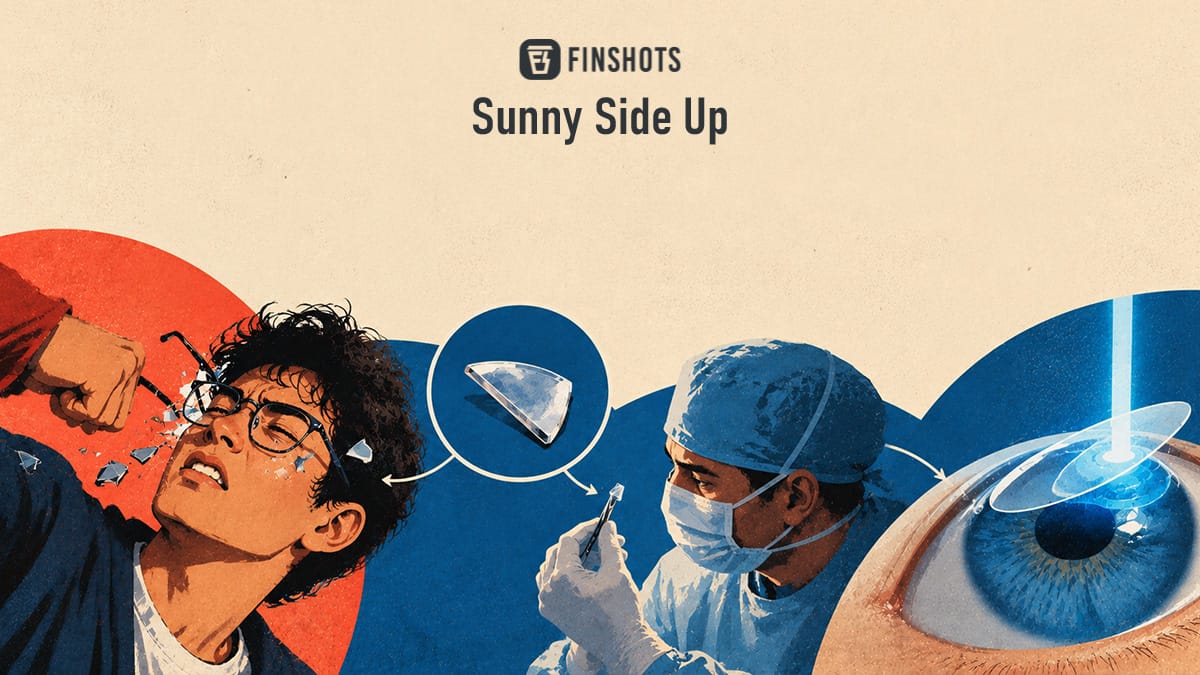
But one of the ideas that helped make this possible came from a rather unlikely place: a boy who got into a fistfight and ended up with shattered spectacles. And the doctor who noticed something peculiar about his injured eyes was a Soviet ophthalmologist named Svyatoslav Fyodorov.
Yup! The story goes back to the 1970s, when Fyodorov treated a young boy whose spectacles shattered during a fistfight. Tiny glass fragments had injured the boy's cornea, and Fyodorov carefully removed the fragments and treated the injuries.
But as the wounds healed, he noticed something unexpected. The boy's eyesight had improved.
Now, that might sound like a small observation. But for a doctor who was constantly looking for ways to improve vision, it was worth investigating. Fyodorov suspected that the cuts had altered the curvature of the boy's cornea, changing how light entered his eye. That, in turn, reduced his nearsightedness.
And so, he began experimenting.
His idea was to make a series of precise incisions using a blade, radiating outward from the centre of the cornea, much like the spokes of a bicycle wheel. He called the procedure radial keratotomy.
Of course, there was a catch. Cutting into someone's cornea to improve their eyesight wasn't exactly the sort of idea that would win over the medical establishment overnight.
But Fyodorov pushed ahead anyway. He believed that medicine shouldn't be limited to what doctors already knew how to do. If an idea could improve patients' lives, it deserved investigation, even if it challenged established practices.
That stubbornness would go on to become a defining feature of his career.
By the late 1970s and early 1980s, this procedure attracted international attention. Fyodorov and other surgeons reported encouraging results, and the procedure spread beyond the Soviet Union.
But radial keratotomy wasn't perfect. The incisions weakened the cornea, and the results could be unpredictable. Some patients experienced fluctuations in their vision, while others developed problems years after surgery.
And as more advanced techniques emerged, the medical community gradually moved away from it. And this is where the story takes another interesting turn.
Because the next breakthrough didn't come from making better surgical cuts, but from finding a way to reshape the cornea without relying on a blade.
In the early 1980s, ophthalmologist Steven Trokel learned about researchers at IBM studying the excimer laser. It was meant to make computer chips, but it could also cut biological tissue with extreme precision without damaging the surrounding tissue. So, Trokel, along with photo chemist Rangaswamy Srinivasan, began by removing corneal tissue from cow eyes. The goal was to reshape the cornea with a laser without using a physical blade.
In 1987, researchers performed the first excimer laser procedure on a human eye. The technique, known as photorefractive keratectomy (PRK), was eventually approved for use in the US in 1995. LASIK (Laser Assisted in Situ Keratomileusis) followed, combining corneal reshaping with a surgical flap to help patients recover more comfortably.
Today, LASIK and other refractive surgeries have given millions of people an alternative to glasses and contact lenses.
And while it would be wrong to say that Fyodorov single-handedly invented it, his work helped establish an important principle: you could correct vision by deliberately changing the shape of the cornea. That idea became a foundation for refractive surgery, even as the techniques themselves evolved.
That simply tells you that scientific breakthroughs don't always begin with a million-dollar research programme. They could also begin when someone notices something unexpected and decides to investigate instead of dismissing it as a fluke.
Of course, the boy's injury wasn't a medical procedure, and nobody should take a fistfight as a shortcut to better eyesight. But Fyodorov's response to what he saw undoubtedly made the difference.
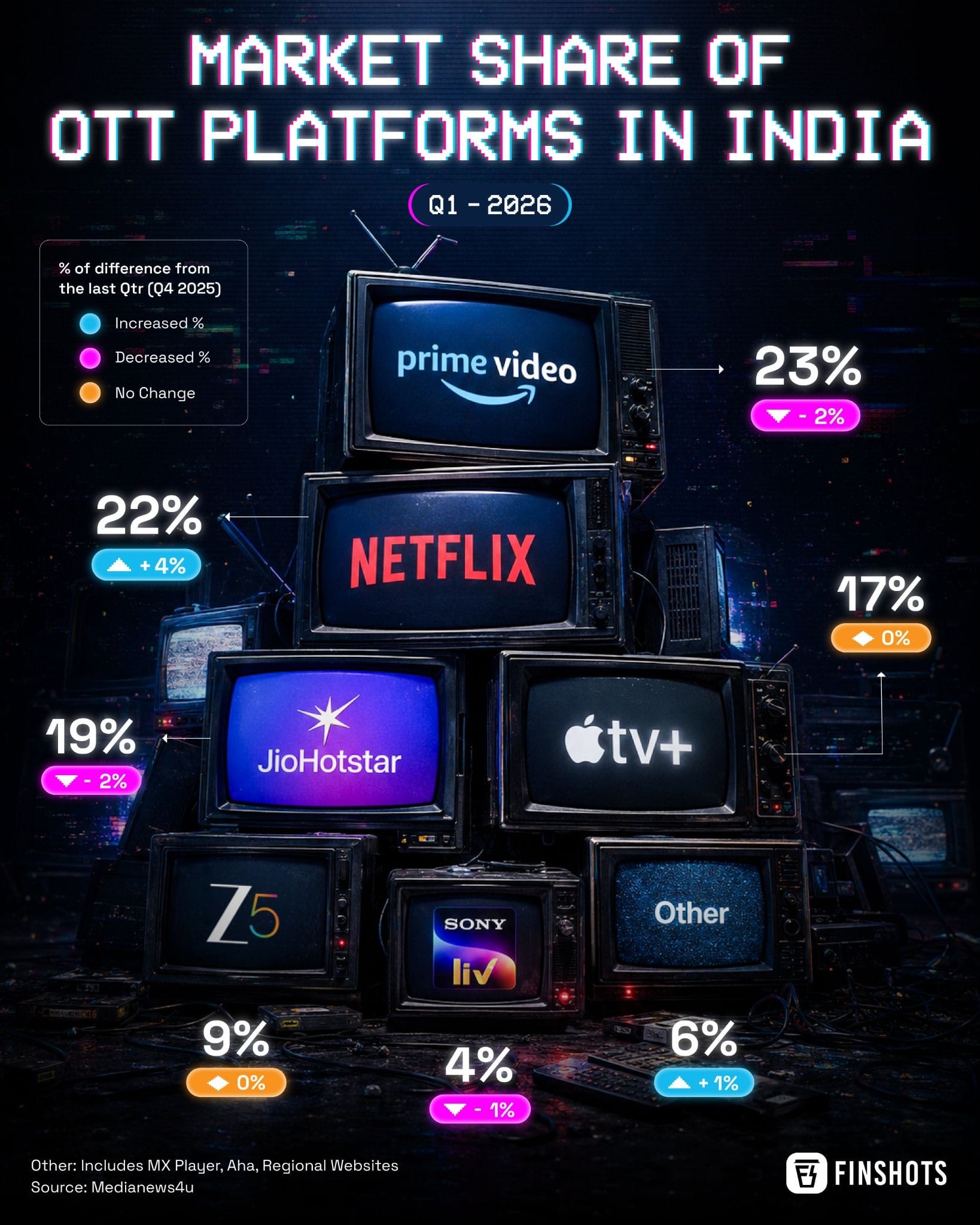
Infographic
Readers Recommend
This week, our reader Lokesh Amarnath R recommends reading Around the Hearth by Kynpham Sing Nongkynrih.
It's a collection of folk tales from the Khasi community that explain the origins of customs our elders still tell us about.
Thanks for the rec, Lokesh!
That’s it from us this week. We’ll see you next Sunday.
Until then, send us your book, music (preferably from underrated Indian artists), business movies, documentaries, or podcast recommendations. We’ll feature them in this newsletter! Also, don’t forget to tell us what you thought of today's edition. Just hit reply to this email (or if you’re reading this on the web, drop us a message at morning@finshots.in).
Don’t forget to share this edition on WhatsApp, LinkedIn and X.