
Why is Singapore building the gold hub that India wanted?

In today’s Finshots, we look at why and how the centre of gravity in the global gold market is shifting.
Before we begin, if you’re someone who loves to keep tabs on what’s happening in the world of business and finance, then hit subscribe if you haven’t already. We strip stories off the jargon and deliver crisp financial insights straight to your inbox. Just one mail every morning. Promise!
If you’re already a subscriber or you’re reading this on the app, you can just go ahead and read the story.
The Story
India loves gold.
We buy it during weddings, festivals, and pretty much every major life event. In fact, Indian households collectively hold an estimated 25,000 tonnes of gold, which is actually more than the official reserves held by most central banks.
But here’s the strange part. Even though India is one of the world’s biggest consumers of gold, it plays only a small role in the business of trading, storing, financing, and moving gold around the world.
And that’s exactly where Singapore sees an opportunity.
For context, recently, Singapore unveiled plans to launch a new gold clearing and settlement system along with specialised vaulting services for central banks. The goal is seemingly simple: make Singapore the undisputed hub for storing, trading, and settling gold in Asia.
But hey, if India sits at the centre of global gold demand, why is Singapore positioning itself to become Asia’s gold hub, you ask?
To understand that, you have to start by looking at how the gold ecosystem operates. It works in four distinct layers:
- Mining and refining,
- Trading and price discovery,
- Storage and clearing,
- and finally, Consumption.
Of these four layers, India dominates only the last as you’ve seen.
But to be fair, there isn’t a single “global gold market”. Gold trading is spread across multiple financial centres, each specialising in a different part of the ecosystem. London dominates wholesale bullion trading and clearing. New York is the centre for gold futures and derivatives through COMEX (the Commodity Exchange). Shanghai has become Asia’s most important hub for physical gold trading and price discovery. Switzerland handles much of the world’s refining and storage, while Dubai has emerged as an important bridge connecting bullion flows between Asia, Africa, and Europe.
And India did try to change that. In 2022, it launched the India International Bullion Exchange (IIBX) in GIFT City. The vision was ambitious. Instead of importing gold through traditional channels, India wanted buyers to source gold through a domestic exchange. Over time, policymakers hoped this would deepen liquidity, improve price discovery, and eventually help India become an important centre for bullion trade.
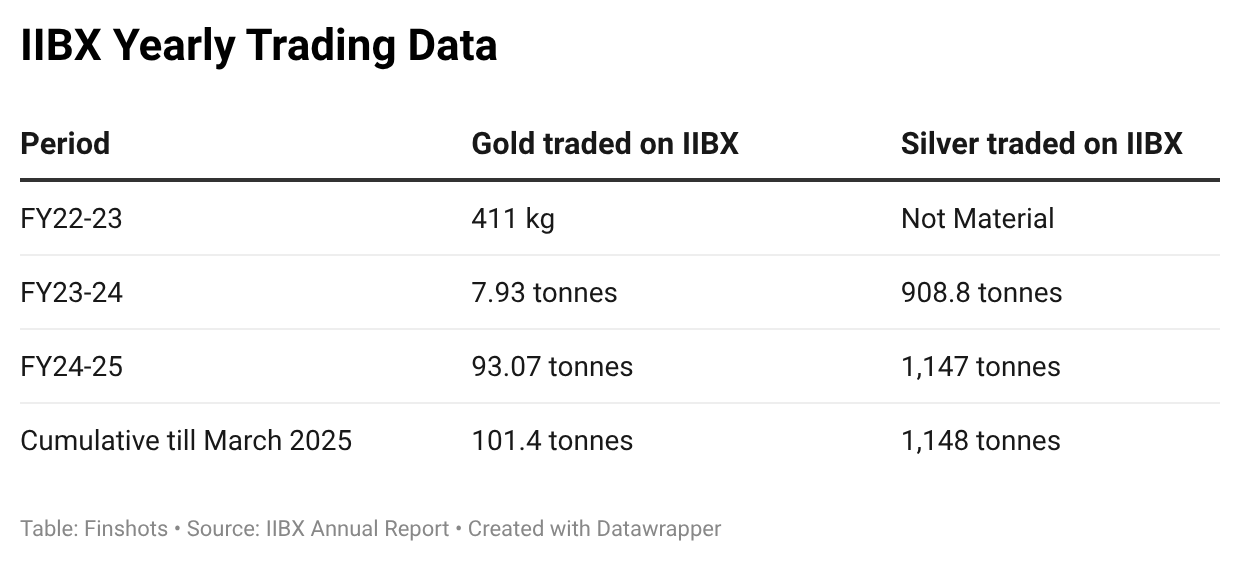
And at first glance, things seemed to be moving in the right direction. Gold traded on IIBX jumped from just 411 kg in FY23 to over 92 tonnes in FY25. That is roughly a 227x jump in just two years! By March 2025, more than 100 tonnes of gold had been imported through the exchange. Those are impressive numbers for a platform that’s only a few years old.
But there’s a catch because building a successful exchange and building a successful gold hub are two very different things.
Just think about London.
For centuries, London has been the undisputed king of the global gold trade. If a central bank wants to buy bullion, or a financial institution needs to move billions of dollars worth of the yellow metal, London is the one pulling the strings.
And that’s not just because it has the world’s largest gold exchange, but also because it built an ecosystem.
To put things in perspective, behind London’s gold market sits an ecosystem known as “Loco London”, which is a vast network of vaults, bullion banks, clearing houses, insurers, refiners, and logistics providers. It is supported by globally trusted standards such as the LBMA Good Delivery framework, which allows gold bars to move seamlessly between institutions without constant re-verification.
This infrastructure took decades to develop. And that’s also why central banks store gold there and why traders across the world continue to reference London prices.
And that’s what Singapore seems to have taken note of.
Instead of trying to build another trading venue, it’s focusing on the plumbing that sits behind the gold market which is vaults, clearing systems, custody services, and settlement networks.
The timing actually also makes sense. As you already know, gold prices are hovering near record highs. Central banks are scooping up bullion at the fastest pace in decades. And most importantly, much of that demand is now concentrated in Asia.
So Singapore is probably betting that if Asia is becoming the world’s most important gold-consuming region, then the infrastructure supporting that trade should be located in Asia too.
And the city-state already has a few things in its favour. It already holds a powerful position by sitting at the crossroads of Asia’s largest gold-consuming economies. It brings political stability, robust legal protections, world-class logistics, and a highly prized reputation as a neutral financial centre.
Those factors are important because gold hubs are built on trust. A central bank storing billions of dollars worth of bullion, for instance, is looking for more than just warehouse space. It wants legal certainty, reliable settlement systems, and confidence that its assets can move quickly and securely when needed. That’s the difficult part.
And it’s also why becoming a gold hub takes decades or in some cases, even centuries.
Shanghai offers a useful example. Over the past two decades, it has built itself into a major force in the bullion market through the Shanghai Gold Exchange (SGE). And it didn’t become relevant simply because China bought a lot of gold. Rather, it spent years building the infrastructure, liquidity, and institutional trust around the metal.
To put it simply, creating a financial centre needs solid infrastructure, apart from just demand or a cultural love for the metal.
And that brings us back to India. The launch of IIBX was an important first step. It proved there is demand for a regulated bullion marketplace within India. The challenge now is execution because if India wants to become a genuine gold hub, it needs to build everything around the exchange too.
That means more vaulting infrastructure and deeper liquidity because gold markets thrive on network effects. Traders, refiners, banks, and investors naturally gravitate toward places where liquidity already exists. And once that liquidity reaches a certain scale, it tends to attract even more participants.
Now, none of this means Singapore has already won or that India’s ambitions have failed.
But Singapore’s latest move simply highlights how much work remains to be done. And that in the global gold trade, the biggest opportunity doesn’t necessarily lie in owning the gold, but in owning the infrastructure through which the gold flows.
So yeah, while India already has the demand, Singapore is trying to build the pipes.
And whoever succeeds in building them could end up becoming an important node in Asia’s gold trade, even if it never replaces London outright.
Until then…
Liked this story? Share it with your friends, family or even strangers on WhatsApp, LinkedIn and X.
🚨 ATTENTION: FINSHOTS FAMILY
This weekend, we’re hosting a free 2-day Insurance Masterclass that helps you build real financial security by understanding health and life insurance the right way.
📅 Saturday, 27th June at 11:00 AM: Life Insurance
How to protect your family, choose the right cover amount, and understand what truly matters during a claim.
📅 Sunday, 28th June at 11:00 AM: Health Insurance
How hospitals process claims, common deductions, the mistakes buyers usually make, and how to choose a policy that won’t disappoint you when you need it most.