
What went wrong with South Korea’s AI boom?
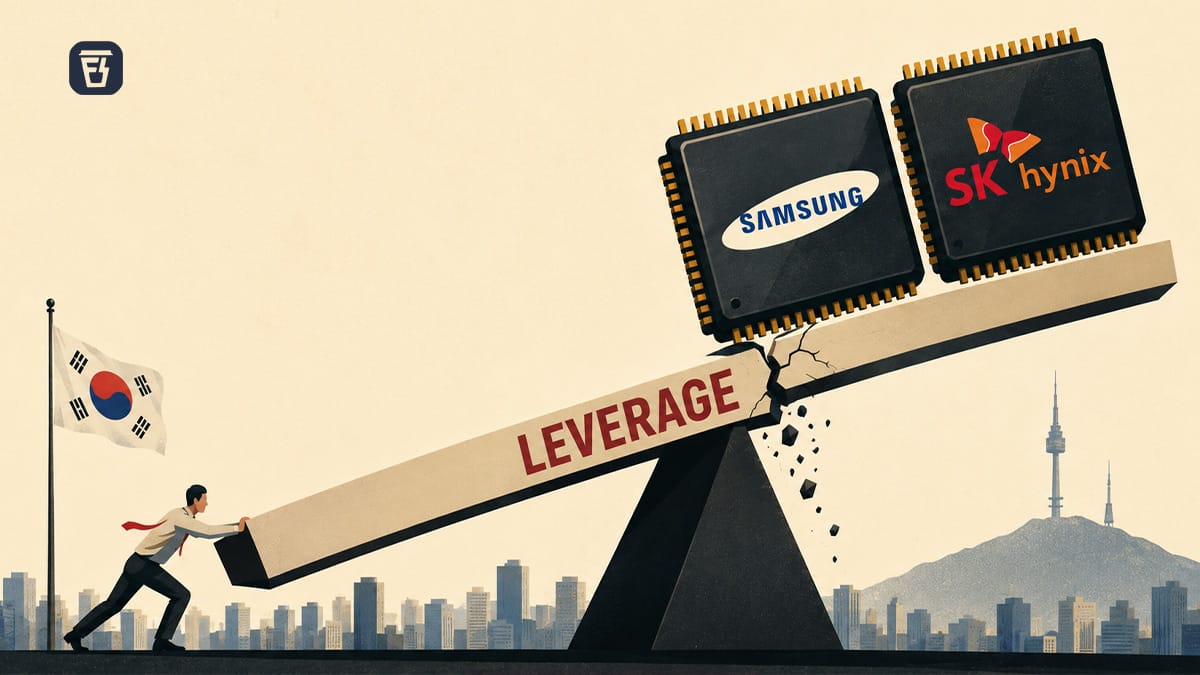
In today’s Finshots, we explain why South Korea’s massive AI boom turned into market turmoil, and what happens when a crowded technological trade meets heavy leverage.
But here’s a quick sidenote before we begin. Your 30s and 40s are peak earning years. They’re also the years most people fly without an insurance safety net.
Between EMIs, school fees, and ageing parents, there’s always something more urgent. But one medical emergency or unexpected loss of income can unravel everything you’ve built.
Our 2-day Insurance Masterclass will help you put that safety net in place.
📅 Tuesday, 11th August at 6:30 PM: Life Insurance
📅 Wednesday, 12th August at 6:30 PM: Health Insurance
👉🏽Click here to save your spot.
Now onto today’s story.
The Story
For a while, the artificial intelligence trade looked almost impossible to lose. Global investors poured billions of dollars into companies supplying the advanced chips, specialised memory, and massive computing infrastructure required to power the AI economy.
And in Asia, South Korea became the quintessential proxy for this global trade. The country is home to Samsung Electronics and SK Hynix, two of the world's premier high-bandwidth memory (HBM) manufacturers. HBM, for the uninitiated, is a specialised type of memory that sits alongside AI processors and allows them to access a huge amount of data at extremely high speeds, making it important for training LLMs and running advanced AI models. As demand for AI computing exploded, so did the demand for HBM, turning Samsung and SK Hynix into two of the world’s biggest beneficiaries of the AI boom.
As a result, their combined market capitalisation of 2494 trillion won (978 billion won – SK Hynix and 1516 billion won – Samsung Electronics) makes up roughly half of South Korea’s benchmark KOSPI index.
Sidebar: Won is South Korea’s currency. 1 USD = 1407 won as of August 8, 2026.
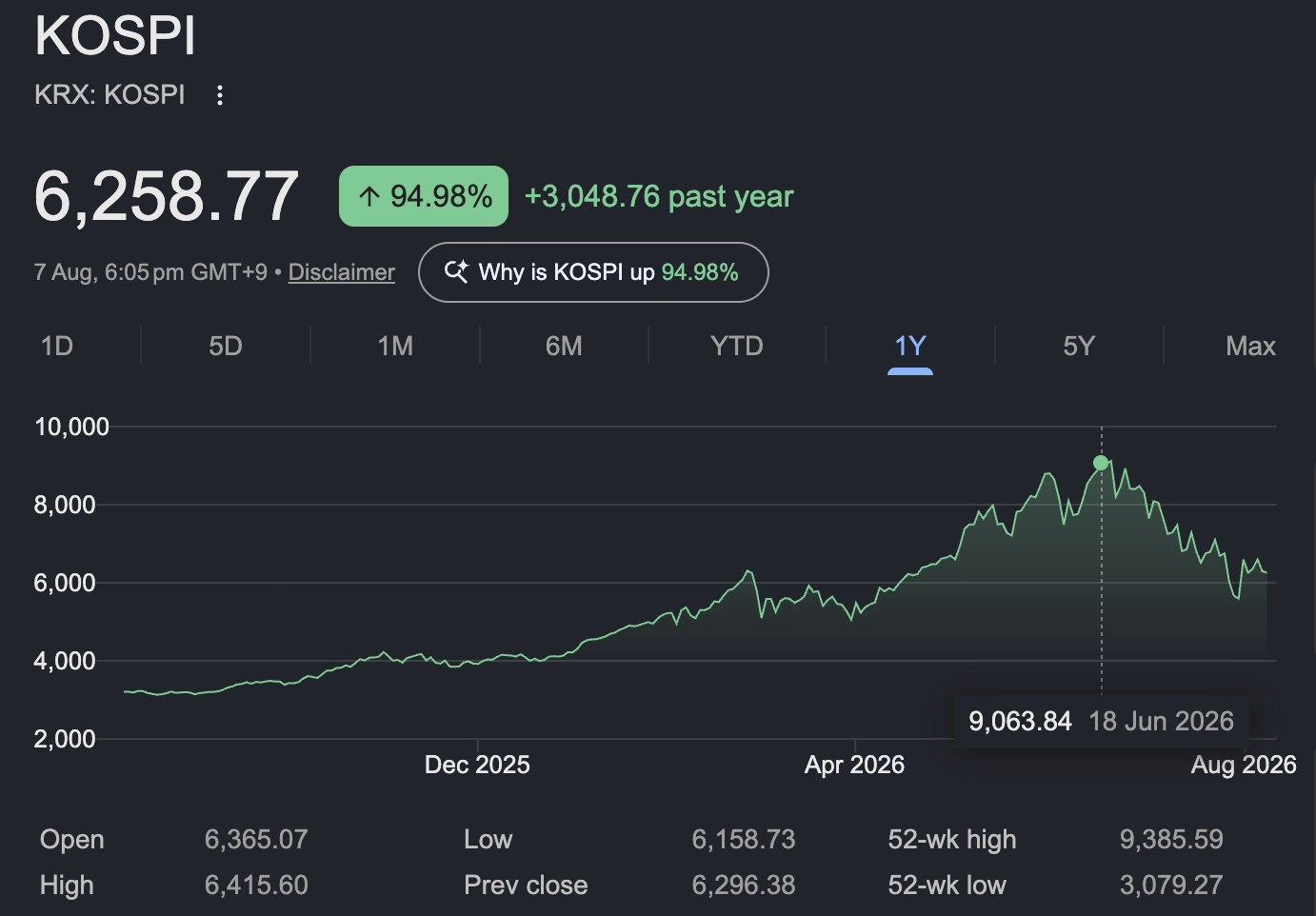
So, investors piled into the trade, and the money followed. The KOSPI surged from around 3,000 to more than 9,000 points from June 2025 to June 2026, with Samsung Electronics and SK Hynix doing much of the heavy lifting.
But the rally also created a new problem. The more these stocks went up, the more attractive they became to investors who wanted to amplify their returns with borrowed money.
Then, in May, South Korea made it even easier to bet on the AI trade. The Korea Exchange introduced single-stock leveraged ETFs tracking Samsung Electronics and SK Hynix. These products promised roughly twice the daily movement of the underlying stocks, so a 5% rise in SK Hynix could translate into a roughly 10% gain for the ETF. And investors came rushing in.
And this wasn't just a Korean retail-investor problem. A remarkably similar episode played out in Silicon Valley, where former OpenAI researcher Leopold Aschenbrenner's AI-focused hedge fund, Situational Awareness, saw its over 400% returns rapidly collapse when AI stocks reversed.
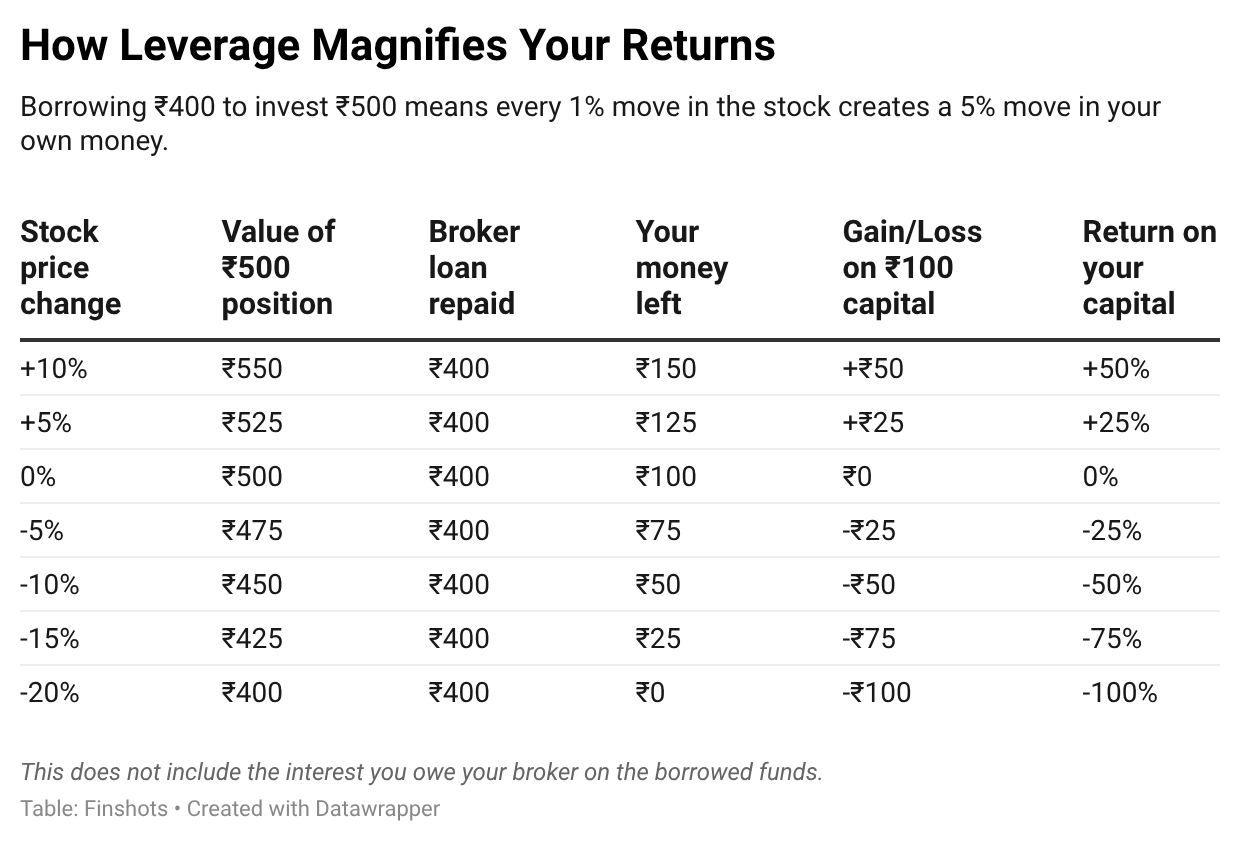
To understand why that matters, imagine you have ₹100 and want to buy ₹500 worth of shares. You borrow the remaining ₹400 from your stock broker. If the shares rise 10%, your ₹500 position becomes ₹550. Then, once the trade is done, you return the ₹400 to your broker, and you have made a ₹50 profit (minus interest paid to your broker), which means your gross return is 50% on the ₹100 even though the stock itself rose by only 10%.
But here’s the thing. This math cuts both ways. If the stock falls by 10%, the investment drops to ₹450, wiping out half of your original capital, while a 20% decline erases your cash entirely. This is because with ₹100 of your own money controlling a ₹500 position, every 1% move in the stock creates roughly a 5% move in your equity. So while a 10% rise produces a 50% return, a 20% fall wipes out your entire ₹100 investment.
So, to prevent this, there’s something called a ‘margin call’.
A broker does not lend you ₹400 simply because it trusts that you will eventually make money. Your shares act as collateral, and you are required to maintain a minimum amount of your own capital against the position.
If the value of the shares falls far enough, the broker can demand that you put in more money. That demand from your broker is the “margin call.”
If you cannot provide the cash, the broker can sell your shares to recover its money.
Now imagine thousands of investors holding the same stock with borrowed money. The stock falls, brokers issue margin calls, and investors who cannot provide additional cash start selling.
That selling pushes the stock down further, which triggers more margin calls, which creates even more selling. So, a perfectly ordinary correction can therefore turn into something much worse because investors are no longer deciding whether they want to sell. They are being forced to.
And South Korea provided a dramatic illustration of just how violent that process can become. The KOSPI triggered its market-wide circuit breaker six times in 2026 alone, which is as many times as it had been triggered in total from its introduction up to the end of 2025. The market also recorded a record 34 sidecar activations, both of which temporarily halt program trading when markets move sharply.
Now, remember the leveraged ETFs we spoke about earlier? They made things worse.
Let’s take the KODEX SK Hynix 2X leveraged ETF, for instance.
This was designed to deliver twice the ‘daily return’ of an underlying stock. If SK Hynix rises 5% in a day, the ETF rises roughly 10%. But if SK Hynix falls 5%, the ETF falls 10%.
But to maintain that 2x exposure, the fund has to constantly adjust its positions using SK Hynix shares and derivatives. That creates an important feedback loop. When SK Hynix rises, the fund needs more exposure. When SK Hynix falls, it has to reduce exposure. And when thousands of investors are simultaneously trading products linked to the same underlying stock, these adjustments can add another layer of buying and selling to an already stressed market.
The scale became extraordinary. Within just a month, leveraged and inverse ETFs linked to Samsung and SK Hynix attracted over 7 trillion won. That meant a product designed to magnify a stock's daily movement had itself become a major source of trading activity in the underlying stocks.
There is also a less obvious problem with leveraged ETFs that investors often miss. When an ETF promises twice the daily return, that does not mean it will deliver twice the return of the underlying stock over a longer period. So, if a stock falls 10% one day and then rises 10% the next. You might think it has recovered because the percentage moves look symmetrical, but it has actually fallen from ₹100 to ₹90 and then risen to ₹99. The leveraged ETF follows the same path, with twice the daily movements, so compounding can leave investors with an even larger loss. This is why these products are designed primarily as short-term trading instruments rather than simple long-term bets on a company's future.
And that brings us back to the AI boom.
The KOSPI, which had climbed to around 9,100 won at its peak, subsequently fell sharply to around 6,300 won as the AI trade began to unwind and leveraged positions were forced out of the market.
Still, there is nothing inherently wrong with investing in Samsung, SK Hynix or the semiconductor industry. AI may very well continue driving enormous demand for memory, computing power and data-centre infrastructure. The problem begins when thousands of investors arrive at the same conclusion at the same time and then start borrowing money to express that view more aggressively.
At that point, the investment thesis changes. You are no longer simply betting that AI will transform the economy over the next decade. You are also betting that AI stocks will keep rising tomorrow, next week and next month, because if they fall sharply before your thesis has had time to play out, your broker may not give you the luxury of waiting.
That is essentially what the Aschenbrenner episode demonstrated. His broader thesis about AI did not become worthless because the market fell. The problem was that the structure of the trade could not withstand a sharp reversal. Once losses became large enough, leverage turned a temporary market decline into a forced liquidation.
South Korea's experience offers the same lesson at a market-wide level.
However, the good news is that South Korea has already started trying to unwind some of this leverage. Regulators have suspended new listings of single-stock leveraged ETFs and raised the cash requirement for investors, while policymakers have been considering additional restrictions as they assess how these products affect market stability. The measures suggest that authorities recognise the problem before it becomes even more deeply embedded in the market.
And for us retail investors, this episode offers a clear playbook for identifying dangerous trades before they implode: look out for spiking margin debt, extreme stock concentration, and derivative trading volumes that outstrip underlying market activity.
And asking who is buying with borrowed money can reveal whether the rally actually represents genuine long-term growth or a fragile skyscraper built on leverage.
Until then…
If you liked this story on the KOSPI collapse, share it with your friends, family or even strangers on WhatsApp, LinkedIn, and X.
Also, if you’re someone who loves keeping tabs on the world of business and finance, hit subscribe if you haven’t already. And if you’re already a subscriber, thank you! Maybe forward this to someone who’d enjoy our stories but hasn’t discovered us yet.