
Why is SEBI’s investor protection fund barely being used?
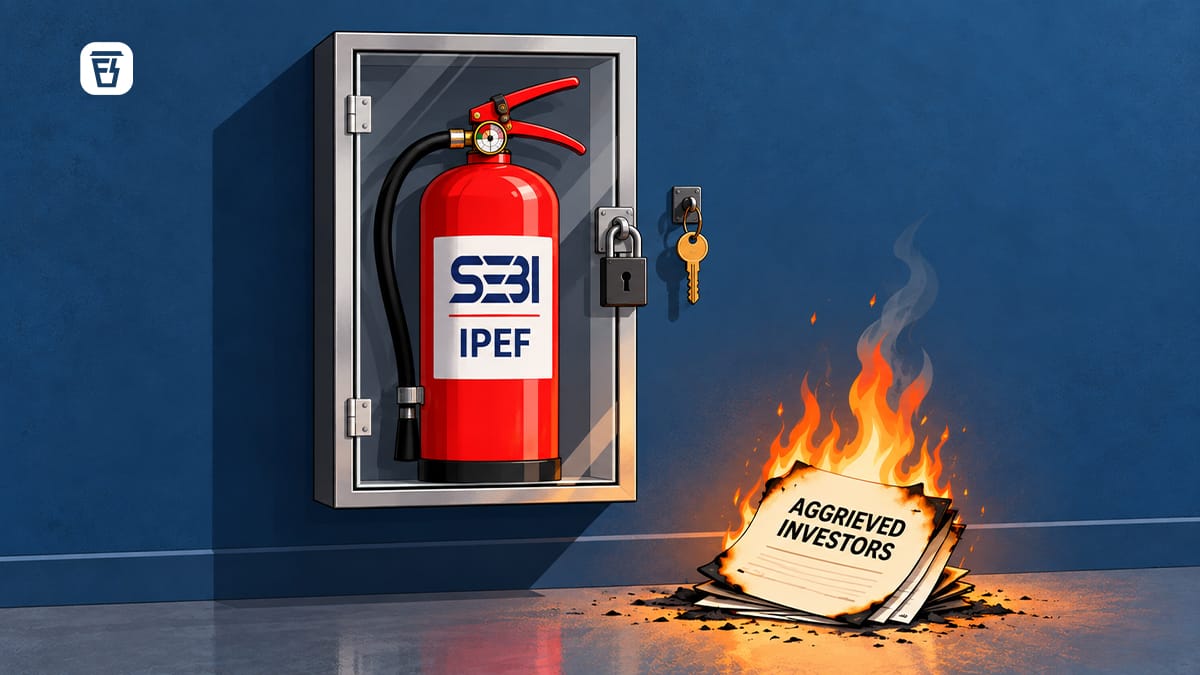
In today’s Finshots, we explain what the IPEF (Investor Protection and Education Fund) is and why it has been criticised for being underutilised.
But before we begin, if you’re someone who loves to keep tabs on what’s happening in the world of business and finance, then hit subscribe if you haven’t already. We strip stories off the jargon and deliver crisp financial insights straight to your inbox. Just one mail every morning. Promise!
If you’re already a subscriber or you’re reading this on the app, you can just go ahead and read the story.
The Story
Whenever there’s a story about a fraud or scam, we love writing about it. But it’s been a while since we covered one. The last big manipulation we remember writing about was the Jane Street saga last year, where the American trading giant was alleged to have manipulated a stock market index.
Market regulator SEBI subsequently barred Jane Street from trading in Indian stock markets and asked it to put the ₹4,800 crore it allegedly made from the manipulation into an escrow or bank account over which SEBI had a lien.
That’s because the case isn’t resolved yet. It was only an interim order, and Jane Street has since appealed to the Securities Appellate Tribunal (SAT), which hears appeals against SEBI’s decisions. But if SAT eventually upholds SEBI’s order and the money is disgorged, a significant portion of it could end up in a fund called the Investor Protection and Education Fund (IPEF).
In fact, any money recovered from illegal gains, through a process called disgorgement or penalties levied by SEBI, goes into the IPEF. The fund can also receive government grants, donations and other permitted receipts.
And this money can then be used to educate investors and spread awareness through workshops and seminars, promote financial literacy, or, in some cases, provide restitution. This is simply jargon for a mechanism through which illegal gains can be returned to eligible investors who suffered losses.
But this last bit has been attracting some attention lately.
That’s because the fund had a balance of about ₹970 crore as of FY26, which for context, is roughly 300% more than what it had three years ago. Yet, expenditure from the fund has risen by a measly 2% to around ₹5 crore during the same period. That’s just about 0.5% of the corpus. And nearly half of this money was spent on seminars, financial literacy, committee meetings and other expenses that SEBI hasn’t specified.
A recent Livemint story also pointed out that this underutilisation comes even as the risk of fraud is rising, with investors sometimes making investment decisions based on influencer recommendations that can be risky if they don’t fully understand what they’re investing in.
So we thought we’d dig into why that’s the case. Why is expenditure from the IPEF so low?
Well, to begin with, we need to understand how this money actually grows.
Sure, we mentioned earlier that the fund grows when money flows in from sources such as disgorged amounts. But the money can also be invested, which means it earns returns and compounds over time. In fact, in FY26, the fund earned ₹67 crore as investment income, 58% more than the previous year. Income from other receipts, on the other hand, fell by about 25% to ₹140 crore.
So the fund can find itself in a bit of a peculiar situation. Its returns can make the corpus grow faster than SEBI can actually spend it. Which means that even a steady pace of spending may struggle to keep up.
Then there’s another misconception. That compensating investors who suffer losses is as simple as dipping into the IPEF and handing them their money back.
It isn’t.
The law is quite specific about when the fund can be used to compensate aggrieved investors. Compensation can only be given to eligible and identifiable investors who can prove that their losses are directly linked to the malpractice. And even then, restitution is discretionary. SEBI can choose to use it only in cases where it thinks that it is appropriate.
This creates a rather tricky situation. If an investor can’t directly trace their loss to a particular fraud or manipulation, they may not be eligible for compensation from the IPEF, even if SEBI has successfully disgorged the unlawful gains from the person who committed the fraud.
Take the Jane Street case. Even if the ₹4,800 crore is eventually disgorged, it could be difficult to trace the manipulation back to every individual investor who may have suffered because of it. And without that link, those investors may never be compensated.
That helps explain why SEBI has ordered restitution in very few cases. In fact, the last major instances date back to 2006, when SEBI ordered restitution in a few cases involving IPO malpractice.
So the problem seems to lie in the law itself. And fortunately, there may be a way to fix it by looking at how similar funds work in other developed countries.
Take the US, for example. There’s a system somewhat similar to SEBI’s IPEF called the Fair Fund, created under the Sarbanes-Oxley Act, 2002.
It has one basic principle. Penalties, disgorged amounts and interest collected by the US SEC (Securities and Exchange Commission or US’ equivalent of SEBI) can be pooled together and distributed to investors who were harmed in a specific case, instead of simply being kept by the government or the SEC itself.
But there’s an important difference. You have a separate fund for each case. A fund administrator, often an SEC employee or a professional firm, is appointed to distribute the money. The SEC then creates a plan of distribution, usually with a formula that determines how much each eligible investor should receive. There’s also a deadline for completing the payouts. And once the process is over, that particular fund is shut down. Any money that can’t feasibly be distributed goes to the US Treasury.
Now, if we were to draw a parallel and replicate something like this with SEBI’s IPEF, it could potentially solve a few problems.
Because today, the IPEF is one growing pool of money. Fines and other receipts go in, and a committee decides if and when the money should be used to compensate victims. A Fair Fund, on the other hand, is more like creating a separate wallet for every case, with someone specifically responsible for distributing that money within a defined timeline.
That could plausibly change three things:
- Each fund would be created specifically for the investors affected by that case. So compensating them becomes the fund’s purpose rather than something SEBI can choose to do at its discretion.
- An administrator would be accountable for distributing the money, creating a clear record of what was collected, what was paid out and what was left over in each case.
- Just as the SEC uses a formula to distribute disgorged amounts, SEBI could create a formula based on its investigation records to work out who lost what. That could address the problem of trying to find victims years after a case is over. Of course, identifying every affected investor in a large case like Jane Street’s could still be difficult. But given that exchanges today maintain detailed trading records, it isn’t far fetched to think that such a system could be feasible.
But this isn’t a cure all either. Even the US system has slow, case by case distribution plans, and in smaller cases, only a handful of investors might actually benefit.
Besides, changing how the IPEF works would require changes to the law itself. That means amendments to the SEBI Act and related laws to give investors a clearer right to compensation and a simpler process.
So yeah, that’s the long and short of why the humongous corpus sitting in the IPEF remains underutilised. Whether that’ll change is something we’ll have to wait and see. The reality is that it may take longer than expected because the government and the Finance Ministry are aware of this and have actually discussed it many times, without much coming of it.
Until then…
Don’t forget to share this story on WhatsApp, LinkedIn, and X.
How Strong Is Your Financial Plan?
You've likely ticked off mutual funds, savings, and maybe even a side hustle. But if Life Insurance isn't a part of it, your financial pyramid isn't as secure as you think.
Life insurance is the crucial base that holds all your wealth together. It ensures that your family stays financially protected when something unpredictable happens.
If you’re unsure where to begin, Ditto's IRDAI-Certified insurance advisors can help. Book a FREE 30-minute consultation and get honest, unbiased advice. No spam, no pressure.