
What’s behind the looming global food crisis
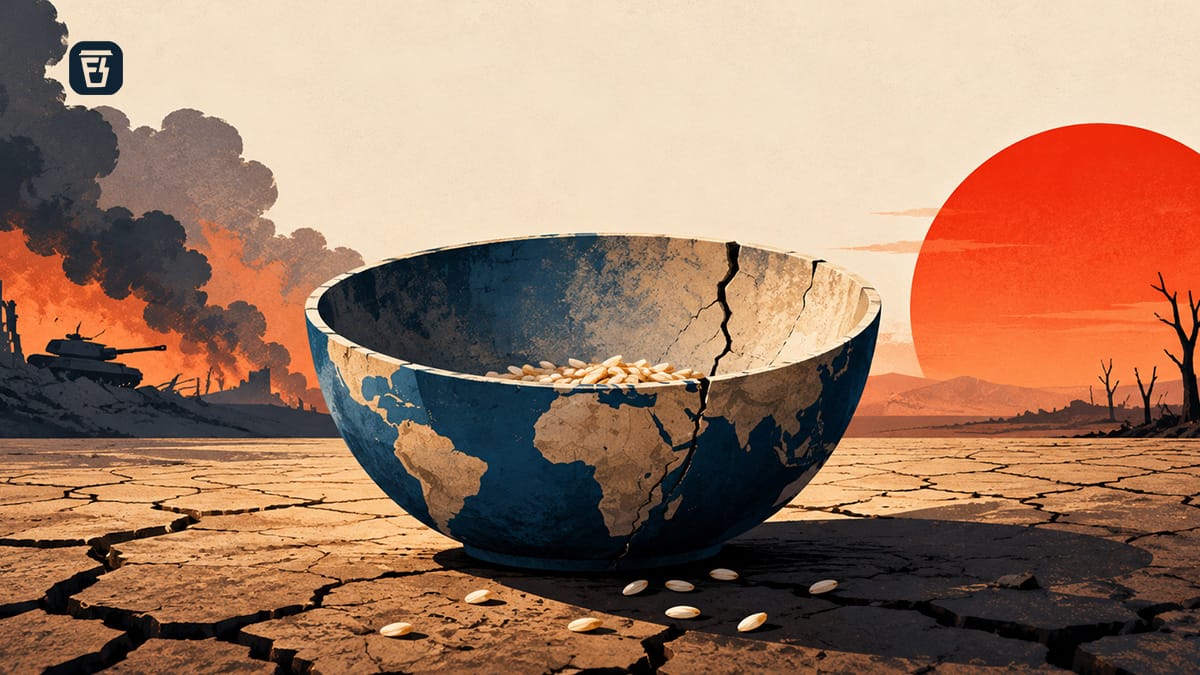
In today's Finshots, we explain why global food security concerns are returning to the table despite good harvests in some parts of the world.
 Love our insights? Add Finshots as a Preferred Source on Google ⭐
But before we begin, if you love keeping up with the buzz in business and finance, make sure to subscribe and join the Finshots club, loved by over 5 lakh readers.
Already a subscriber or reading this on the app? You’re all set. Go ahead and enjoy the story!
The Story
You’ve probably noticed that grocery bills have a way of creeping up even when there doesn’t seem to be any obvious shortage of food. Sugar, wheat and rice prices have recently gone up.
And what’s interesting is that this is happening even when some regions in the world are producing plenty of food. That’s because what we pay for groceries depends on much more than what farmers harvest.
The reason we’re telling you this is that food security concerns have returned to the centre of international discussions. And the problem is slightly different from a typical agricultural shortage.
The primary challenge seems to be that the systems required to produce, transport, and finance food supplies are running into trouble. For context, when External Affairs Minister S. Jaishankar addressed the United Nations General Assembly recently, he summarised this dilemma for the Global South as a 4F crisis involving food, fuel, fertiliser, and finance. He linked it to an intensifying El Niño, fertiliser shortage, and persistent transport disruptions along major trade corridors.
And you can already see some of these pressures showing up in global food prices. The FAO (Food and Agriculture Organisation) tracks this using an index called the ‘FAO Food Price Index’. It is essentially a global thermometer for food prices which tracks the international prices of a basket of major food items from cereals and sugar to meat, dairy and vegetable oils.
The index rose to 136 points in September 2026, up 1.5% from August and 5.8% from a year earlier. Food prices saw a sharper increase. Cereal prices, for instance, jumped 5.1% during the month and 17.2% over the past year, with international wheat prices reaching their highest level since August 2023. Sugar prices also rose, climbing 6.1% in September and 14.7% over the past year.
But if you look at the harvest data, it’s a completely different story. The FAO projects total global cereal production for 2026 to reach 2.9 billion tonnes, only 2.1% below the previous year's record harvest.
So if so much grain is being produced, why are food prices rising, and why are governments worried about another food crisis?
To begin with, transport bottlenecks continue to disrupt supply in grain markets. Ukraine is a major exporter of wheat and maize, and the Black Sea is a key route for shipping these grains around the world. So, disruptions in the region have been one of the main reasons global wheat prices rose 6.3% in September.
But unlike grain production, which occurs across dozens of agricultural economies, fertiliser manufacturing is heavily concentrated among a small group of producers, including Russia, China, Morocco, and countries within the Persian Gulf.
When Hormuz was disrupted in 2026, fertiliser trade slowed, and roughly one-third of global seaborne fertiliser trade was put at risk. Nitrogen fertilisers, such as urea and ammonia, require natural gas as both a chemical feedstock and an energy source. Gas-price or supply shocks can therefore result in nitrogen fertiliser costs going up.
The economic impact of this, though, does not show up immediately in food markets because farming runs on rigid biological timelines. Farmers have narrow windows to plant crops and apply fertilisers. If fertiliser becomes too expensive or fails to arrive during that window, they may use less of it or skip it altogether. That can affect the crop months later, when lower yields reduce food supply and push prices higher. So, a fertiliser disruption in 2026 can end up hurting agricultural output well into 2027.
But there’s another problem. When countries themselves start worrying about fertiliser supplies, they naturally try to keep whatever they can for their own farmers. China and Russia, for instance, have used export quotas, duties and licensing requirements to restrict fertiliser exports.
And that creates a bit of a vicious cycle. The supply was already under pressure because of disruptions. Now, some of the fertiliser that could have reached global markets is being kept at home. The WTO (World Trade Organisation) estimates that restrictions introduced after the Persian Gulf disruptions affected up to 15% of global fertiliser exports, rising to 23% if regional Gulf exports are treated as fully restricted.
For countries that depend heavily on imports, that means there is simply less fertiliser available to buy. And when that happens, prices go up.
This is where the problem gets even bigger for developing countries. Because even if fertiliser is available somewhere in the world, they still need the money to buy it.
But most international trade in food, fuel and fertiliser is priced in US dollars. And during periods of geopolitical stress, money tends to move towards safer assets, which can weaken developing-country currencies. That makes dollar-priced imports more expensive, even if the global price of the commodity itself hasn't changed.
Richer countries can absorb some of this shock because they have larger foreign exchange reserves. Poorer economies, on the other hand, don't have that luxury. They may have to choose between spending more on import subsidies, running down their foreign reserves, cutting other public spending or simply allowing food prices to rise.
And just when you think that the problem couldn’t get more complicated, another variable enters and changes the equation: climate change. NOAA’s (National Oceanic and Atmospheric Administration) September outlook puts the chances of a very strong El Niño during the 2026–27 winter at more than 90%. There’s also a 75% chance that the October–December period could see what it calls a historically strong El Niño.
Sure, El Niño doesn’t cause drought everywhere, and its impact varies from region to region. But the FAO suggests that Southern Africa, South and Southeast Asia, and parts of Central America are particularly vulnerable to El Niño-related drought.
And that brings us to India, which is in a relatively strong position when it comes to foodgrains. India’s 2025–26 foodgrain production is estimated at 376 million tonnes, including record production of rice, wheat and maize. The government also provides subsidised foodgrains to around 810 million people, giving households a buffer against global food-price shocks. So, for now, the immediate risk isn’t that India will suddenly run out of rice or wheat.
But you have to remember that we are still dependent on imported fertiliser and fuel. So, when regional disruptions reduced liquefied natural gas and fertiliser exports from the Persian Gulf, Indian procurement agencies had to secure nitrogen fertilisers from alternate suppliers.
In fact, Indian nitrogen fertiliser imports increased by 1.1 million tonnes, or 52%, during the first half of 2026 compared to the previous year, as the country procured supplies from China, Egypt, Vietnam, and Russia.
So, while our physical grain reserves are full today, the availability and cost of the inputs required for future crops remain tied to international events.
These interconnected factors tell us that rather than shortage being the culprit, the real challenge is affordability and distribution.
For India and the Global South, the bigger lesson is that food security is no longer just about growing enough food, but making sure that a shock in one part of the world does not become a crisis at home. This means strengthening the links between farm inputs and final delivery. This strategy demands investments in climate-resilient seeds to withstand droughts and new techniques such as vertical farming that can provide less dependence on the land and weather.
And there’s also a simpler, often overlooked investment: helping our own farmers use fertilisers more efficiently around when and how much to apply. This can reduce costs and imports while also protecting soil health.
In other words, the real measure of food security may not be how much food a country has in its warehouses today, but how quickly it can keep producing food when the world around it stops working normally.
Until then...
If you liked this story about what’s behind the looming global food crisis, feel free to share it with your friends, family, or even strangers on WhatsApp, LinkedIn, or X.
🚨 ATTENTION: FINSHOTS FAMILY
This weekend, we’re hosting a free 2-day Insurance Masterclass that helps you build real financial security by understanding health and life insurance the right way.

📅 Tuesday, 6th October at 6:30 PM: Life Insurance: How to protect your family, choose the right cover amount, and understand what truly matters during a claim.
📅 Wednesday, 7th October at 6:30 PM: Health Insurance: How hospitals process claims, common deductions, the mistakes buyers usually make, and how to choose a policy that won’t disappoint you when you need it most.