
What ails Nike?
In today’s Finshots, we explain why everyone’s talking about Nike kind of losing its Swoosh.
 Love our insights? Add Finshots as a Preferred Source on Google ⭐
But before we begin, if you love keeping up with the buzz in business and finance, make sure to subscribe and join the Finshots club, loved by over 5 lakh readers.
Already a subscriber or reading this on the app? You’re all set. Go ahead and enjoy the story!
The Story
Some very unpleasant things have been happening at Nike over the past few years. Things haven’t looked good since the stock peaked in 2021.
A few days ago, Nike was dropped from the S&P 100, an index of the 100 biggest US companies. It was the first time in 20 years. And over the last five years, it has lost about $200 billion, or nearly 80% of its market value.
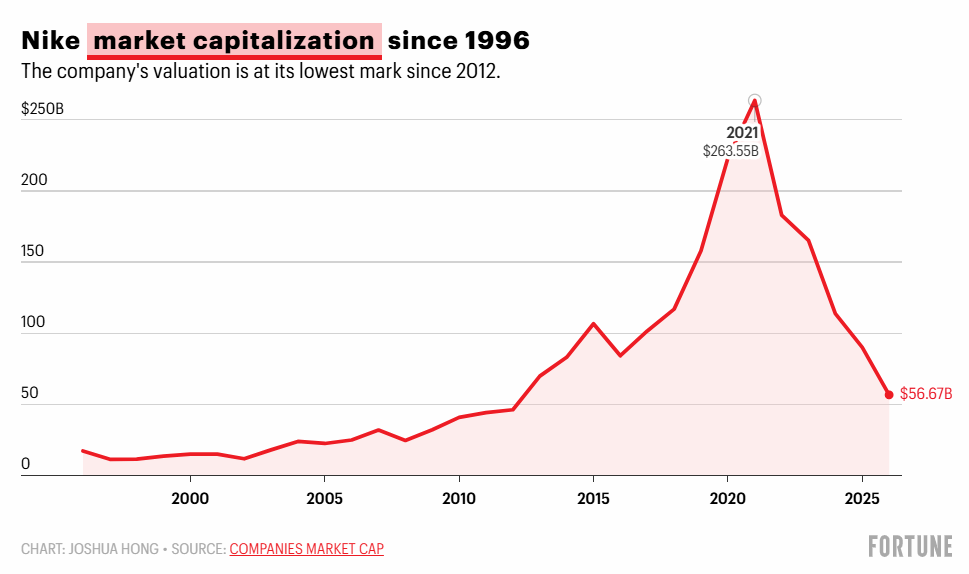
Then came its latest quarterly results. Nike reported $11.21 billion in revenue for the first quarter of its financial year (June-August 2026). That was not only slightly below what analysts and investors expected, but also 4% lower than the same quarter last year. And this isn’t a temporary blip. Nike has already warned that revenue could fall this financial year.
As you can imagine, the stock fell even further.
But wait. Wasn’t Nike once the world’s most iconic sportswear brand? The kind of brand everyone wanted because it was supposed to be the best? So, how did a company like Nike fall from there?
Well, let’s take a quick trip back to where it all began.
Nike started out as Blue Ribbon Sports in 1964. And back then, it didn’t make shoes at all. Its co-founder, Phil Knight, had a plan to challenge Adidas’s dominance in running shoes by importing Japanese copies of Adidas shoes, made by Onitsuka Tiger, and selling them in the US.
But turning that idea into a business needed money. Knight got some from his university coach, Bill Bowerman, after showing him the samples he planned to sell. Bowerman liked what he saw and eventually became his business partner.
Sales took off, reaching $3 million in 1972. That’s when Knight and Bowerman decided it was time to stop reselling other people’s shoes and start making their own.
And that decision would eventually give birth to Nike.
Then call it luck or destiny, but that same year, Bowerman became the coach of the American Olympic team. And that gave them the perfect opportunity to get Nike on athletes’ feet. Bowerman simply encouraged athletes to wear the new shoes, turning them into walking advertisements for the brand.
And it worked. When one of the greatest tennis players, John McEnroe, hurt his ankle and started wearing Nike’s three-quarter-top shoes, sales of that style jumped from 10,000 pairs to more than 1 million. Suddenly, everyone wanted a pair of Nikes.
Besides, athlete endorsements became such a powerful sales engine that within a decade and a half, Nike had actually turned its ambition into reality. It overtook Adidas to become the world’s top shoe maker.
But there was a problem. Running shoes could only take Nike so far. If it wanted to stay at the top, it needed to win over fans of other sports too.
Football, America’s favourite sport, seemed like an obvious choice. But that market was already dominated by Adidas and Puma, and taking them on would have been expensive. So Nike looked elsewhere. Basketball was exploding in popularity through the NBA (National Basketball Association), and Nike saw an opportunity.
But it wasn’t the only brand looking to expand. When you become the strongest player in the field, someone eventually comes along wanting to knock you off the top. And for Nike, that challenger was Reebok.
In the 1980s, Reebok rode the growing aerobics craze and overtook Nike, while Nike had largely missed the trend.
So to fight back it doubled down on technology and innovation and moving beyond running shoes. And this is where it made one of its biggest bets yet.
In 1984, it offered Michael Jordan a five-year, $2.5 million contract, along with a royalty on every pair of Air Jordans sold. The shoe was designed specifically for him, but Nike had bigger plans. It wanted to build an entire shoe range around Jordan. It was a risky bet because Jordan wasn’t yet the basketball superstar we know today. But Nike struck gold.
Jordan was already on the verge of stardom, and then the NBA banned his shoes for violating its colour guidelines. But Nike cleverly turned the controversy into a marketing opportunity. It paid Jordan’s $5,000 fine for every game and ran a commercial saying the NBA could ban the shoes, but it couldn’t stop people from wearing them. And just like that, a ban turned the Air Jordan into a symbol of rebellion and “being cool”. The end result was $126 million in sales in its first year, against Nike’s modest $3 million expectation.
Now, from all this, you’ve probably noticed one thing. Nike’s business strategy was built around two simple ideas.
First, source cheaply. It initially imported Onitsuka Tigers from Japan. Later, it started making its own shoes by outsourcing manufacturing to countries where they could be produced cheaply and then selling them at higher margins in the US and around the world.
Second, organise the business by sport. Running, basketball, football and so on each had their own teams and products.
But some of these things started changing in 2020, when Nike got a new CEO, John Donahoe.
For instance, instead of organising its products around sports, Nike started organising them around men, women and kids. That may sound harmless, but there was a reason the old system worked. A runner, a basketball player and a footballer need very different things. Having separate teams for each sport helped Nike understand those differences, improve its products and come up with new ideas. It also helped management track how each sport was doing and decide where to invest in new products or athlete deals.
But when Nike shifted to a gender-based structure, that equation changed. And it may have taken a toll on the kind of sport-specific innovation that had once fuelled the brand.
The other thing was that Donahoe came from a tech background. He wanted Nike to sell more through its own website, apps and stores instead of relying on other wholesalers and retailers. On paper, it made sense. Nike could keep more of the money from each sale. But there’s a catch. If new consumers didn’t see Nike when they walked into a store, they may have simply bought whatever looked best among the options in front of them.
That’s exactly what happened. Nike’s loyal customers stayed, but the shelf space it left behind was filled by newer brands such as On and Hoka. And what that meant is by FY26, Nike’s direct-to-consumer revenue had fallen 6% to $17 billion, while wholesale revenue rose 6% to $27 billion.
And finally, there’s also China. China was once Nike’s fastest-growing market. But despite the country’s sportswear market doubling over the past decade, Nike’s business there has fallen 30% since 2021.
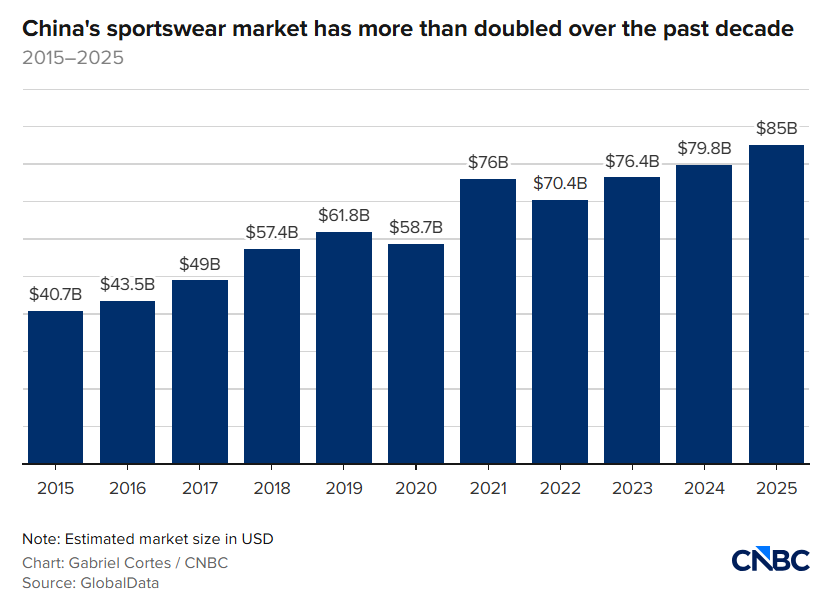
That’s because young Chinese consumers increasingly wanted local brands, and companies like Anta and Li-Ning got much better at giving them exactly that. And remember, Nike had already pulled its products from some retail partners’ shelves. That probably didn’t help either.
And all of this explains why Nike’s dominance has weakened.
But does that mean the brand has crashed?
Well, not really. Sure, it may have lost some of its luster. But Nike is now trying to bring back some of what made it special.
In 2024, Nike brought back one of its own veterans, Elliott Hill. His plan, called the “Sport Offense”, wants to put athletes and sports back at the centre of the company and rebuilds ties with retail partners. He’s also trying to bring more creativity to the lifestyle business, make shoes like Dunks and Jordan retros less available so that they feel rare and desirable again, rethink how Nike products are presented to Chinese consumers and basically restructure the entire company so it can make decisions faster.
But bringing back the old Nike won’t happen overnight. These changes will take time, and the turnaround could stretch until 2028 or even later.
So, Nike is still the world’s largest sportswear maker. But right now, it is in the middle of a long repair job.
And perhaps its own history offers some hope. Nike has reinvented itself before when a rival like Reebok or even others got ahead. So whether it can do it again, with new ideas and new shoes that people actually want to wear, is something we’ll have to wait and see.
Until then…
If you’ve been hearing all the chatter about Nike’s crisis, well, now you know what’s behind it. And if you liked this story, spread the knowledge and share it with your friends, family, and even strangers on WhatsApp, LinkedIn, and X.
A message to all breadwinners
You work hard, you provide, and make sacrifices so your family can live comfortably. But imagine when you're not around. Would your family be okay financially? That’s the peace of mind term insurance brings. If you want to learn more, book a FREE consultation with a Ditto advisor today.