
What did demonetisation do for India in a decade?
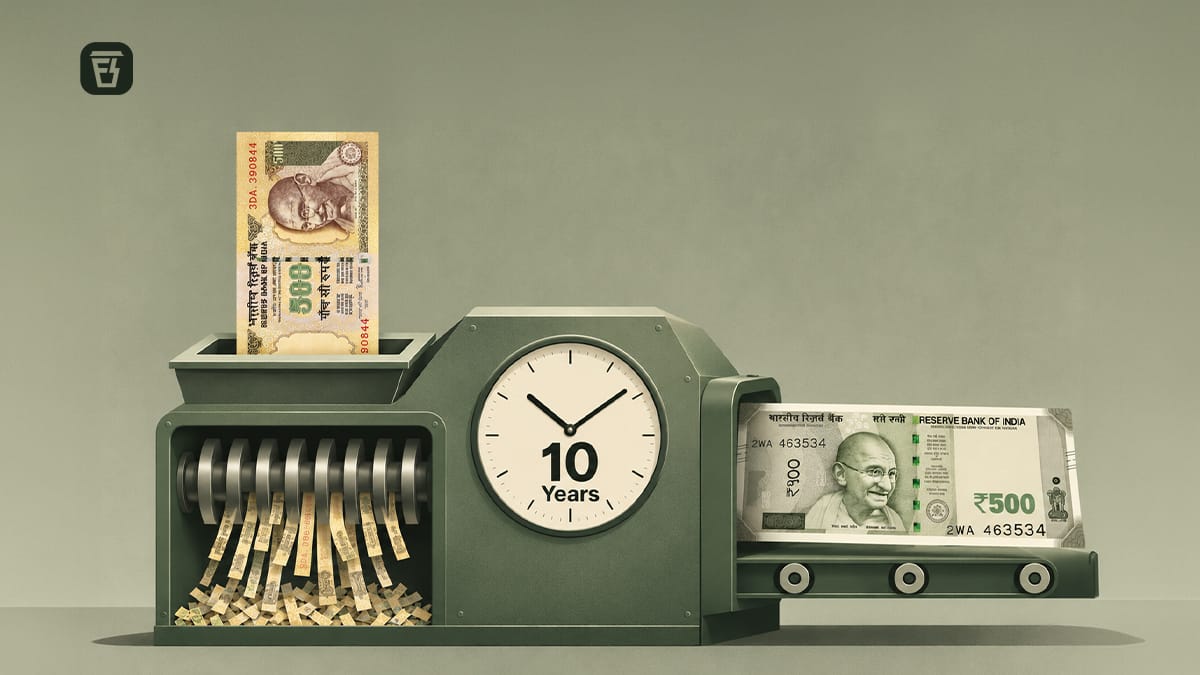
In today’s Finshots, we evaluate demonetisation against what it promised, using ten years of data, and talk about the habits it left behind.
But before we begin, if you love keeping up with the buzz in business and finance, make sure to subscribe and join the Finshots club, loved by over 5 lakh readers.
Already a subscriber or reading this on the app? You’re all set. Go ahead and enjoy the story!
 Love our insights? Add Finshots as a Preferred Source on Google ⭐
The Story
I very clearly remember the day the old ₹500 and ₹1,000 notes were demonetised in 2016. We were sitting in the living room, watching TV over dinner, when the news suddenly broke that these high-denomination notes had been demonetised. They would no longer be accepted as legal tender. One announcement by the Honourable Prime Minister, and notes worth about ₹15 lakh crore went poof! Gone!
People were obviously confused about what to do with the big notes they had. Most of us lined up outside ATMs to withdraw ₹400 and keep some cash in our wallets because ₹100 notes were the only denomination coming out of ATMs that people could use at the time. UPI existed, but it had been around for barely three months. And I don’t remember anyone using it back then.
So, when almost everything ran on cash, we suddenly had very little of it. And most of India, especially the informal sector that depended heavily on cash, suffered.
Now, it’s been a decade since this mess. And that means we have enough data to ask a simple question: what did we get in return for all that?
Let’s take a look, promise by promise, at what the government hoped to achieve when it initially announced demonetisation.
The first and main thing the government said was that it would tackle black money. The plan assumed that people hoarded untaxed money in the form of cash. But the data later showed that 99.3% of the banned notes came back. Only about ₹10,720 crore didn’t.
Before the ban, the expectation was that roughly ₹4-5 lakh crore worth of cash in circulation held as black money would not return. But that didn’t really happen because people who earn untaxed income don’t usually keep all of it as cash. They often park it in other assets such as real estate, gold or shell companies. So, banning high-value notes couldn’t really touch much of that wealth.
Besides, the RBI’s board had also warned the government beforehand that demonetisation was unlikely to have a significant impact on black money and counterfeit notes.
So no, demonetisation didn’t do much to eradicate black money.
That brings us to the second objective: eliminating fake currency.
“The magnitude of cash in circulation is directly linked to the level of corruption,” is what the Honourable Prime Minister said while announcing demonetisation. Unfortunately, that’s not entirely true because the amount of cash held by the public doesn’t automatically tell us anything about the level of corruption. What matters is why people hold that cash.
To put that in perspective, you could look at Japan. It’s a much cleaner economy than India when it comes to corruption. But if you look at its cash as a percentage of GDP, it’s around 20%, considerably higher than in other major economies. Thanks to extremely low interest rates, sometimes even zero or negative, which made it more sensible for people to hold physical cash for emergencies rather than park it in a bank or deposit, where it wouldn't earn them any returns.
In India on the other hand, cash is still king as you know. The amount of cash held by the public is now more than double what it was a decade ago despite the meteoric rise of UPI and digital transactions. As a percentage of GDP, the ratio is around 12%, and has remained fairly stable for a while. That’s largely because India’s GDP has also grown over the years. And also because a large number of transactions, such as real estate purchases, wedding expenses, tips and payments at small neighbourhood shops in rural areas, still happen in cash.
There’s also a chance that this could increase now that NPCI (National Payments Corporation of India) is planning to introduce a small fee for UPI transactions above ₹2,000. This could prompt some small shops to go back to accepting cash.
And coming to the actual question of how much of that cash is fake, well, RBI data has it that the number of counterfeit notes detected per crore notes in circulation fell from 70 in FY16 to 13 in FY26. But that’s the overall picture, which includes all denominations.
So, a more useful comparison would be to look at just the higher-denomination notes, as that’s where counterfeiting is most common. Today, the highest denomination in circulation is the ₹500 note, and the number of fake notes detected per crore between demonetisation and now has increased from 0.3 to 20.
There’s an important caveat here, though. This comparison only considers the new ₹500 notes we use today. So FY17, the year demonetisation took place, isn’t a good baseline because the new notes had only just been introduced. And it takes time for counterfeit versions to be produced and make their way into the banking system.
So, if we compare the old ₹500 notes in circulation in the financial year before demonetisation with today's notes, the number of counterfeits has actually fallen from about 167 per crore to 20 per crore, as we mentioned earlier.
That seemingly tells you that the objective of bringing down counterfeit notes has largely been met.
But again, there’s one thing you may have noticed here. Counterfeit notes were never really a huge problem because they made up a tiny fraction of the total notes in circulation. So, you didn’t necessarily need such a massive exercise as demonetisation to tackle them.
After all, the move caused an estimated 1.5-2% loss in economic output and dealt a huge blow to the cash-dependent informal sector. Which means that the benefit of eliminating these fake notes was tiny compared to the loss of income and economic output it caused.
And finally, let’s talk about an objective that wasn’t part of the original announcement but was added later. We’re talking about widening the tax net.
Sure, demonetisation did bring more people into the tax-filing system, partly because cash deposits could now be traced to their PAN records. The number of people filing returns jumped in the years that followed.
But it’s difficult to credit this entirely to the note ban because you had GST coming in in 2017, and then the wider use of TDS, which also brought more people into the tax net.
Besides, just because someone files a tax return doesn’t necessarily mean they’re actually paying tax. The 2017 Economic Survey itself found that the new filers earned about ₹2.7 lakh on average, barely above the ₹2.5 lakh income threshold at the time. Direct tax collections also rose only slightly, from 5.53% of GDP in FY17 to 5.86% the following year. But the ratio then fell to 4.78% by FY21.
Sure, it eventually reached a high of 6.73% in FY25. But this increase came after the pandemic, so you can’t really credit demonetisation alone for it.
So, after looking at all this, the final verdict seems to be that demonetisation did nudge people towards digital payments and brought more people into the tax-filing system.
But then, the pandemic was also a powerful force that pushed people towards contactless digital payments. And digital transactions leave a trail, which can eventually bring more people into the tax system.
The basic objective of curbing black money, however, clearly wasn’t met. For that, you’d need stricter law enforcement and measures to plug the loopholes that allow people to park undisclosed income in other assets, buy property using cash or bribe their way into breaking the law, fuelling a system that makes corruption easier than staying clean.
Until then…
If you liked this story, feel free to share it with your friends, family, or even strangers on WhatsApp, LinkedIn, or X.
A message to all breadwinners
You work hard, you provide, and make sacrifices so your family can live comfortably. But imagine when you're not around. Would your family be okay financially? That’s the peace of mind term insurance brings. If you want to learn more, book a FREE consultation with a Ditto advisor today.