
Why Dutch prisons are shutting down, GTA's Kannadiga connection, & more...
Hey folks,
The popularity of the GTA (Grand Theft Auto) series is evident from the hype around GTA VI’s release right now. But did you know that the GTA franchise has a rather interesting connection to Karnataka?
Before you ask us how, the answer lies in the official soundtrack of GTA: Liberty City Stories, an action-adventure video game developed by Rockstar and released in 2005.
In this game, if you happen to get into a vehicle and switch to the Radio Del Mundo station, a fictional radio station within the game, there’s a chance you might hear the song “Neeve Nanna Thayi Thande” by the legendary S.P. Balasubramaniam. But how did a Kannada song find its way into a GTA game?
You see, the song “Neeve Nanna” is from a 1987 Kannada movie called Dance Raja Dance, with its music directed by Vijaya Anand. An American couple, painter Amy Sillman and her musician boyfriend Kurt Hoffman, were visiting India when they came across a bootleg cassette labelled ’Vijaya Anand - Dance Raja Dance’. They played it for the team at Luaka Bop, musician David Byrne’s record label. And that set off a project that would last decades, involving several trips to meet Anand and eventually a collaboration with Byrne.
Luaka Bop later released Asia Classics 1: The South Indian Film Music of Vijaya Anand – Dance Raja Dance distributed by Warner Bros. In his biography on Luaka Bop’s website, Byrne wrote that Anand “is the invisible presence behind each of these songs.” Track 5 on the album is “Neeve Nanna (Only You Were Mine)”. Now, we know that the English subtitle isn’t entirely accurate because the song’s title “Neeve Nanna Thayi Thande” literally translates to “You are only my mother and father”. But this is the English title under which the song eventually found its international identity.
In 2005, Liberty City Stories featured the song on Radio Del Mundo, whose fictional DJ was Panjit Gavaskar. And the GTA soundtrack credits list “Neeve Nanna (Only You Were Mine)” by Vijaya Anand, using the same English title and spelling of “Vijaya” as the Luaka Bop album. So there seems to be a direct connection between the album and its appearance in the game. Some other Indian songs on the station included Asha Bhosle’s “Dum Maro Dum” and Ananda Shankar’s “Raghupati”.
But the story doesn’t end here. Vijaya Anand was born Jude Matthew in Madras and grew up speaking Tamil. Yet he spent much of his career scoring Kannada films. On Dance Raja Dance, he even had a young keyboard player named Dileep assisting him. The world would later know him as the living legend A.R. Rahman.
Anand passed away in Chennai in February 2024 at the age of 71. He was also among the first wave of music directors to use electronic instruments in Indian film scores. But it’s unlikely he ever imagined his music playing in a make-believe virtual version of New York.
So while everyone waits for GTA VI, maybe go back to Liberty City Stories for a while. Hop into a car, tune in to Radio Del Mundo and wait for a little bit of Karnataka to come on.
Here’s a soundtrack to put you in the mood… 🎵
Patta by Harmeeet
You can thank our reader, Prateek Senapati again for this rec. Prateek seems to be hooked to this artist’s songs because he says “Here’s another recommendation from Harmeeet. I just love how he writes!”
If you want your recommendations featured in our Sunday editions too, send them our way. Especially hidden gems from underrated Indian artists that many of us may not have discovered yet.
Ready to roll?
What caught our eye this week
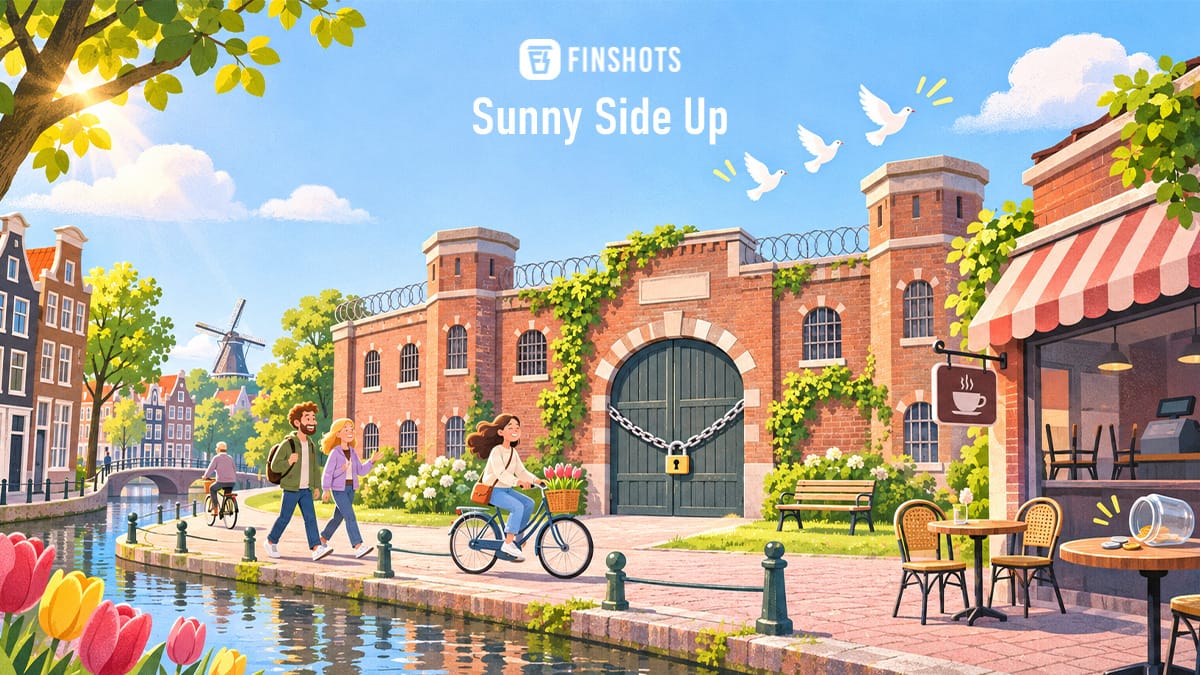
The Netherlands is shutting down its prisons… But why?
Crime rates around the world have generally been falling. In the US, for instance, violent crime fell by about 9% in 2025 to 11.2 lakh cases. This was the largest annual decline since the FBI began estimating crime trends in 1936. India, on the other hand, recorded 6% fewer criminal cases in 2024 than in the previous year, according to the NCRB’s latest report.
But that hasn’t necessarily eased the pressure on prisons. Federal prisons in the US are operating at 110% capacity, while in India, the figure is a whopping 120%.
But there’s one country where the exact opposite has been happening: the Netherlands. It has a shortage of prisoners, so much so that it’s actually been shutting down some of its existing prisons over the last few decades.
To put that in perspective, the country’s prison population fell from 20,463 in 2006 to 12,570 in 2025. That’s roughly 70 prisoners per lakh people. In comparison, the US, which has the world’s highest incarceration (imprisonment) rate, has 542 prisoners per lakh people.
So, if prisons are overcrowded in so many parts of the world, why is the Netherlands shutting them down?
Well, like in the rest of the world, violent crimes such as murder, kidnapping and burglary have declined significantly in the Netherlands. But many other crimes have moved online, such as digital fraud and other cybercrimes. And the Dutch prefer to deal with some of these offences differently rather than send people to prison.
For instance, state prosecutors can handle certain cases without involving a judge. They can also impose punishments that don’t involve prison time, such as fines or community service. Drug offenders, meanwhile, are given rehabilitation. The Netherlands introduced these measures about two decades ago to reduce the number of cases going to court. Naturally, this also meant fewer prison sentences and, consequently, fewer prisoners.
And there’s a logic behind this approach. The Dutch believe that putting someone in prison doesn’t necessarily make them a better person. Think about it. The harsh prison environment and limited contact with family and friends can make inmates feel worse. They could even become more violent or ruthless, leaving prison only to return to a life of crime. This is especially possible if they’ve built connections with other criminals behind bars.
Even shorter prison sentences can mean losing your job and becoming disconnected from the outside world. That’s why the Netherlands reserves prison sentences mainly for serious violent and sexual offences, while opting for alternative punishments for less serious crimes.
There’s also an economic reason. Keeping people in prison involves significant operational and maintenance costs. So, the Netherlands believes it’s more sensible to keep fewer people behind bars and focus on rehabilitation or other punishments for less serious offences.
And with fewer prisoners, maintaining prisons that were only partially occupied didn’t make much sense. So the country began renting out its surplus prison cells to neighbouring countries like Belgium and Norway, which were struggling with overcrowding.
But the prisons that the Netherlands no longer needed were eventually shut down. And guess what happened to these buildings?
They were converted into cinema halls, hotels and cultural centres, creating new economic activity in the process.
Of course, this approach has its downsides too. Shutting down prisons means that people working there could lose their jobs or have to be absorbed into other roles. According to an older estimate from 2016, closing excess prisons led to around 2,000 job losses, with less than half of those affected being absorbed elsewhere.
There’s also the possibility that crime rates could rise again, leaving Dutch prisons overcrowded. Right now, prison occupancy is about 78%. But if the number of prisoners increases, rebuilding prison capacity could be expensive. And the country could find itself short of both prison cells and staff.
So yeah, it’s a double-edged sword. As interesting as it is that shutting down prisons can free up buildings for other economic activities and allow the country to focus more on rehabilitation, not all of it is sunshine and rainbows.
Infographic
Readers Recommend
This week, our reader Tomy Kuriakose recommends watching a movie called “Su from So”. Here’s the trailer if you’d like to watch it.
He writes,
It’s a Kannada movie set in the rural landscape of Someshwara village in Dakshina Kannada (South Kanara district) and the events triggered by a young man’s innocent crush.
Thank you for the rec, Tomy!
That’s it from us this week. We’ll see you next Sunday.
Until then, send us your book, music (preferably from underrated Indian artists), business movies, documentaries, or podcast recommendations. We’ll feature them in this newsletter! Also, don’t forget to tell us what you thought of today's edition. Just hit reply to this email (or if you’re reading this on the web, drop us a message at morning@finshots.in).
Don’t forget to share this edition on WhatsApp, LinkedIn, and X.