
India's Company Law Tribunal is in a crisis
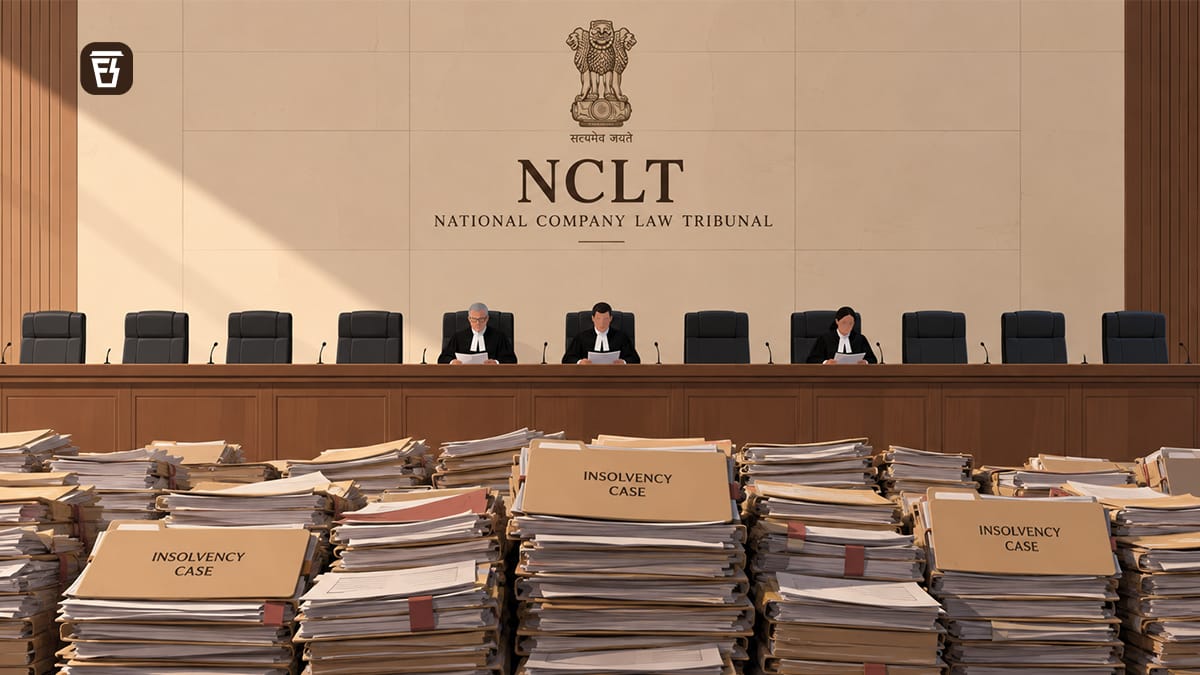
In today’s Finshots, we explain why the NCLT, the body that handles corporate insolvency cases, is stuck in a sort of never-ending crisis of staff shortages and inadequate infrastructure.
 Love our insights? Add Finshots as a Preferred Source on Google ⭐
But before we begin, if you love keeping up with the buzz in business and finance, make sure to subscribe and join the Finshots club, loved by over 5 lakh readers.
Already a subscriber or reading this on the app? You’re all set. Go ahead and enjoy the story!
The Story
If you’re an Indian company and you have a case pending before the National Company Law Tribunal (NCLT), life isn’t easy for you. That’s because the NCLT deals with company disputes and insolvency cases. And resolving these can take days, sometimes even years.
Now, we know you’ll say, hey Finshots, but we had something called the Insolvency and Bankruptcy Code (IBC), which came into effect a decade ago. It said that such cases must be resolved within 330 days, including a grace period.
But that’s not really happening. Instead, there are long waits and case adjournments at the NCLT, sometimes for no clear reason. In fact, cases are even being dragged on, with delays ranging from 48 days to a whopping 738 days.
And all this has left the Supreme Court literally frustrated. For context, a couple of days ago, a bench led by Chief Justice (CJI) Surya Kant heard a plea from the NCLT Bar Association (a body that represents lawyers who practise before the NCLT and NCLAT). The lawyer fighting the Association’s case told the court that the NCLT was “in shambles”. And there’s a reason for that. Eighteen NCLT benches are currently working only half a day since last month, simply because there aren’t enough members.
Just to give you some context, the NCLT is supposed to have 63 members, but only 50 are currently in place. Another 18 are due to retire by the end of next year. And it’s not just judges and technical members. The Supreme Court had years ago approved 246 permanent administrative staff posts for the tribunal, but none have actually been made permanent. Besides, more than 95% of the NCLT’s workforce is still working on a contractual basis or on deputation. That’s hardly the setup for an institution meant to resolve time sensitive corporate insolvency cases.
So, how did we get here, you ask?
To begin with, the NCLT’s workload grew massively, but its size didn’t. It was created in 2016 to handle company-law disputes, but that same year, the IBC gave it another much bigger responsibility — handling corporate insolvency cases. Earlier, these cases were handled by different bodies under different laws. So the NCLT suddenly had a lot more work on its plate. Yet its sanctioned strength has remained frozen at 63 members ever since, even as insolvency cases started making up a large part of its workload.
The next problem is that even when vacancies arise, filling them can take a long time. The process is actually supposed to be fairly straightforward. Since the NCLT sits administratively under the Ministry of Corporate Affairs (MCA), the MCA first advertises the vacancy. A judge-led committee called the Search-cum-Selection Committee (SCSC) then screens candidates and recommends names, after which the government formally appoints them. But the trouble is that vacancies are usually advertised only after someone has already left, so the NCLT is often playing catch-up.
And the delays don’t always end there. The Supreme Court has repeatedly pulled up the government over how it handles these recommendations.
Take the Tribunal Reforms Act of 2021, which was meant to simplify the way tribunals work across the country. India had dozens of tribunals created under different laws, each with its own rules for appointing members, their tenure and qualifications. So, the government tried to streamline the system by abolishing some smaller tribunals and moving their work to existing courts. It also created a common set of rules for the remaining tribunals, including the NCLT and NCLAT (National Company Law Appellate Tribunal), instead of having separate rules for each.
But some of those rules went against what the Supreme Court had already directed. For instance, the Court had said the SCSC should recommend one person for each vacancy. The new law instead allowed it to recommend two names, effectively giving the government a choice between them. What you have to note here though is that the Court had specifically struck down this provision earlier, yet the government went ahead with it.
So, the Supreme Court accused the government of “cherry-picking” candidates by appointing some people from the waiting list while leaving those recommended in the main list waiting. If you think about it, this defeated the purpose of having an independent selection committee in the first place. That’s exactly what the Court thought as well.
And this isn’t just a theoretical problem. We’ve seen it happen in other cases too. In one involving the Income Tax Appellate Tribunal, a candidate selected in 2014 was still waiting for an appointment years later because the process was stuck with the government.
Delays like these are exactly why even when the system identifies people to fill vacant seats, getting them into those seats can still take years.
Apart from this, the NCLT also suffers from a lack of permanent buildings and proper infrastructure at several of its benches.
And the end result is that people or companies sometimes have to travel long distances just to have their cases heard. For instance, someone from Telangana or Andhra Pradesh may have to travel all the way to Kolkata because their local bench doesn’t have enough members to hear the case.
But that doesn’t mean nothing is being done to fix the problem. The government’s biggest move so far is the Tribunals Reforms Act, 2026, which received presidential assent just last month.
This new law creates a National Tribunal Commission (NTC), an independent body that will handle appointments, performance reviews and disciplinary matters across all central tribunals, including the NCLT. The idea is to take these decisions out of individual government ministries and give tribunals a more independent administrative setup.
But even this reform has taken years to arrive. In fact, India has tried to reform the tribunal system roughly three times over the past decade, with earlier versions repeatedly being challenged in court. The government would introduce rules giving it more control over appointments or tenure, the Supreme Court would strike some of them down, and it would kind of run into a vicious cycle.
But there’s an important catch with the latest reform too. The NTC has only just been created and its members are yet to be appointed. So, for now, it cannot do much about the NCLT’s immediate problems. For instance, it might help fix who gets appointed and how quickly, but it doesn’t automatically solve the NCLT’s bigger capacity problem. Decisions like building more courtrooms or having more permanent positions still require the government to provide more money and staff.
So, we’ll have to wait and see whether the new Act can finally resolve the tussle between the government and the Supreme Court, which has left tribunals like the NCLT caught in the middle. Or whether the same cycle continues. We hope it doesn’t.
Until then…
If this story helped you understand the problems India’s Company Law Tribunal is facing and why it’s going through them, spread the word by sharing it on WhatsApp, LinkedIn, and X.
🚨 ATTENTION: FINSHOTS FAMILY
This weekend, we’re hosting a free 2-day Insurance Masterclass that helps you build real financial security by understanding health and life insurance the right way.

📅 Saturday, 26th September at 11:00 AM: Life Insurance: How to protect your family, choose the right cover amount, and understand what truly matters during a claim.
📅 Sunday, 27th September at 11:00 AM: Health Insurance: How hospitals process claims, common deductions, the mistakes buyers usually make, and how to choose a policy that won’t disappoint you when you need it most.