
IDBI Bank is finally being sold
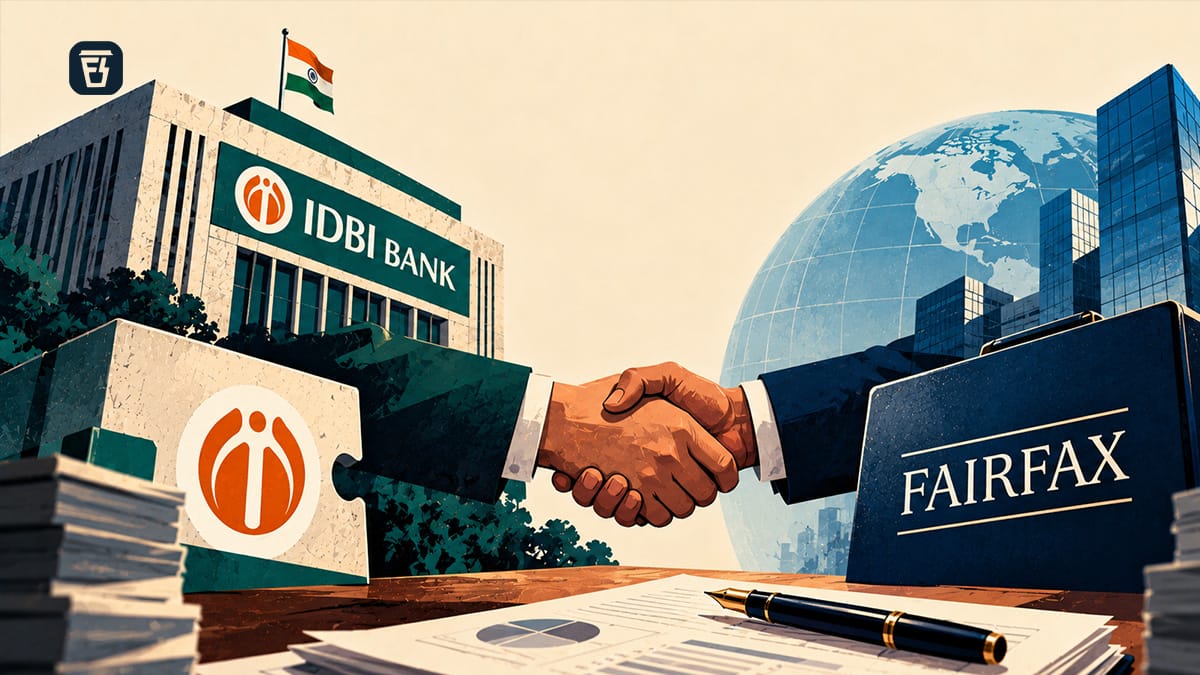
In today’s Finshots, we break down the Fairfax-IDBI Bank deal.
But before we begin, if you’re someone who loves to keep tabs on what’s happening in the world of business and finance, then hit subscribe if you haven’t already. We strip stories off the jargon and deliver crisp financial insights straight to your inbox. Just one mail every morning. Promise!
If you’re already a subscriber or you’re reading this on the app, you can just go ahead and read the story.
The Story
The last time we wrote about IDBI Bank was in 2022. And back then, we asked a rather perplexing question: When will the IDBI saga end?
You see, almost every year, there were talks about the government selling its stake in the bank to meet its divestment targets. Sometimes, potential buyers showed interest. Sometimes, negotiations even began. But the sale would always get stuck. Either the buyers couldn’t meet the regulatory conditions or the government wasn’t happy with the price they were offering.
But now it looks like all of that seems to have finally ended.
The day before yesterday, the government approved the sale of a majority stake in IDBI Bank to a Toronto-based company called Fairfax for ₹52,878 crore in cash. Once the deal goes through, Fairfax will control 60.72% of the bank. This stake currently belongs to the government and LIC, whose respective holdings will fall to 15% and 19% after the sale. And that would also make the deal the largest foreign direct investment (FDI) in India’s financial sector.
Sidebar: Indian FDI rules allow foreign companies to own up to 74% of a private sector bank. So Fairfax can acquire a majority stake. But RBI rules require it to eventually reduce its promoter holding to 26%. It will have 15 years to do this after a five year lock-in period ends.
Of course, the deal isn’t done just yet. It still needs approvals from the RBI and SEBI, among others. Fairfax will also have to make an open offer, giving IDBI Bank’s minority shareholders an opportunity to sell their shares.
But assuming that the deal goes through, let’s understand why Fairfax wants to bet on IDBI Bank in the first place.
To do that, we need to know a little about Fairfax. Officially called Fairfax Financial Holdings, it’s an insurance and investment company founded and run by Prem Watsa. Its business model relies on something called “float”. Basically, insurers collect premiums from customers first and pay claims later. In the meantime, they can invest that money and earn returns, much like Warren Buffett’s Berkshire Hathaway does.
And Fairfax has been putting that money to work in India for a while now. It owns significant stakes in Bengaluru International Airport, Thomas Cook India, IIFL, Go Digit General Insurance and CSB Bank (formerly the Catholic Syrian Bank). It also owned a stake in ICICI Lombard a few years ago, before selling it.
That brings us to IDBI Bank. IDBI is much bigger than CSB Bank in terms of business, profits and branch network. For Fairfax, that means access to a much larger network through which it could potentially distribute its financial products.
Of course, you might wonder whether Fairfax can control two banks at the same time. And you’d be right. Under RBI rules, it cannot simply keep controlling stakes in both indefinitely. So it may eventually have to either exit CSB Bank or merge its banking, IIFL Capital, and insurance businesses into a single entity, depending on whatever’s more beneficial. The broader idea, though, is to build a powerful financial business offering loans, gold loans, insurance and deposits.
And the thing is, Fairfax might be getting this opportunity at a reasonable price. To put that in perspective, it’s paying roughly nine times IDBI Bank’s FY26 profit of ₹9,513 crore. The price per share is also only about 23% above the bank’s book value, or net assets (assets minus liabilities), of ₹65.75 per share. And roughly 7% above the average estimated fair value of ₹76 per share. Most importantly, the offer price is still slightly below what the stock is trading at in the market.
And this is where we start to see a few challenges that the deal faces. We say this because, after the government approved the deal, it attracted some displeasure from IDBI Bank’s employees’ forum. They aren’t sure whether the bank has been valued fairly and are asking for evidence that the bank isn’t being undersold.
And well, their scepticism may not just stem from the fact that IDBI is being sold for less than its market value. It could also be because over the past decade, the bank has improved its financial health considerably, partly after the government infused capital into it.
For instance, its gross non-performing assets (NPAs), which are loans that have stopped being repaid for a prolonged period of 90 days, fell from 31.8% in 2018 to just 2.3% in 2026. Net NPAs have also declined significantly. And the bank’s ability to absorb unexpected losses has improved, with its capital adequacy ratio rising from 6.2% to 26.7% over the same period.
So the employees’ forum may be looking at the bank’s turnaround and wondering whether the offer adequately reflects how much it has improved.
But the government has its own reasons for believing that the price isn’t unfair.
For starters, it argues that comparing Fairfax’s offer with IDBI’s current market price isn’t the best way to judge the deal. That’s because the bank’s shares had nearly tripled since the government first announced its plans to sell its stake. Investors may have been anticipating a takeover and hyping up the stock even before an actual buyer committed to the deal.
Another thing to consider is that LIC and the government still hold 94.72% of IDBI Bank between them. That means only a small portion of the bank’s shares are in public hands. And when a stock has very few shares being traded, even a small purchase can push its price up significantly. That’s something that had been happening for a while whenever the government’s plans to sell IDBI Bank came up.
The problem is that this could make the stock price a poor reflection of IDBI Bank’s actual worth. Which is why the government says it didn’t use the market price as a benchmark to value the bank. Instead, it consulted independent valuers who looked at the bank’s worth using two methods. The first was the Market Multiple Method, which looks at measures such as the price to earnings ratio and enterprise value to EBITDA. The second was the Asset Valuation Method, which considers the bank’s net asset value.
That said, the valuation isn’t the only open question surrounding this deal. There’s another potential clash, if you want to call it that, over how LIC and Fairfax distribute their insurance products through IDBI Bank.
Because you see, even after the deal goes through, LIC will continue to hold a small stake in the bank. And IDBI Bank has been one of LIC’s key bancassurance partners, helping it sell insurance policies to the bank’s customers.
But you also have to remember that Fairfax also owns Go Digit General Insurance. So once it takes control of IDBI, could LIC possibly face competition from another insurance company through the same banking channel it has relied on?
That’s something we’ll have to wait and see.
Until then…
If you liked this story feel free to share it with your friends, family, or even strangers on WhatsApp, LinkedIn, or X.
Did you know? Nearly half of Indians are unaware of term insurance and its benefits.
Are you among them?
If yes, don’t wait until it’s too late.
Term insurance is one of the most affordable and smartest steps you can take for your family’s financial health. It ensures they do not face a financial burden if something happens to you.
Ditto’s IRDAI-Certified advisors can guide you to the right plan. Book a FREE 30-minute consultation and find what coverage suits your needs.
We promise: No spam, only honest advice!