
Do we really need blockchain for bonds?
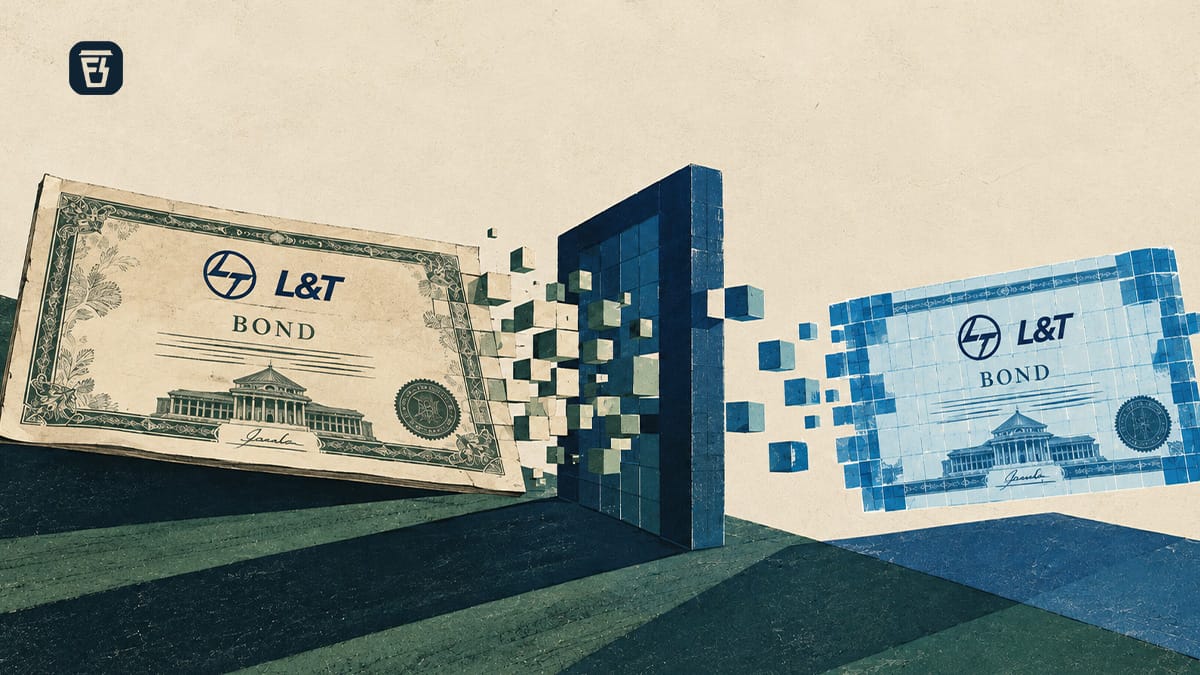
The name’s bond. Decentralised bond. In today's Finshots, we explain why SEBI is testing tokenised corporate bonds under its Demat 2.0 pilot, and whether they solve real problems in India’s debt markets.
 Love our insights? Add Finshots as a Preferred Source on Google ⭐
But here's a quick sidenote before we begin. If people depend on your income, you need to read this.
Most first-time earners skip insurance entirely - or buy the wrong thing because someone sold it to them. Both are expensive mistakes.
That's why we're running a 2-day Insurance Masterclass to help you get it right from the start.
📅 Tuesday, 22nd September at 6:30 PM: Life Insurance
📅 Wednesday, 23rd September at 6:30 PM: Health Insurance
Only 300 seats remaining. 👉🏽 Click here to reserve your spot today.
Now, on to today’s story.
The Story
For the better part of the last decade, cryptocurrencies such as Bitcoin and Ethereum have promised to change the way we think about how currency (or any store of value) can be represented digitally. Then came NFTs, decentralised finance, and a long list of other applications that promised to reshape how we exchange and own digital assets.
And understandably, governments all around the world have been concerned about what this could mean for their existing financial systems. Cryptocurrencies, after all, could operate outside traditional banking systems, while decentralised networks challenged the role of institutions such as banks that traditionally sat between buyers and sellers.
But over time, governments have started to separate the underlying technology from the applications built on top of it. You don't necessarily have to embrace Bitcoin to see a use case for blockchain as a whole, which is what cryptocurrencies are built on top of.
And that's exactly what we've started to see, with governments and financial institutions experimenting with blockchain to improve parts of the existing financial system. One of its uses, as it turns out, is something far less exciting: a corporate bond.
SEBI just rolled out a pilot project to test tokenised corporate bonds under its new Demat 2.0 framework. REC, L&T and IIFL Finance have already raised over ₹1,000 crore combined through these bonds. It uses a ‘permissioned distributed ledger’ and the RBI's eRupee (e₹) infrastructure to facilitate transactions. We’ll come to these complicated terms a little later.
But for now, you’re probably wondering why SEBI needs all this fancy new infrastructure in the first place.
After all, when you buy a bond in India today, you don't get a piece of paper handed to you. Bonds are already digital, and the security is recorded electronically in your demat account.
While this might seem pretty straightforward to you and me, the transaction actually goes through a pretty complicated journey.
Let’s say you hold ₹1,00,000 worth of corporate bonds that pay an 8% annual coupon quarterly. Every three months, you expect to receive ₹2,000 directly into your registered bank account. From the bondholder's perspective, the transfer looks immediate and automated.
But in reality, that quarterly payout requires coordination among multiple independent intermediaries.
Each institution also maintains its own separate database, and these parties must cross-reference records, verify the list of eligible bondholders on the record date, calculate tax deductions, generate payment files, and reconcile debits and credits across multiple banking ledgers. If even a small error appears in any single system, the reconciliation process requires human intervention, which increases operational costs and administrative delays.
Bond tokenisation aims to solve exactly this problem.
So, under Demat 2.0, instead of maintaining separate database records that require periodic reconciliation, the bond is created as a digital token on a shared distributed ledger. And the security's terms, such as interest payment schedules, calculation formulas, and final redemption dates, etc. are all encoded directly into the bond as a smart contract.
So, when a scheduled coupon date arrives, the smart contract can execute the code and trigger the payout automatically, without requiring multiple back-office teams to verify and reconcile their ledgers independently.
More importantly, this does not change anything much for the bondholder. Retail and institutional buyers do not have to write down recovery phrases or secure private keys. Instead, regulated depositories manage the private keys and blockchain.
And while this may seem to go against the idea of a ‘decentralised’ system, it allows financial markets to benefit from distributed ledger technology while keeping the legal protections and regulatory oversight that investors get today through the traditional demat system.
Besides, this isn’t just about automation. The pilot also addresses another important point: the timing gap in standard securities settlement AKA counterparty risk.
Simply put, right now when there’s a bond transaction, the two sides of a transaction don’t necessarily settle at exactly the same time. There’s a period when the investor has delivered funds while waiting to receive the bond. That means if an institution experiences operational failure or insolvency during that window, the trade can break, leaving the investor exposed to financial loss.
That’s where tokenised bonds come to the rescue. These bonds use the RBI’s e₹ framework, which links payment and securities transfers through something called “atomic Delivery-versus-Payment”.
Under this, the bond transfer and the fund transfer occur simultaneously in a single transaction. In simple terms, the payment succeeds only if the securities transfer succeeds. If one fails, the other one also doesn’t settle, and the entire transaction cancels automatically. That eliminates the counterparty exposure while also reducing some of the reconciliation and manual intervention currently required.
But all this doesn’t mean it’s all rainbows and sunshine. The Financial Stability Board, which monitors the global financial system, has highlighted an interesting trade-off with atomic settlement.
You see, in traditional settlement systems, transactions are netted throughout the business day. Banks only need enough cash in hand to settle their net differences at the end of the cycle. This reduces the number of transactions and the amount of money actually moving between banks and financial institutions.
But in an atomic settlement system, where trades are cleared individually and immediately, institutions must maintain sufficient cash or CBDC (Central Bank Digital Currency) upfront to cover every single transaction.
For commercial banks, this could mean larger cash reserves or requiring depository systems to block funds before trade execution. This could tie up money that could otherwise be used elsewhere.
And because of complexities like these, the next phases of the Demat 2.0 roadmap will be the real test of whether the model can actually work. For now, Demat 2.0 is still a controlled experiment.
The first pilot showed that companies can issue and manage tokenised debt in a controlled setting. The next phase is expected to bring secondary-market trading to existing exchanges and eventually open it up to retail investors. And the final phase will expand the network to other regulated entities, such as credit rating agencies.
And only if all these systems can work together smoothly will Demat 2.0 be able to offer a blueprint for how financial contracts and securities could be traded around the world.
Until then...
If you liked this story about tokenised bonds and Demat 2.0, feel free to share it with your friends, family, or even strangers on WhatsApp, LinkedIn, or X.
Also, if you’re someone who loves keeping tabs on the world of business and finance, hit subscribe if you haven’t already. And if you’re already a subscriber, thank you! Maybe forward this to someone who’d enjoy our stories but hasn’t discovered us yet.