
Why ISRO is handing its commercial empire to private industry
In today's finshots, we explain why the Indian government is transferring some commercial space operations to private industry, and what this structural shift means for ISRO's future.
 Love our insights? Add Finshots as a Preferred Source on Google ⭐
But here’s a quick sidenote before we begin. Most new parents are so caught up in the chaos of a newborn that insurance keeps getting pushed to “next month”.
But next month has a way of becoming next year.
That’s why we’re running a 2-day Insurance Masterclass, so you can finally stop postponing and understand what’s the best for you.
We’ll break down health and life insurance in simple, jargon free steps so that you can avoid costly mistakes.
📅 Thursday, 24th September at 6:30 PM: Life Insurance
📅 Friday, 25th September at 6:30 PM: Health Insurance
Only few seats left. 👉🏽Click here to save your spot.
Now, on to today’s story.
The Story
India's space programme has built a reputation for achieving extraordinary things without spending extraordinary amounts of money.
Take the Mars Orbiter Mission. Launched in 2013, it cost roughly ₹450 crore, making it one of the most cost-effective interplanetary missions ever attempted. A decade later, Chandrayaan-3 became the first mission to land near the Moon's south polar region, at a cost of around ₹613 crore, or roughly $75 million.
To put that into perspective, NASA's MAVEN Mars mission cost about $485 million, while its much more ambitious Artemis lunar programme costs about $4.1 billion per launch, compared to Gaganyaan’s total estimated budget of around $2.3 billion. Europe's Mars Express cost about €150 million, while its broader ExoMars programme was budgeted at €1.3 billion.
Now, these comparisons aren't exactly apples-to-apples. NASA and ESA's missions often carry different payloads and use more expensive launch systems.
But the bottom line is simply that ISRO (Indian Space Research Organisation) has built a reputation for delivering extraordinary capability on relatively small budgets.
And for several decades, that frugality defined how India's space programme operated. Partly because of a lack of funding back then, and partly because the country's aerospace industry was so small, ISRO had to design the technology, build the hardware, launch the satellites, and commercialise the resulting services.
But as India’s space ambitions have grown, that same model, which worked remarkably well, is beginning to change. And that change has sparked a fair amount of chatter about the government “privatising” ISRO.
The reality, however, is slightly more nuanced.
You see, the country’s current ambition is to build a commercial space industry. That requires far more capital, infrastructure and commercial capacity than the government can provide on its own. And the first clue that something is changing is buried in ISRO’s budget.
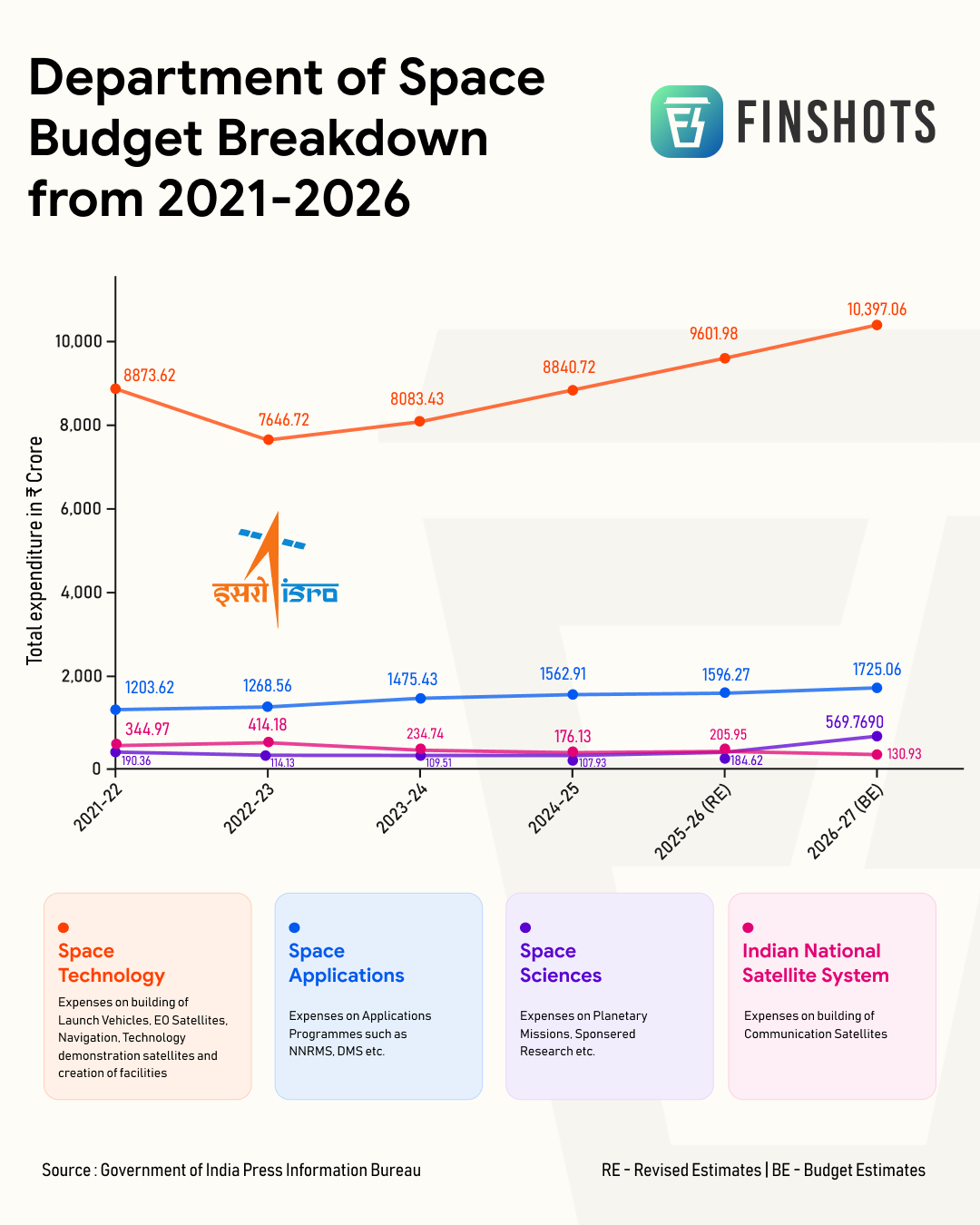
The Department’s FY27 budget includes ₹10,397 crore for Space Technology, which covers rockets, spacecraft and programmes like Gaganyaan. Another ₹1,725 crore goes towards Space Applications, using satellites for things like weather monitoring, Earth observation and disaster management. And ₹570 crore is set aside for Space Science, which funds missions like Chandrayaan and the Venus Orbiter Mission.
Meanwhile, the budget for building, launching and maintaining India’s INSAT satellite fleet has fallen from ₹345 crore in FY22 to just ₹131 crore in FY27.
This not just reflects a change in where the money is going, but also a change in what ISRO itself is expected to do.
This is because the Indian Space Policy 2023 asks ISRO to focus less on building mature, operational systems and more on advanced research, new technologies and developing capabilities that serve national priorities. Once these systems are mature, they can be handed over to private companies for commercial use.
But for this to work, simply telling ISRO to focus on R&D isn't enough. The government also needs to separate the different roles that were once housed within ISRO. That's exactly what the Indian Space Policy 2023 does. It unbundles India's space sector into four distinct roles.
First, there's ISRO. Its job is to focus on advanced R&D, deep-space exploration, human spaceflight and developing new capabilities, rather than routinely manufacturing or conducting commercial operations.
Second, there's IN-SPACe. It acts as an autonomous body that authorises and facilitates private companies to enter activities that were once largely reserved for ISRO.
Third, there's NSIL, or NewSpace India Limited. It is the commercial arm of the ecosystem, responsible for taking mature ISRO technologies and services to the market, arranging commercial launches and satellites, and moving the industry from a traditional "supply-driven" model to a "demand-driven" one.
And finally, there's the Department of Space. It retains the broader policy and strategic role, including oversight and coordination of India's space activities.
Put simply, ISRO is meant to build what doesn't exist yet, private industry is meant to scale what already works, IN-SPACe is meant to enable and regulate that private participation, and the Department of Space sets the broader direction.
You can already see this happening with launch vehicles. Instead of ISRO continuing to manufacture every operational PSLV itself, NSIL has contracted HAL and L&T to produce them. SSLV technology has also been transferred to HAL so that the company can independently build and commercialise the vehicle.
The same logic applies beyond rockets. If the government wants to build a large commercial space industry, it doesn't necessarily make sense for a taxpayer-funded research organisation to keep tying up engineers, factories and capital making products that private companies can manufacture once the technology is mature.
But this is where the story gets slightly more complicated.
You see, handing over the commercial side of space only makes sense if ISRO can use the freed-up capacity to focus more on R&D. And for that, it needs something more valuable than rockets or satellites: exceptional scientists and engineers.
The irony here is that the very private space industry ISRO is helping create could also become a source of competition for that talent.
That concern became particularly relevant earlier this year, when more than 100 ISRO scientists and technical personnel resigned or sought VRS, including people associated with important programmes such as Gaganyaan (India’s first human spaceflight mission).
And naturally, as the sector opens to private players, former and current ISRO scientists now have more career options outside the organisation, including better-paying opportunities. In fact, The Indian Express notes that almost all private space companies operating in India have employees who previously worked with or retired from ISRO.
That creates a paradox, where the government is deliberately building a private space industry that can absorb ISRO technology, but that same industry can also compete with ISRO for the people who developed that technology.
And there is a similar question around the economics of technology transfer.
By 2026, ISRO, NSIL and IN-SPACe had signed over 100 technology-transfer agreements with non-government entities. In fact, NSIL's commercial revenue grew from ₹322 crore in 2020 to over ₹3,000 crore in 2025. However, the objective is clearly not to maximise licensing revenue from every technology, but to make it easier for Indian companies to turn it into products and build an industry around it.
Roughly 70 of those 100 agreements reportedly involved licensing fees of less than ₹10 lakh each, with some technologies being transferred for ₹6,000. This makes it easier for young companies to adopt ISRO’s technologies, but it also means that ISRO could miss out on potential commercial revenues if these technologies eventually become successful products. Those revenues could have helped fund the R&D that ISRO is now expected to prioritise.
NASA offers an interesting contrast. Its commercial technology licences can include an upfront fee, annual minimum royalty and a running royalty linked to sales, with the exact terms negotiated according to the technology and the deal. NASA also offers startup-friendly arrangements where upfront fees can sometimes be waived, and royalties are collected only when commercialisation happens.
India, on the other hand, seems to be taking a different approach: get new technologies into the hands of Indian companies quickly and help the space industry grow, even if the government earns less from each technology transfer.
This is why calling it “ISRO privatisation” misses the bigger picture. What India is really doing is unbundling the space business, where private companies can manufacture mature launch vehicles and satellites, operate commercial launches and build downstream applications.
But to do that, you also have to make sure the people doing the R&D have a reason to stay. That could mean better incentives, project-completion rewards, opportunities to collaborate with academia and industry, or carefully designed arrangements that let scientists work with the private ecosystem without immediately severing their ties to ISRO.
Because ultimately, the success of this reform will be determined by what ISRO does with the bandwidth it frees up and the licensing fees it generates.
Until then…
If you liked this story about why ISRO is handing its commercial empire to private industry, feel free to share it with your friends, family, or even strangers on WhatsApp, LinkedIn, or X.
Also, if you’re someone who loves keeping tabs on the world of business and finance, hit subscribe if you haven’t already. And if you’re already a subscriber, thank you! Maybe forward this to someone who’d enjoy our stories but hasn’t discovered us yet.