
The economics of India's never ending onion price problem
In today’s Finshots, we try to make sense of why India keeps struggling with rising onion prices.
But before we begin, if you love keeping up with the buzz in business and finance, make sure to subscribe and join the Finshots club, loved by over 5 lakh readers.
Already a subscriber or reading this on the app? You’re all set. Go ahead and enjoy the story!
The Story
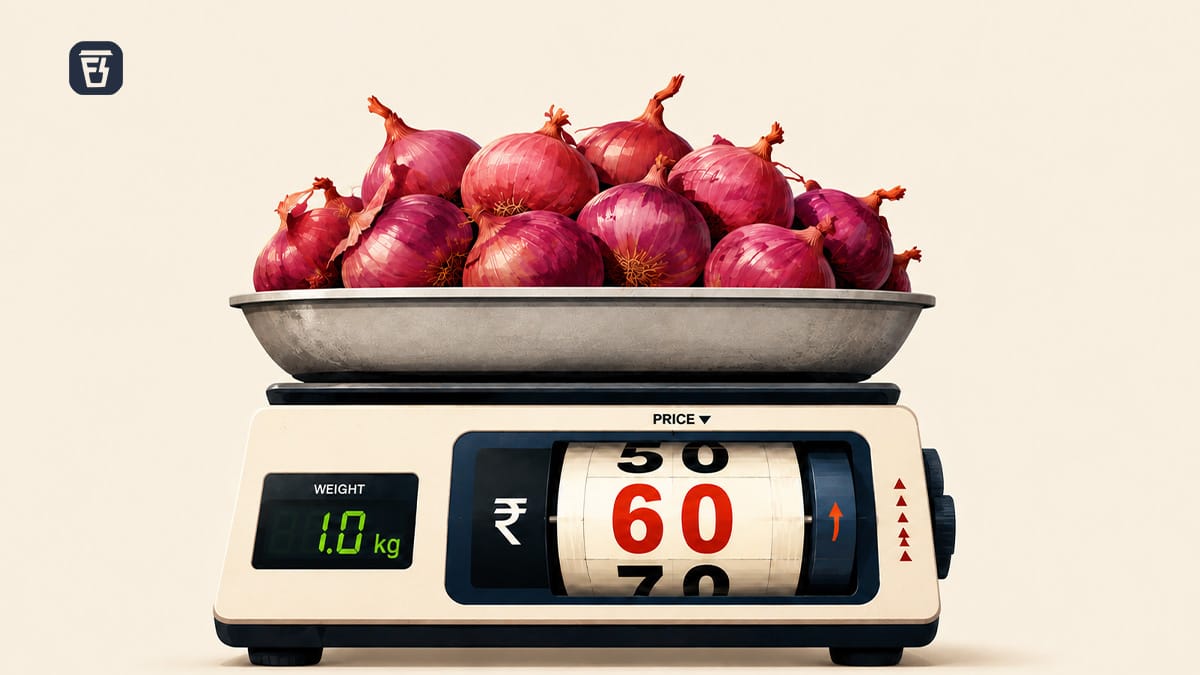
Onion prices have crossed ₹60 a kg in many parts of India. And the government is trying to step in and manage the situation by sending buffer stocks through a “Kanda Express” (Onion Express or a dedicated onion freight train) to places where prices have shot up.
It’s hardly surprising though. Because, at this point, most of us are used to it. We’ve seen major onion price crises every eight to ten years since 1980, with sharp price spikes, and sometimes even crashes, popping up more frequently in between.
But instead of normalising this, have you ever wondered why it keeps happening so often?
Okay, maybe you have. And the answer would probably have been the usual suspects: harvests, weather, storage and political interests. But that’s only the surface-level explanation. There’s more to the problem than that.
So let’s understand it. But to do that, we’ll first need to understand the basics.
See, if you want to understand India’s onion market, there’s one place you can’t ignore. The Lasalgaon market near Nashik in Maharashtra. It’s not just the country’s, but Asia’s largest onion market. You could call it the onion capital of India.
And Maharashtra is the state that produces well over 40% of India’s onions. Of course, there are other key producing states such as Madhya Pradesh, Karnataka and Gujarat.
But the point is that the entire country relies heavily on these handful of states for a staple that sits on millions of plates. It’s perhaps the most basic food on an Indian plate, irrespective of the cuisine or economic background. A few rotis, raw onions and chillies, and that can be a whole meal. Which perhaps explains why demand for onions is pretty much constant in India.
Despite this, India actually produces more onions than it consumes. To put that in perspective, we produce around 3 crore metric tonnes a year, against household consumption and exports of roughly over 2 crore metric tonnes.
At first glance, that shouldn’t even be a problem. If we produce more onions than we consume and export, where does the shortage come from?
The catch is that this production obviously isn’t even throughout the year. The crop comes in three broad harvest windows, and each has a different ability to survive in storage.
First, there’s the rabi crop, harvested between March and May, which accounts for roughly 70% of total output. Then there’s the kharif and late-kharif crop, which comes in between October-November and January-February.
But the rabi harvest is the only one that stores reasonably well. So stored rabi onions have to carry the market from around June through October or November, until the kharif crop arrives. That means India becomes heavily dependent on the storage quality of a single harvest for a significant part of the year.
And if rabi sowing or harvesting is disrupted by excessive rain, drought or other weather shocks, there isn’t enough supply from elsewhere to cushion the blow.
Because even a perfectly good harvest can bleed out afterwards. Onions may look sturdy, but they’re actually semi-perishable. And because most Indian farmers still store them the old way, piled in open, ventilated sheds rather than proper cold storage, a sizeable chunk of the crop gets damaged, rots or loses weight while just sitting there. And when weather disasters hit, those losses can get even worse. So by the time the next crop arrives, a significant portion of the onions harvested months earlier may have simply disappeared from the supply chain.
Which is precisely what is happening right now. Unseasonal rain damaged onion output back in April.
But there’s also another thing that gets blamed for onion price rises, just as it has been during previous price spikes: hoarding, black marketing and, of course, middlemen.
Now, middlemen aren’t necessarily the villains they’re made out to be. They do provide an important link between farmers and buyers. The problem is that the system can leave farmers, especially small ones, with very little bargaining power.
Farmers often depend on commission agents, also called arhatiyas, to sell their produce, find buyers and even provide them with credit. So the person helping them sell the onions can also be the person they owe money to. And when you’re in that position, getting the best possible price becomes a lot harder.
Then there are commissions, loading charges, wastage and other deductions that can eat into what the farmer actually earns. By the time an onion travels from the farm to the consumer, there can be a surprisingly large gap between the two prices.
And this isn’t just speculation. A Competition Commission of India (CCI) study once found a case where onions bought from farmers at ₹34 a kg were being sold to consumers for ₹80. That’s a huge difference.
And it simply tells you that the onion price you see at the retail market isn’t simply a reflection of what the farmer actually got paid.
The bigger problem is that farmers have very little protection against wild price swings. Unlike crops such as wheat and rice, onions don’t have a Minimum Support Price (MSP) that guarantees farmers a floor price when prices crash. (Not that something like MSP can solve the problem entirely, because it comes with its own set of problems. You can check it out here.)
Sure, the government intervenes when the prices of perishable crops such as onions fall sharply. But that support is largely reactive. It kicks in only after prices have already fallen.
Nor is there a functioning futures market for onions, where farmers or traders could agree today on a price for onions that will be delivered months later. Such a market wouldn’t magically stop prices from rising or falling, but it could at least give farmers a clearer signal of where prices might be headed and allow some participants to protect themselves against a future crash.
Interestingly, India has considered onion futures before. NCDEX, the country’s commodity derivatives exchange, even received regulatory approval to launch them years ago. But it never really took off, partly because onions are difficult to store and, well, an extremely politically sensitive commodity (since it’s an essential vegetable, and angry voters tend to remember the last price rise when they vote).
So what does an onion farmer have left to go by?
Well, last year’s prices. Yup, you see, a farmer has to decide how much onion to plant months before the harvest, long before they know what price it will fetch. So they do the only reasonable thing — look at last year’s price and plant accordingly. But that can set off something economists call the “cobweb cycle”, where onion prices can swing wildly even without any bad weather.
Let’s explain. Say onion prices crashed last season because there was too much supply. That could discourage farmers, because many may then plant less this time. Less planting means a smaller harvest, which can create a shortage. And that shortage sends prices soaring.
Seeing those high prices, farmers then rush to plant more onions the following season. But when everyone does the same thing, a flood of new supply hits the market and prices crash all over again.
And then the cycle starts over.
This theory was developed in the 1930s by several economists, including Nicholas Kaldor, Henry Schultz, Jan Tinbergen and Mordecai Ezekiel. It gets its name from the way the movements in supply and prices look like a cobweb when plotted on a graph.
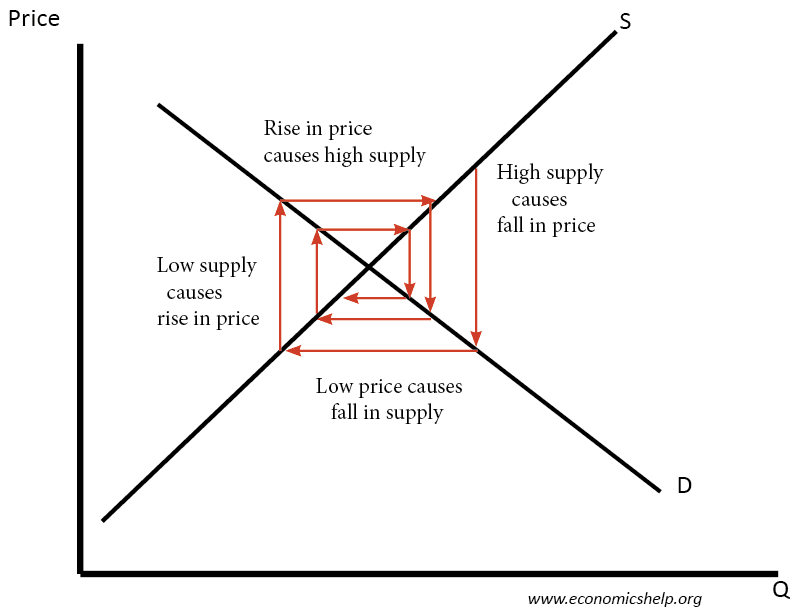
And it’s pretty apt in the context of onions, or any other agricultural crop, because there’s a real time lag between the planting decision and the harvest reaching the market. So farmers can end up making decisions based on old information, and repeating the same cycle season after season.
So yeah, folks, that’s pretty much why onion prices keep swinging up and down every few years, even beyond all the other factors we’ve talked about. Turns out economics has an answer for a lot of the things we see and do every day.
Until next time…
Also, before we go, the ending of this story reminded us of Finshots Pocket Economics — a series we did not too long ago on how you can use economics to make better decisions in everyday life. You can check it out here.
And if you like the series and this story, don’t forget to share it with your friends, family, colleagues or even strangers on WhatsApp, LinkedIn or X.
A message to all breadwinners
You work hard, you provide, and make sacrifices so your family can live comfortably. But imagine when you're not around. Would your family be okay financially? That’s the peace of mind term insurance brings. If you want to learn more, book a FREE consultation with a Ditto advisor today.