
What’s really going on with ESDS?
In today's Finshots, we explain why ESDS Software Solution shares fell into consecutive lower circuits after a sharp rally and unpack its $1.25 billion AI contract.
But before we begin, if you’re someone who loves to keep tabs on what’s happening in the world of business and finance, then hit subscribe if you haven’t already. We strip stories off the jargon and deliver crisp financial insights straight to your inbox. Just one mail every morning. Promise!
If you’re already a subscriber or you’re reading this on the app, you can just go ahead and read the story.
The Story
ESDS Software Solution has had a rather extraordinary journey since it went public.
It went public last month, giving investors a 76% gain on day one of listing. But that was just the beginning. Over the next few weeks, the stock surged by roughly 310% above its IPO price, pushing its market capitalisation close to ₹16,000 crore.
And it’s easy to see why everyone was excited. ESDS operates at the intersection of three of the biggest technology trends in India right now:
- Cloud computing,
- Data centres, and
- Artificial intelligence.
But ESDS isn't simply another company putting servers in a building and renting out space. It has spent more than two decades building a combination of hosting, cloud infrastructure, and managed services for banks, government organisations, and enterprises that need secure, reliable, compliant infrastructure.
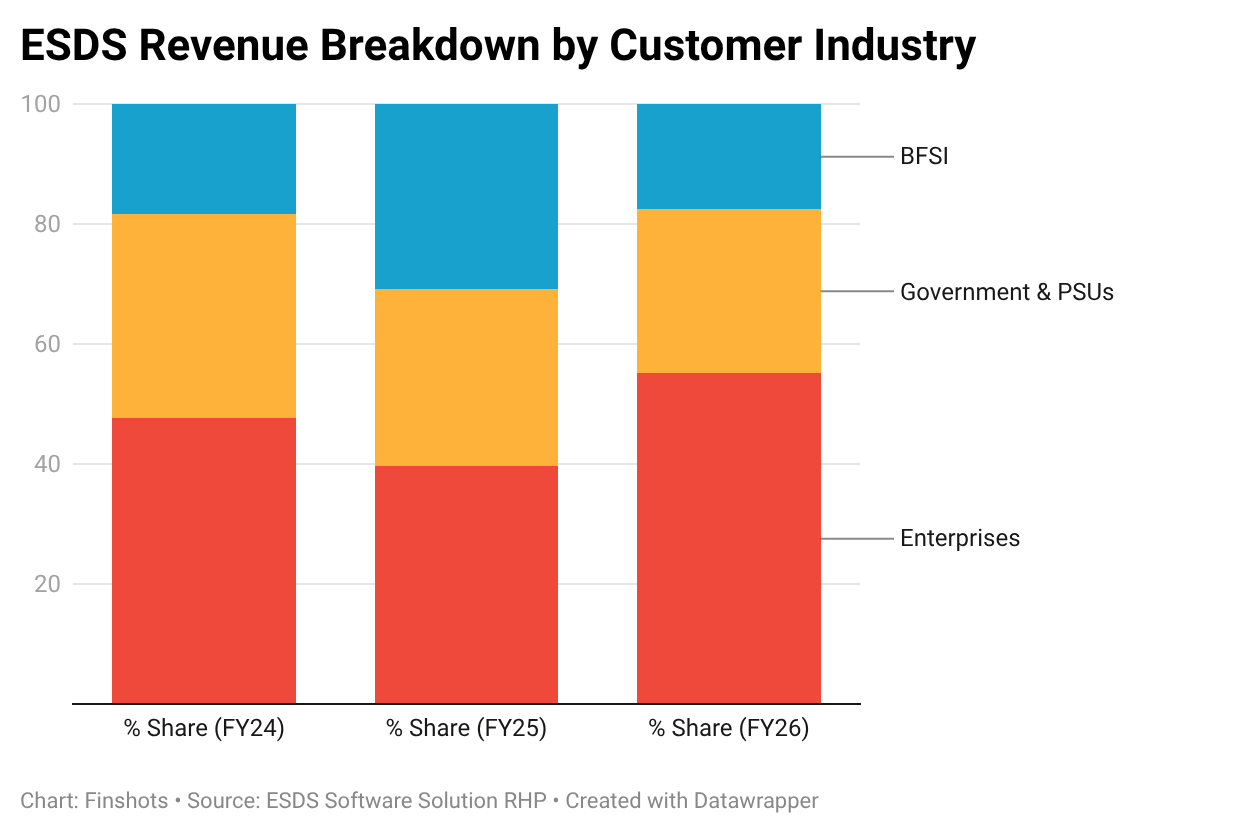
It operates something called “community clouds” for over a hundred banks and even the government. Basically, a community cloud is a private cloud shared by organisations with similar needs. So instead of every bank building and managing its own IT infrastructure, ESDS can provide a common, secure environment that multiple banks can use while keeping their data and applications isolated from one another.
And this isn't necessarily a business where customers can casually switch providers every few months.
Because once a bank or government department has built its applications and workflows around a particular infrastructure provider, moving everything to another system can be expensive and complicated. That makes these relationships relatively sticky, which means that ESDS has a recurring customer base to sell additional cloud and managed services to.
In fact, in FY26, over 89% of ESDS' customers used all three of its major service lines (IaaS, Managed Services, and SaaS).

And now it is trying to add another, potentially much bigger, opportunity to this business: AI computing.
Training and running AI models requires enormous amounts of specialised computing power, particularly GPUs. Most companies don't want to spend hundreds of crores buying GPUs, building specialised infrastructure and figuring out how to operate it. They would rather rent computing capacity when they need it.
That's the basic idea behind GPU-as-a-Service. And this is where ESDS becomes particularly interesting. In India's listed markets, few companies offer investors a direct way to invest in this specialised infrastructure opportunity. ESDS and E2E Networks are the two obvious listed names.
And that brings us to the reason ESDS has suddenly become a part of recent market chatter. Its stock kept climbing until it hit a peak on September 24. Then, things suddenly turned around.
The stock started falling and hit the lower circuit for six consecutive trading sessions, before recovering slightly this week.
The sell-off began soon after the company announced its Q1 FY27 results. Revenue fell 20% sequentially to ₹133.65 crore, while net profit plunged 56% to ₹29 crore.
And most of this decline came from its subsidiaries. Their combined revenue fell from ₹50.4 crore in Q4 FY26 to ₹17.5 crore in Q1 FY27. Their combined profit also dropped from about ₹37 crore to ₹11 crore.
Interestingly, the first tranche of anchor shares became freely tradable only this week, releasing around 25 lakh shares into the market. By then, five trading sessions had already passed. So while the lock-in expiry may have added to the selling pressure, it wasn’t what triggered the initial correction.
So, what’s going on?
Well, you could blame it partly on ESDS’ business. Because a significant part of the previous quarter's revenue wasn't recurring business at all. During the earnings call, management explained that the subsidiaries had recognised around ₹85 crore for technical design services. The work involved designing the layout for the GPU cluster that an Australian AI cloud platform, Sharon AI, is building.
But here’s the thing. While the ₹85 crore was a one-off fee, the work itself was linked to ESDS’ biggest AI bet yet.
The company had been helping design the GPU cluster that the same Sharon AI plans to build in Sydney. And that relationship eventually turned into a five-year, $1.25 billion AI infrastructure agreement. And for a company of ESDS' size, a billion-dollar deal is quite significant.
Under the deal, ESDS is essentially acting as the middleman. Sharon AI provides the GPU infrastructure, while ESDS leases that capacity and then sells access to its own customers.
In other words, ESDS can pursue the AI opportunity without putting the full cost of the GPUs on its balance sheet. That's clever because GPUs depreciate rapidly and buying thousands of them requires significant upfront capital.
But there is a trade-off. The obligations don't disappear simply because they don’t own the GPUs. ESDS has also received roughly ₹1,177 crore, or about $125 million, in customer advances connected with the arrangement.
That money may look like a giant cash infusion, but it is, in fact, a liability. It represents money received for future services and therefore creates a future obligation to deliver those services.
And execution hasn't been entirely smooth.
The planned GPU cluster was supposed to go live in September, but the project has been delayed. The new target is November, which means ESDS now expects to start recognising revenue from the project only in Q3 FY27.
So ESDS has found an ingenious way to participate in the AI infrastructure boom without buying thousands of GPUs itself. But in doing so, it has effectively swapped some capital expenditure risk for lease, financing, counterparty, and execution risk.
And that becomes clearer when you compare ESDS with E2E Networks. E2E has taken the more straightforward route. It has actually purchased GPUs, putting the assets on its balance sheet and accepting the depreciation that comes with them. Sure, that hurt its FY26 profitability, but at least E2E directly owns the underlying computing infrastructure.
ESDS has chosen the asset-light route. That can make the business more capital efficient if everything works. But it also means that the economics depend heavily on whether it can successfully deploy and resell the capacity it has committed to lease.
And perhaps that explains what happened to ESDS's stock better than simply saying investors lost faith in cloud computing or data centres. At its peak price, investors were valuing it as an AI infrastructure company. And that translated into a P/E multiple of well over 100 times. Such a valuation leaves very little room for disappointment.
So the ESDS story has little to do with the AI and data centres boom. But more about whether ESDS can execute its unusually ambitious AI strategy well enough to justify the expectations that investors had already priced into the stock.
Until then…
If you liked this story about what’s really going on with ESDS, feel free to share it with your friends, family, or even strangers on WhatsApp, LinkedIn, or X.
🚨 ATTENTION: FINSHOTS FAMILY
This weekend, we’re hosting a free 2-day Insurance Masterclass that helps you build real financial security by understanding health and life insurance the right way.
📅 Thursday, 10th October at 11:00 AM: Life Insurance: How to protect your family, choose the right cover amount, and understand what truly matters during a claim.
📅 Friday, 11th October at 11:00 AM: Health Insurance: How hospitals process claims, common deductions, the mistakes buyers usually make, and how to choose a policy that won’t disappoint you when you need it most.